ALONG THE KLAMATH RIVER — The journey was no longer impossible, but that didn’t make it any less audacious. One great waterway, newly freed from the stranglehold of four hulking dams. More than 300 miles, through some of the most intense rapids in the West. And 15 young kayakers, nearly all of them new to the sport.
Their goal: the first full descent of the Klamath River, from its headwaters near the Cascade Mountains in Oregon to its mouth on the Pacific coast of California.

(River Roots Productions)
If they could pull it off, it would be monumental, marking the success of the largest dam removal project in American history.
Yet for the teens, all descendants of the region’s Indigenous tribes, it would also be profoundly symbolic. Parents and grandparents had fought for decades to undam the Klamath, a sacred lifeblood. Now this generation would be the first to travel the river’s entirety.
The challenge was daunting — and exhilarating. They would spend 30 days on the river, with The Washington Post following the odyssey.

They stood on the bank, near the bubbling spring where the Klamath originates. A current of nervous energy passed between them.
It was all becoming real, what they were about to do. For the next month, the river would be their home.

The students, ages 13 to 20, had trained months if not years for this moment. They left families and schools to enroll in an intensive academic paddling program, still carrying full class loads while traveling to whitewater as far away as Zambia to practice. Some sacrificed their senior year and prom. All for a shot at the first full run down the liberated Klamath.
“We are a manifestation of our ancestors’ prayers,” said 17-year-old Keeya Wiki, a member of the Yurok Tribe.


(Tim Meko/The Washington Post)
The four Klamath dams, built during the first half of the 20th century, choked life from the waterway and devastated the tribes that for millennia had relied on it for food, travel and spiritual sustenance. The dams electrified the region, powered its industrialization and changed everything for the Native people here.
After decades of protest, in 2022 the structures were approved for removal. The staff at Ríos to Rivers, a nonprofit advocacy organization, already had a plan to highlight the significance: Indigenous teens would be the first down the restored river, reconnecting once-divided sections with each paddle stroke.
Yet the free-flowing Klamath would unleash intense rapids — with several approaching Class 5, the highest navigable level. No neophyte could run them.
So the organizers founded Paddle Tribal Waters to ensure everyone was ready. Summers and weekends, they honed crucial moves like combat rolls and kickflips. Novices at the start, the teens developed into highly skilled athletes.
“Here, paddling is in your blood,” said Danielle Frank, a 21-year-old Ríos to Rivers director and member of the Hoopa Valley Tribe.“I think we have some of the next best paddlers in the world in this program. And it’s because they’ve never been scared of the river. They’ve never been afraid of the water.”

The hundreds of hours of preparation led up to that hot day in mid-June, when everyone gathered near the Klamath’s headwaters. Each was clad in a life vest, spray skirt and helmet.
Dozens of family members and tribal elders were there to see the group off. They burned celery root and sage, and they blessed the journey with feathers from a red-tailed hawk and an eagle — good medicine for an epic endeavor.


(River Roots Productions)
On the water, the students assembled in a circle, accompanied by several coaches and teachers. From above, their bright kayaks looked like the petals of a sunflower against the aquamarine water. They took a moment for themselves, and then they paddled around the bend.


(River Roots Productions)
Dams transformed the Klamath. As one after another was constructed, the river turned increasingly slack and stagnant. Toxic algae thrived.

Those conditions devastated the salmon population, and they exacted a similar toll on the Native people. Communities where healthy sustenance once swam thick became food deserts. Rates of diabetes and heart disease soared.

Dead fish in the Klamath River in 2002 after water was diverted for farm irrigation. Such massive kills were part of why the dams were removed. (Joe Cavaretta/AP)
Though last year’s unprecedented removal of the four dams on the Klamath’s lower stretch was hailed as a major achievement, two smaller dams still stand upriver. The tribes want them taken down next.
The students reached the remaining dams after about a week of paddling. They pulled up on the bank, shouldered their kayaks and walked around the barriers.

Just a day later, they hit the stretch of the river that now runs free — the “New Klamath,” some call it.
But really, it’s the old Klamath, the one that the young paddlers’ ancestors would have recognized.
On either side of them, the walls of Kikacéki Canyon rose steeply. The kidsfloated unimpeded past soaring columnar basalt cliffs, where thousands of years ago lava once cooled, hardened and cracked. The earth appeared almost in motion, folding and flowing like the water below.
From her bright pink kayak, Ruby Rain Williams of the Karuk Tribe could see the outline of one felled structure. “It was surreal,” the 18-year-old said. “How could anyone want to dam this?”

(Courtesy of Ruby Rain Williams)

The setting was serene, but in kayaking parlance, this part of the river was stout, even gnarly. The current ripped through the canyon and cascaded frenetically over large, jagged boulders. This left holes of swirling water that could trap someone not on guard.
In such powerful rapids, picking a line — or a safe path through the river — is critical. Miss the line and expect to be knocked around. The group christened one ferocious run the Salmon Slapper, and as Ruby approached it, she knew she needed to focus.
She skirted a big rock, picked up just the right amount of speed and drove through one of the river’s trickiest holes. She emerged at the bottom of the rapid screaming gleefully.
The thrilling runs also carried reminders of the risks inherent in any extreme sport. Keeya got into trouble on one large rapid when she picked a line that turned harrowing. The current pulled the kayak and pinned her against two boulders. For a few terrifying seconds, Keeya fought to keep her head above water.
Others rushed over to help. Ruby, who hopes to become an instructor herself, was rattled. Seeing her best friend in danger made her question whether she could handle that degree of responsibility.
She decided she could. “Every time I’m going through a hard time,” Ruby said, “I’m able to go through it with the river.”


(Swiftwater Films/RES)
As the teens headed toward the ocean, a parallel passage was happening right below them: Juvenile salmon, spawned in newly opened territory, were also making their way to the sea. The fish had returned to their habitat above the dams with astonishing speed — only days after removal.

“It was the fish migration heard ’round the world,” said Barry McCovey, director of the Yurok Tribe’s fisheries department.
For some young people on the Klamath, a river full of salmon will eventually be the norm. Ruby’s father was floored when she mentioned that she’d seen fish spawning upriver. “You don’t understand how important that is,” Laurence Williams responded. “That’s a milestone.”
A massive environmental restoration project — the largest of its kind ever — is underway to help the river and its surrounding ecosystem heal. The salmon are the most visible sign of success to date. Researchers have also observed tiny aquatic insects thriving on the river bottom, a key part of the food chain.

Tribal crews and scientists have scattered billions of native seeds by hand and helicopter across 2,200 acres of reservoir footprint. (Swiftwater Films/RES)

(River Roots Productions)
But the best remedy might be these young paddlers.
“They’re part of the cure,” said McCovey, whose 14-year-old son, Albee, joined for part of the voyage.
“Sure, we can go up and plant trees, do restoration work,” he said. “There are all these things we can do from a physical standpoint. But from a tribal standpoint, those kids are the medicine the river needs right now.”
Organizers also imagined the descent as a way to foster more unity among the tribes on the Klamath, some of whom had been physically separated by the dams. They planned special events in each tribal territory the kayakers passed through.
The group spent most evenings at campgrounds along the river, where they collapsed in fatigue after miles of paddling.
They nursed blisters, sunburns, aching muscles. They learned to treasure regular showers and proper mattresses. And in their collective isolation, they grew even closer.

Elders and other adults told them constantly that they were their communities’ future leaders, and the students took that responsibility seriously. One key decision came on Day 21, when they neared a part of the river known as Ishi Pishi Falls. It is a sacred place for the Karuk Tribe.
According to tribal tradition, few are allowed to go to the falls. As a sign of respect, and to set an example for any boaters who might follow, the group gave Ishi Pishi a wide berth, portaging around that section.
“I hope,” Keeya said, “this first descent echoes out to the rest of the world and says, ‘Hey, here’s how we actually treat land and waters.’”

(River Roots Productions)
For the Paddle Tribal Waters students, “first descent” is a fraught label. History is filled with examples of White outsiders claiming to have been the first to accomplish something on Indigenous land, overlooking the achievements of Native people.
This first is different, Keeya, Ruby and the others say. They’re not trying to conquer the river; instead, they hope to show how to have more respect for places like it.

On one of the last days of their journey, some of the teens whittle pieces for a traditional game to play at camp.
Most plan to continue kayaking. Some may join or start clubs at school; others are nurturing dreams of a pro career. Their month on the Klamath was an important pivot point, and they all said the experience changed them.
“I had a lot of self-doubts, but kayaking’s helped me,” said Julian Rogers, a 16-year-old member of the Hoopa Valley Tribe who became a trip leader as his skills blossomed.
“You’re out there, you’re kayaking these huge rivers, and you have to know that you’re good at what you’re doing. And I do, and that makes me more confident in myself, in all other aspects of life.”

As the end of the trek neared, more paddlers from local tribes joined up, along with an international flotilla of representatives from communities protesting dams in their own countries — in New Zealand, China, Bolivia.
The last few days took them through a rugged and striking part of Northern California, where Karuk, Hoopa and Yurok territories meet and the river arcs north toward the village of Requa, the mouth of the Klamath.

With just under 20 miles to go, the kids steered over flat water. The mood was festive. Dense forest stood on each side of the river. Bald eagles and blue herons soared above. A black bear watched from land.
That night at camp, they savored the last bit of time with their friends before reaching their goal. “I’m jittery,” Keeya said, confessing to both excitement and sadness that the journey was almost over. “I have this buzz.”

On the morning of the final day, barely three miles remained. The kids gathered and stretched before slipping their kayaks into the water and setting off.
They were aiming for a spit of sand that separated the river from the ocean. There, at the mouth, tribal leaders and throngs of family members were gathered to greet them. A hard breeze blew. Dense fog hung low, obscuring visibility. An hour passed.

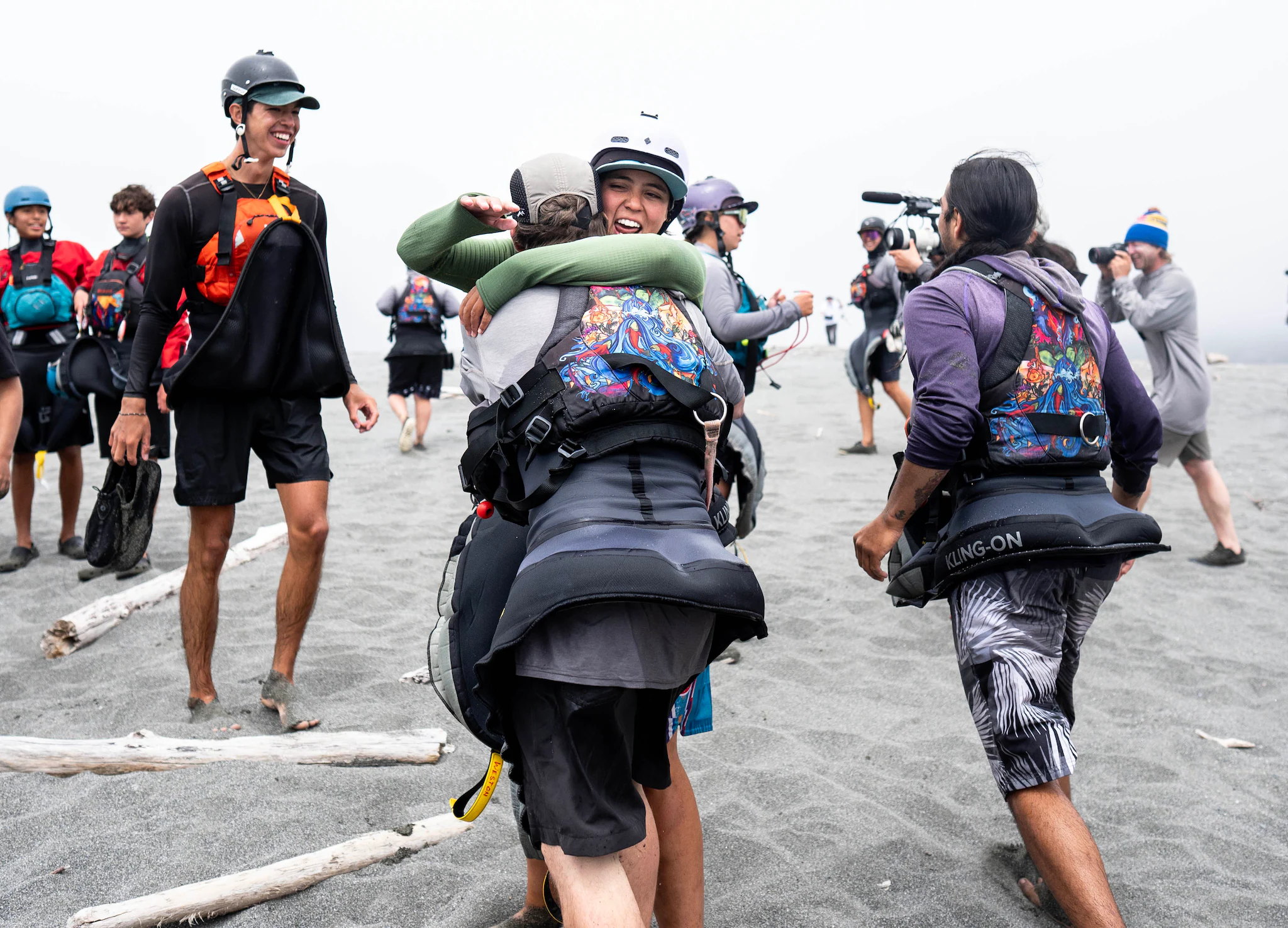
Finally, they emerged out of the mist. Led by two Yurok canoes made from the trunks of redwoods, the kids matched each other stroke for stroke. As they drew closer, they lifted their paddles in celebration. Their welcome party whooped and cheered.
They hit the sandbar in unison, hauled their kayaks out of the water and clambered over a small ridge. On the other side, the Pacific awaited. Waves crashed heavy and cold in a raucous greeting. Shouting, screaming, laughing, they ran to the sea.