The descendants of enslaved people in Suriname accepted on Monday the apologies offered by the King of the Netherlands. Willem-Alexander had presented his apologies to the former colony in 2023.
By
Outre-mer La 1ère Editorial Team,
AFP
Published December 2, 2025 at 5:35 a.m.
Updated December 2, 2025 at 5:37 a.m.
Reading time: 4 minutes
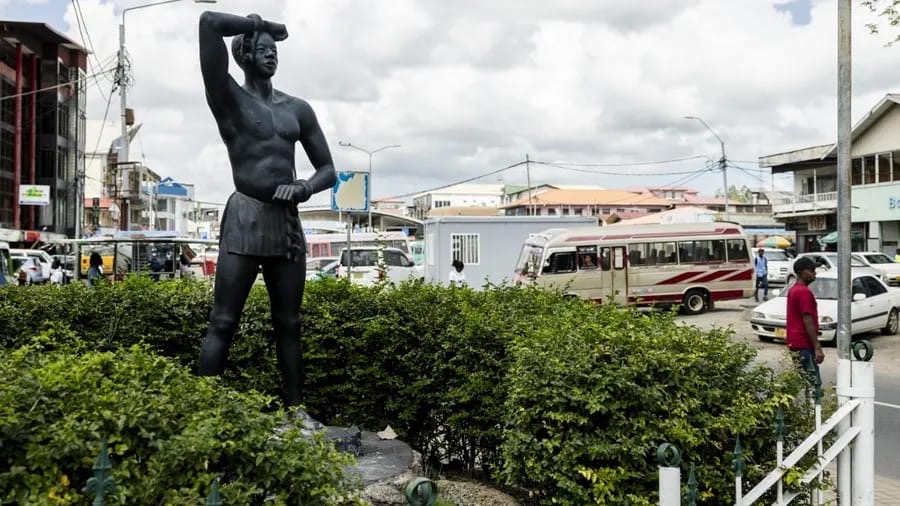
The statue of Kwakoe, commemorating slavery in Paramaribo, Suriname.
Descendants of African slaves and Indigenous peoples in Suriname accepted on Monday, December 1st, the apologies presented in 2023 by King Willem-Alexander of the Netherlands for slavery in the former Dutch colony, during a ceremony reported by Suriname’s Communication Services (CDS). “We accept the apologies and the request for forgiveness in the full conviction that the King, with a clear conscience, wishes to cooperate in healing and restoration,” said Wilgo Ommen, representative of the Indigenous communities.
The Netherlands issued an official apology for slavery through former Prime Minister Mark Rutte in December 2022. In 2023, the King did the same. During a closed-door meeting, members of the royal family held discussions with Suriname’s president, Jennifer Geerlings-Simons, and traditional authorities. On behalf of the King, the Dutch Minister of Foreign Affairs, David van Weel, announced a fund of 66 million euros for social projects benefiting the descendants of enslaved people and Indigenous peoples.
First official visit in 47 years
King Willem-Alexander and Queen Maxima arrived Sunday in Paramaribo for a three-day visit to Suriname, which celebrated on November 25 the 50th anniversary of its independence. This is the first visit by the royal family in 47 years.
A small country in northern South America, undermined since its 1975 independence by rebellions and coups d’état, Suriname has significant recently discovered offshore oil reserves. Before the closed-door meeting, Willem-Alexander took part in a public reconciliation ceremony. The King sat in a special chair facing an Indigenous tribal chief and a Maroon tribal chief (descendant of enslaved people), while Winti spiritual leaders performed rituals using a rope, cloth, grass, and a matta (mortar). The mortar was then placed in a boat on the river so that the spirit of nature could continue to heal the wounds of the past, according to the explanation given.
The King expressed his emotion: “This is a moment to come listen to you, hear what resonates within you, learn from you how we can continue to build a future together between Suriname and the Netherlands. I fully realize that the pain of the past endures for generations, and I feel responsible for my predecessors,” he said, according to remarks reported by the CDS.
Complicated diplomatic relations
President Simons emphasized that “the losses suffered are significant.” “We are not going to discuss it now, but the question of reparations will have to be addressed one day (…) Today we have the opportunity to take a step toward building a shared path (…) It is not an easy task, but if we work together, as our ancestors proved, we will move forward through respectful exchanges.”
Diplomatic relations between the two countries were interrupted in 1982 during the military regime of former dictator Desi Bouterse. They were restored under the democratic government in 1988, then broken again during Desi Bouterse’s presidency (2010–2020), whose party, the National Democratic Party (NDP), is now led by the current president.