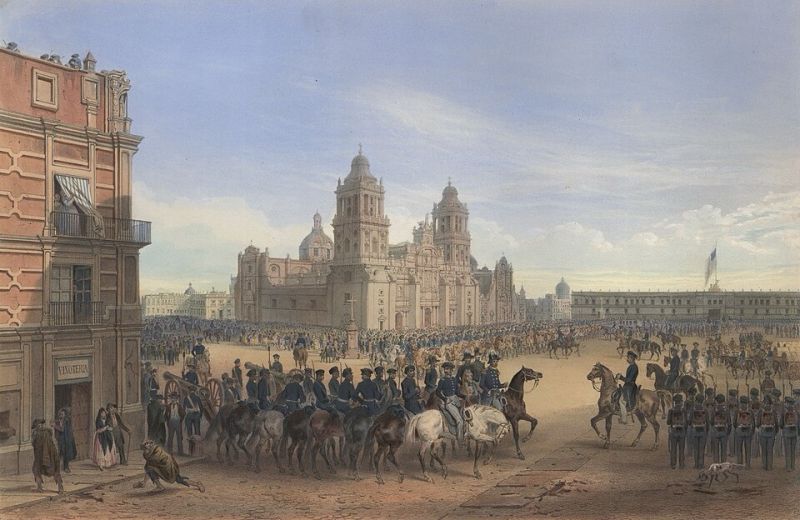
From 1846 to 1848, the U.S. fought Mexico in a war that ended with the Treaty of Guadalupe Hidalgo and the transfer of more than half of Mexico’s territory; lands that today are California, Nevada, Utah, most of Arizona and New Mexico, and parts of Colorado, Kansas, Oklahoma, Texas, and Wyoming. On U.S. maps this looks like “expansion.” On the ground, for Mexican and Indigenous communities, it felt like the border moved over them without their consent.
Before the war, this region was a complex borderlands: Mexican settlements, Spanish and Mexican land grants, and large sovereign Native nations; Navajo, Apache, Pueblo, Comanche, Ute, and many others; who dealt with Mexico, Texas, and the U.S. as separate powers in their own right.
When the U.S. won, the treaty was negotiated only between Washington and Mexico City; Indigenous nations weren’t at the table, yet their homelands were cut in half by a new international line and their sovereignty was effectively placed under U.S. control.
On paper, the Treaty of Guadalupe Hidalgo promised that Mexicans who stayed in the ceded territory could keep their property and become U.S. citizens with full rights. In practice, as Anglo settlers and new state governments took over, many Mexican and Hispano families lost land through violence, legal manipulation, and courts that refused to honor older Spanish and Mexican grants.
States and territories quickly wrote laws and constitutions that limited voting and office-holding to “white” men, and over time, Mexican-descent communities were pushed into segregated schools, low-wage work, and second-class political status despite the treaty’s promises.
For Indigenous nations, the shift from Mexican to U.S. rule often meant even harsher policies. Raids, retaliation, and conflict had existed under Spain and Mexico, but the U.S. brought large-scale military campaigns, removals, reservations, and, in places like California, genocidal state violence and bounties on Native lives.
Tribes who had negotiated or resisted with one colonial state now faced another, more powerful one that viewed the new Southwest primarily as land to settle, mine, and farm.
The war also lit a fuse inside the U.S. While many white Americans celebrated “Manifest Destiny,” critics; including Ulysses S. Grant; later called it an unjust war of aggression against a weaker neighbor and argued that the land grab helped set the stage for the Civil War by inflaming the fight over whether slavery would spread into the new territories.
Seen from Indigenous and Mexican perspectives, the Mexican–American War left a legacy of broken treaty promises, land loss, and imposed borders that communities in the Southwest are still navigating generations later.