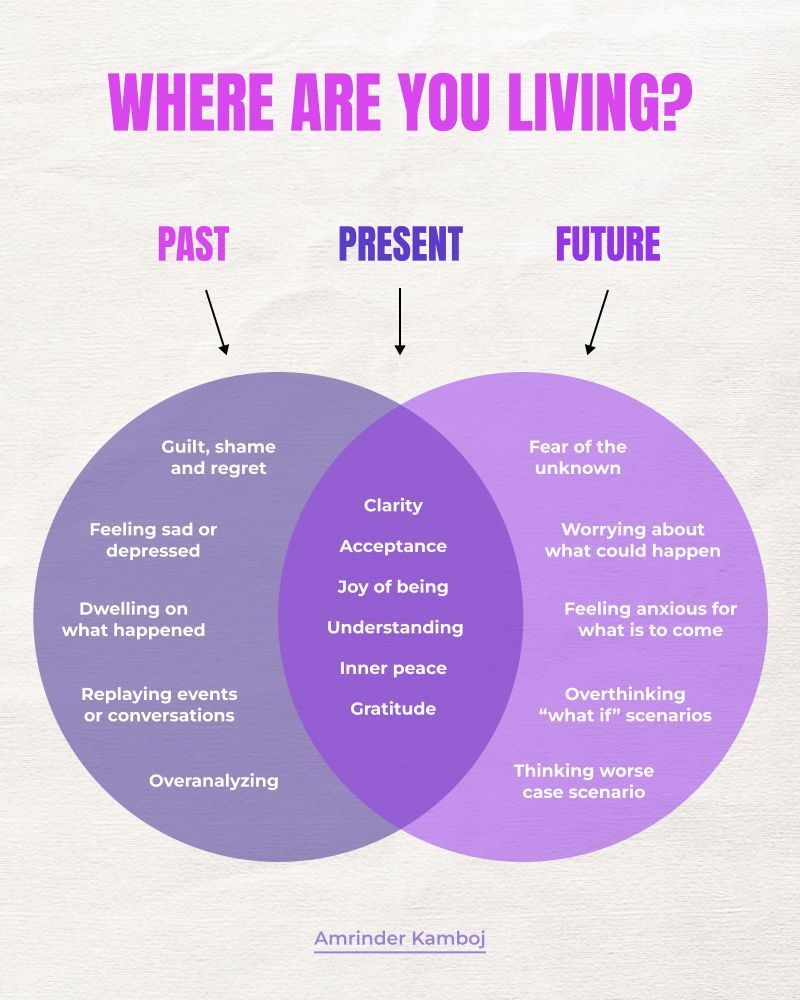
When attention drifts into the past, the body often follows with heaviness, contraction, and the familiar pull of guilt or regret. These states aren’t moral failings; they’re physiological echoes of unfinished stories, unresolved meanings, or moments where the nervous system didn’t get to complete its cycle. The past becomes a place we revisit not because we want to suffer, but because something in us is still trying to understand.
When the mind leaps into the future, the body tends to brace. Muscles tighten, breath shortens, and the imagination fills with “what ifs” that feel like warnings rather than possibilities. Anxiety is often a form of over preparationan attempt to stay safe by anticipating every outcome. The future becomes a terrain of uncertainty, and the nervous system responds as if danger is already present. This is why worry feels so physical: the body is rehearsing for threats that haven’t arrived.
The present, in contrast, is less a time period and more a physiological state. It’s the moment when the mind stops time-travelling long enough for the body to settle. Clarity, acceptance, and inner peace arise not because life is perfect, but because attention and physiology are aligned. In this state, the nervous system isn’t fighting old battles or scanning for future ones. It’s simply responding to what is. This is why presence feels spacious, grounded, and strangely simple.
What’s powerful about this diagram is that it doesn’t shame any of the circles. Past, present, and future are all necessary. Reflection helps us learn. Imagination helps us plan. Presence helps us live. The difficulty comes when we get stuck in one circle, looping, rehearsing, or bracing—rather than moving fluidly between them. Emotional regulation, in many ways, is the art of noticing where we are living and gently guiding ourselves back to where our body can breathe again.
In therapeutic work, this model serves as a compass. It helps clients locate themselves without judgment and understand their symptoms as time-travel rather than personal failure. It also opens the door to somatic interventions: grounding for the future-focused mind, completion work for the past-focused mind, and breath or sensory anchoring for returning to the present.