On 26 June 1945, representatives of fifty nations signed the Charter of the United Nations in San Francisco. It was a carefully negotiated document—part idealism, part compromise—crafted in the ruins of a global war and under the shadow of power politics.
Eighty years later, that Charter remains the only constitutional backbone of the international system. In just 111 articles, it set out a broad ambition: to maintain peace, affirm the equal rights of nations large and small, promote human dignity, and foster cooperation across economic, social, and humanitarian fields.
The world it envisioned has changed. The number of Member States has nearly quadrupled. The forms of conflict have shifted. Challenges like climate breakdown, cyber insecurity, and mass displacement stretch the Charter’s language—and at times its authority.
Yet its core ideas endure. Article 2(4) established the prohibition on the use of force, now a peremptory norm. Article 1 set international cooperation as a legal purpose, not just a political aspiration. Chapter IX linked peace with justice, social progress, and human rights—long before these became universal slogans.
The Charter has not prevented war. It has not always protected the vulnerable. It has at times mirrored the will of the powerful more than the needs of the many. But it has given an agreed framework—a legal and moral grammar—for how the world should work.
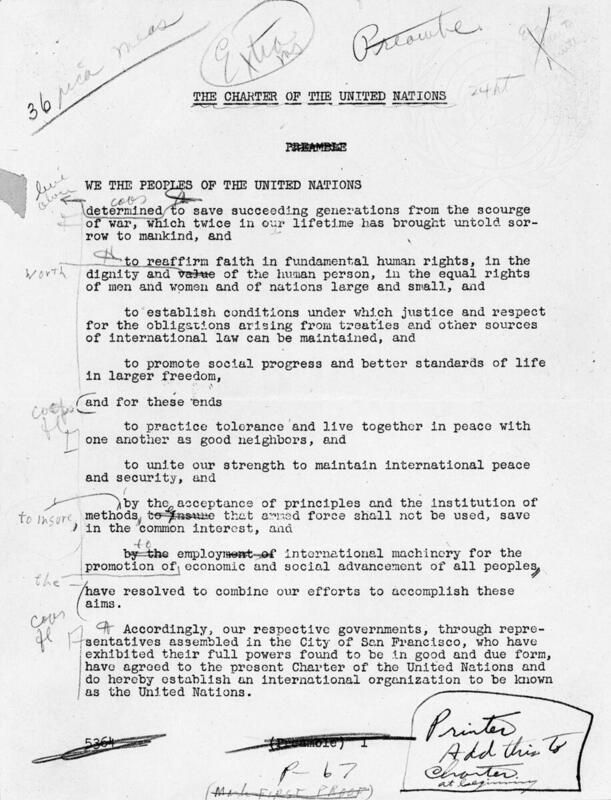
The photograph below is a working draft of the Preamble, annotated during the San Francisco Conference. In it, one can see the hand of history in motion: edits to the phrasing, shifts in tone, careful insertions of principle. It reminds us that the Charter was not inevitable. It was constructed.
As the United Nations marks 80 years, the challenge is not only to recall the Charter’s words, but to renew their meaning—across a rapidly changing world.
Secretary‑General Dag Hammarskjöld once said the UN was not created to take humanity to heaven, but to save it from hell. That remains its purpose.
The Charter is not perfect. But it is still the only global compact signed in the name of “We the Peoples.” Eighty years on, it remains our unfinished blueprint.