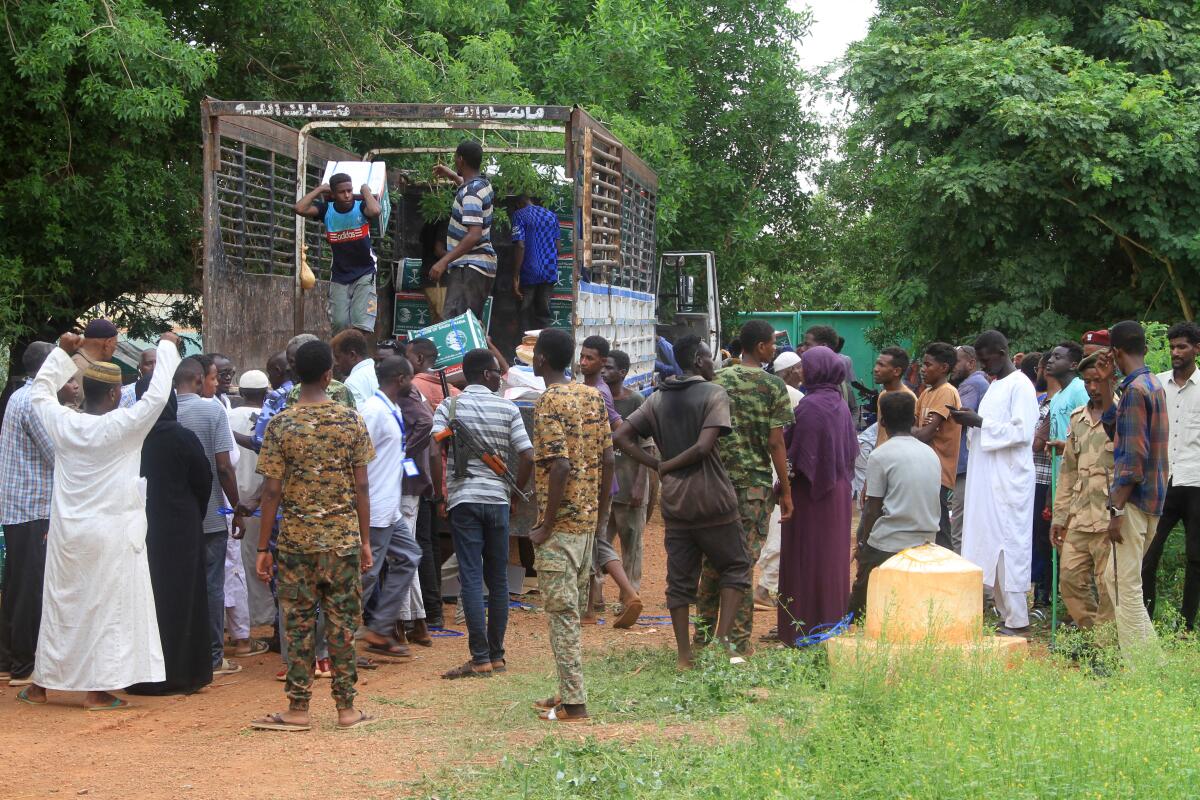
Famine declarations are relatively rare. But the leading international authority on hunger crises this week declared that regions of war-torn Sudan face catastrophic shortages of food.
Famine declarations are relatively rare. But the leading international authority on hunger crises this week declared that regions of war-torn Sudan face catastrophic shortages of food, water and medicine, just months after the same multi-agency body — the Integrated Food Security Phase Classification (IPC) — formally declared famine in Gaza had reached catastrophic levels amid Israel’s campaign against Hamas.
Previously, the IPC has confirmed catastrophic famine conditions in Somalia in 2011 and South Sudan in 2017 and 2020.
So why are formal famine declarations — meaning that there is documentation of widespread starvation, widespread illness and widespread mortality — so rare?
NPR spoke with two people working within the web of government officials, aid workers, and analysts responsible for monitoring hunger crises around the world.
There’s a very specific, internationally-agreed upon system for gauging hunger crises
The system the world relies on to track food emergencies began in the 1980s, said Tim Hoffine, now deputy chief of Party-Innovation at the Famine Early Warning Systems Network (FEWS NET). In response to famines in East and West Africa, U.S. aid officials realized the need for a way to monitor global hunger. The goal, Hoffine said, was to provide “independent, timely and evidence-based analysis” to help decision makers prevent future famines.
That led to the founding in 1985 of FEWS NET by the U.S. Agency for International Development (USAID) to contract experts to collect and analyze data on at-risk areas monthly.
Still, there was no universal standard to define the severity of hunger crises — making coordination among donors and aid groups difficult.
“Donors wanted a single estimate of need,” Hoffine said. “And the IPC responded to that desire for consensus.”
Multiple conditions need to be met before a location is technically considered in “famine”
The IPC categorizes hunger on a five-phase scale. FEWS NET, which monitors hunger hotspots monthly, also uses this system.
Phase one means conditions are normal. In phase two, communities are “stressed” — still eating enough, but many households struggle to afford other essentials.
At phase three — “crisis” — “that’s where we start getting nervous,” Taravella said. People begin to have trouble getting enough food. “They might not have meals as often.” Many turn to short-term coping strategies that undermine long-term survival, like selling off livestock.
In phase four — “emergency” — hardships deepen. Food gaps widen, and people resort to “really extreme forms of coping,” Hoffine said. That might mean liquidating nearly all assets or eating seeds needed for future planting. Rates of acute malnutrition and excess deaths rise.
Only in phase five is a location considered in “famine.” Three criteria must be met: at least 20% of households face “catastrophe,” meaning, Hoffine explained, “an extreme lack of food that … leads to acute malnutrition and mortality.”
“In conflict zones, collecting reliable data, especially on non-trauma mortality, often proves difficult,” Jean-Martin Bauer, the World Food Programme’s director for Food Security and Nutrition Analysis Service, told NPR. “This means lack of data can hinder an official classification of famine. By the time famine is declared, people are already dying.”
Some areas in Sudan have been declared to be facing famine conditions since 2024. Parts of South Sudan were declared in famine in 2020 and 2017.
There’s an even higher bar for actually declaring a famine
Even if FEWS NET or the IPC determine that a location meets all three famine criteria, they can’t declare it on their own. Their findings must be reviewed and approved by a committee of independent experts convened by the IPC. In Gaza’s case, the committee reviewed and signed off on similar reports from both organizations.
Still, neither FEWS NET nor the IPC makes the official declaration. “It’s up to government institutions, United Nations upper leadership, and other high-level representatives to actually make a famine declaration,” Hoffine said.