The ride from Gwynn Oak Amusement Park has been out of commission for renovations since 2023. It opens to the public on April 24
Michelle MehrtensApril 22, 2026
On August 28, 1963, a young Black couple in Baltimore had to decide whether to travel about 45 miles south to attend the March on Washington, along with more than 250,000 other Americans devoted to civil rights and racial equality. The gathering is now often remembered as the site of Martin Luther King Jr.’s “I Have a Dream” speech, one of the most significant orations in American history.
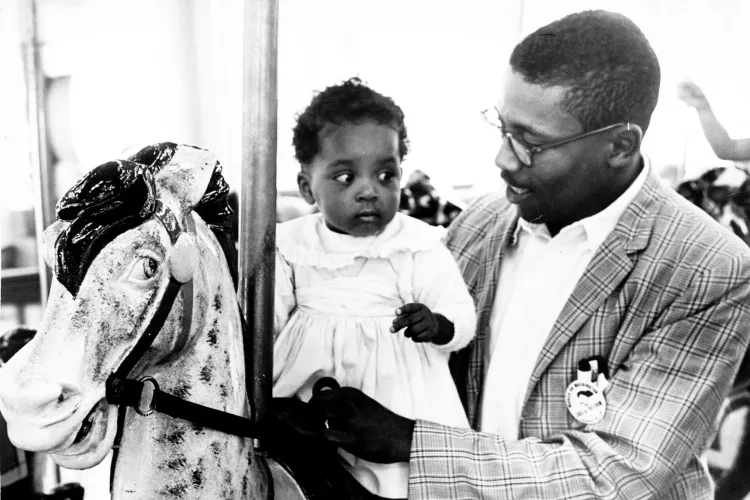
The pair, Charles and Marian Langley, hoped to witness this moment—but they had an 11-month-old daughter to consider. They worried about the risks of navigating such a large crowd with a baby in tow. Ultimately, they instead chose to visit the much closer Gwynn Oak Amusement Park. It was making history that day, too.
Gwynn Oak, established in Maryland in the 1890s, had long been segregated. Activists fought an extensive battle, with years of protests, to integrate the park. Their work came to fruition: That morning, the Langleys were the first Black family to walk into the newly desegregated space, and their daughter, Sharon, the first to ride the park’s merry-go-round.
Sharon was too young at the time to remember the ride, but her family shared their memories with her as she grew older. She recalls her parents’ explanation that they played a “meaningful role in integrating the park and supporting it being available to every child who wanted to go there for a day of fun and enjoyment.”
She adds, “It made me feel that maybe our going to the park was a way of doing our part, or doing our family’s part, to make progress.”
/https://tf-cmsv2-smithsonianmag-media.s3.amazonaws.com/filer_public/b4/64/b4640964-3cea-4c47-ae0d-34b6c342ad47/provided_by_amy_nathan_from_round_and_round_together_297.jpg)
Gwynn Oak closed in the early 1970s, after Hurricane Agnes devastated much of its infrastructure. The carousel, which had survived the storm, was later installed on Washington, D.C.’s National Mall in 1981. It replaced an earlier model that had been mounted in 1967 at the request of Smithsonian Secretary Dillon S. Ripley. He wanted the original merry-go-round to be a “living extension of the museums,” and hoped it would brighten the visitor experience.
This week, visitors to the National Mall will be able to ride the Gwynn Oak carousel for the first time since a multiyear renovation began in 2023. The merry-go-round was sent to Carousels and Carvings in Ohio for refurbishment, which included repairs to the platform and accompanying animals, a glossy new coat of paint and increased seating accessibility. Expressive horses trimmed in blue, yellow and red circle the platform—including a fantastical dragon horse.
Beyond its whimsy, the piece remains an important artifact of American history. A brass marker nods to its powerful backstory. The exact horse that Sharon rode in 1963 is emblazoned with the names of lauded figures from the civil rights movement along with the words “Freedom Riders.” Sharon’s name is painted on one of its horseshoes.
/https://tf-cmsv2-smithsonianmag-media.s3.amazonaws.com/filer_public/7b/db/7bdba29e-28ba-4e80-8cca-2bcaacb127d8/provided_by_amy_nathan_sharon_langley_with_her__freedom_horse__in_2014.jpg)
Today, the restored merry-go-round is an object of “joy and wonder,” says Smithsonian Secretary Lonnie Bunch III, and simultaneously a testament to “what happens when people demand America live up to its ideal.”
It represents “how something as simple as entertainment becomes part of the fight for fairness and civil rights in America,” Bunch says. “The carousel was a symbol of what African Americans weren’t allowed to do. They weren’t allowed to have the same joy as other people.”
Now, he says, it’s a symbol of transformation.
/https://tf-cmsv2-smithsonianmag-media.s3.amazonaws.com/filer_public/4e/bd/4ebdbf4c-22c6-409e-862a-82fc2bdfec16/img_0062.jpg)
The story of the Gwynn Oak carousel underscores that young people have always been part of creating change in the world. Whether participating in protests or simply living their lives, they regularly made history during the civil rights era. In 1960, 6-year-old Ruby Bridges became the first Black child to attend an all-white elementary school in New Orleans. Claudette Colvin was 15 when she refused to give up her seat at the front of an Alabama bus in 1955. (Rosa Parks famously did the same nine months later.)
Stories like these happened across the country.
By 1963, when Sharon first rode the carousel, youth activism had become an undertaking that “people paid attention to,” says Daphne Chamberlain, a historian and the chief program officer of the Emmett Till Interpretive Center in Mississippi.
“During the civil rights movement, these were children who fully understood the world, and how it moved around them, and their place in the world,” explains Chamberlain. On segregation and other modes of racial inequality, they knew it was “not right,” she says, and “not how we should live. This is not how my parents or my grandparents should live. This is not how anybody should have to live.”
That same year, 9-year-old Linda Dorsey-Walker was protesting segregation at Gwynn Oak in her own way: by repeatedly returning to the park even though she was rebuffed each time.
/https://tf-cmsv2-smithsonianmag-media.s3.amazonaws.com/filer_public/86/17/8617a8b0-3f00-4d54-9780-742db274655f/provided_by_amy_nathan_carousel_on_the_mall_historical_marker16.jpg)
Park manager Arthur Price Jr. refused to grant entry to Dorsey-Walker and her friends, informing them that they would never be welcome, she notes. When they went back on another day, she recalls a group of white teenagers approaching them. “Next thing I know, we were punched, kicked to the ground,” she says. “I had people for the first time in my life spit on my face.”
Undeterred, she and others continued to show up.
Dorsey-Walker had been excited to enjoy the park since her family moved to town three years earlier. She says that one of the first things they did was drive around their neighborhood, where she and her brother first spotted Gwynn Oak. They asked when they could visit, only to be told by their parents that they were barred from the park because they were Black.
This was an experience that Dorsey-Walker recalls being “familiar with.”
“I can remember right from the beginning of my childhood that we weren’t welcome in certain places,” she says. “And it could be dangerous if we went into those places where we faced a lot of hostility.”
She remembers a violent incident from her early childhood in which she was grabbed and picked up by a white man: “He was drunk,” she says. “He took a cigarette out of his mouth, and he burned it through a white pleated skirt I had into my thigh.”
When speaking publicly about her experiences, Dorsey-Walker notes that she is often asked what could have prepared her for what she faced at Gwynn Oak. To this, she explains, “I was already taught by fire.”
/https://tf-cmsv2-smithsonianmag-media.s3.amazonaws.com/filer_public/f5/52/f5529690-53a0-4786-8303-43a5b6d66137/img_0064.jpg)
The activist efforts to desegregate Gwynn Oak began in the 1950s.
Within a few years, the Civic Interest Group (CIG)—a student-led coalition central to the Gwynn Oak protests—became heavily involved in grassroots organizing, such as voter registration and political campaigning. The group was created by Baltimore high school and college students committed to desegregating public spaces. They cited the sit-ins in the Deep South as one of their sources of inspiration.
In an inaugural pamphlet, the CIG wrote:
“You may ask yourselves, why is a group of students so concerned about this conflict in our society, why do they put pressure on the community for action? Perhaps it is because the conflict is real and vivid to us, because we have a sharp, clear memory of the first time we realized that all people are not treated equally in our city and nation.”
The students of CIG were backed by Baltimore’s leading civil rights groups, who collectively recruited local community members and invited press to cover their upcoming demonstrations at the park. With a growing number of volunteers, they provided training on the mechanics of nonviolent protest and notified the local police chief of their plans, hoping to keep the peace. By late June, a mix of campaigners, clergy, physicians, lawyers, students and other advocates from Philadelphia, D.C., Baltimore and elsewhere were ready to take a stand.
They chose Independence Day.
/https://tf-cmsv2-smithsonianmag-media.s3.amazonaws.com/filer_public/47/03/4703159c-7718-4738-99a5-998734a3ea4f/provided_by_amy_nathan_horseshoe_of_sharons_horse32.jpg)
That July 4, hundreds of demonstrators rallied to the entrance of Gwynn Oak, including Dorsey-Walker. She remembers her parents telling her and her brother that their “role was to be good representatives of our race.” They were instructed not to become “hostile” or “violent,” “no matter what was said or done to us,” she says.
When picketers attempted to buy tickets, the park’s owners called the police. Some were beaten; almost 300 were arrested.
To apply pressure on both legal and political enforcement, several refused to pay bail and purposefully spent the night in confinement. “A lot of people from the first protest on July 4th did that. And that just completely overwhelmed the Baltimore County judicial system,” says Amy Nathan, who was a teenager in the city at the time. She interviewed some of the original Gwynn Oak marchers for Round and Round Together: Taking a Merry-Go-Round Ride Into the Civil Rights Movement, her comprehensive history of the park’s demonstrations.
Protesters showed up again three days later, on July 7. They faced physical harassment and violence from nearby onlookers, who yelled slurs and threatened to attack. Alison Turaj, a 25-year-old demonstration group leader, was struck in the head with a rock. In an interview with the Baltimore Afro-American, Turaj remembered insisting, “We have to go ahead.”
As they moved forward, the demonstrators held hands and sang “We Shall Overcome.” Eventually, the police arrived with dogs and whistles. As picketers were arrested and transported to Woodlawn Police Station, an angry mob reportedly yelled, “Kill them, kill them, kill them.”
This time, nearly 100 people were arrested for trespassing and disorderly conduct, including children. Along with their parents, three young white boys—Tom, John and Steve Coleman—were detained. At 8 years old, Tom was the oldest son. The Baltimore Afro-American asked him why he had been apprehended.
Tom said, Black people “cannot go to Gwynn Oak, and they should go.”
The images of these arrests, both in newspapers and on television stations, shocked the local community. Such massive publicity, and subsequent backlash, only increased pressure on Gwynn Oak to open its doors to all. After extended negotiations, the park owners dropped the charges against demonstrators and finally settled on a date for integration: August 28.
Dorsey-Walker says she and her friends were waiting in line bright and early.
/https://tf-cmsv2-smithsonianmag-media.s3.amazonaws.com/filer_public/c9/47/c947fbc9-5baf-4acd-b9c0-cfcc5936ebd8/img_0057.jpg)
When the Gwynn Oak carousel replaced the original Smithsonian merry-go-round, its role in the civil rights movement was largely unknown. But in 2008, Nathan saw a picture of baby Sharon’s famous ride in a book about Baltimore’s civil rights history. The image compelled her to dig deeper into the amusement park’s background. She discovered that the historic Maryland carousel and the carousel now on the Mall were one and the same.
Nathan met Sharon when she was working on Round and Round Together.Sharon had been an educator for years, teaching multiple grades in elementary school, and was particularly drawn to books and other materials in which students could see their own histories and “find a touchstone.”
Together, they wrote A Ride to Remember: A Civil Rights Story, an illustrated children’s book that tells Sharon’s story. In the years since its publication, Sharon has received letters from elementary school readers, all of them sharing their hopes for a better future. “Children are aware of the world around them and what they perceive as injustice,” she says.
Chamberlain, of the Emmett Till Interpretive Center, reveals that she herself purchased A Ride to Remember for her 6-year-old daughter. After reading the book, her daughter was particularly influenced by the reality of “Black children not being able to have access to certain spaces,” she says. “And this little Black girl found all of this happiness being on this carousel.”
“Seeing herself reflected in this book through somebody else’s story was what made her happy,” adds Chamberlain. “I do know that my daughter is going to be the one to continue to tell the story if nobody else is telling it.”
/https://tf-cmsv2-smithsonianmag-media.s3.amazonaws.com/filer_public/8e/23/8e23e4f3-4d35-4c05-9d07-1b02176c999a/img_0068.jpg)
During his “I Have a Dream” speech, on the steps of the Lincoln Memorial, Kingsaid, “We can never be satisfied as long as our children are stripped of their selfhood and robbed of their dignity by signs stating: for whites only.” He outlined his vision that one day, children of different races would join hands as sisters and brothers. In A Ride to Remember, Sharon writes, “My carousel ride showed that Dr. King’s dream was starting to come true.”
Sharon emphasizes that young people are still essential to movements: “You can do the things that matter to you. You can change the things that are important to you. The world needs you. Your community needs you. Your people need you.”
She adds, “No act is too small.”
/https://tf-cmsv2-smithsonianmag-media.s3.amazonaws.com/filer_public/4f/6c/4f6c6def-1482-4151-9bb7-f3ad87fdb765/img_0061.jpg)