
The Japanese government issued emergency earthquake warnings for Kumamoto, Nagasaki, Kagoshima, Fukuoka, Saga, Oita, and Miyazaki prefectures, all on Japan’s southern Kyushu island.
JULY 28, 2026 10:48

At least 13 people were killed, and around 260,000 people were given evacuation orders when an earthquake with a magnitude of 7.1 struck Japan‘s Kumamoto Prefecture on Tuesday.
The Japanese government issued emergency earthquake warnings for Kumamoto, Nagasaki, Kagoshima, Fukuoka, Saga, Oita, and Miyazaki prefectures, all on Japan’s southern island of Kyushu.
Power to thousands of homes was knocked out, and roads were torn apart across the region.
Public broadcaster NHK showed several buildings on fire or collapsed, large cracks along roads, including an elevated highway, and a derailed goods train.
“Power outages and fires have occurred in some areas, and there has also been damage to roads and bridges and the collapse of buildings. Above all, I ask everyone to take action to protect themselves, including evacuating to a safe location,” Japan’s Prime Minister Sanae Takaichi said, speaking to reporters at her office in Tokyo.

Aeon Mall in Kumamoto collapses, trapping up to 30
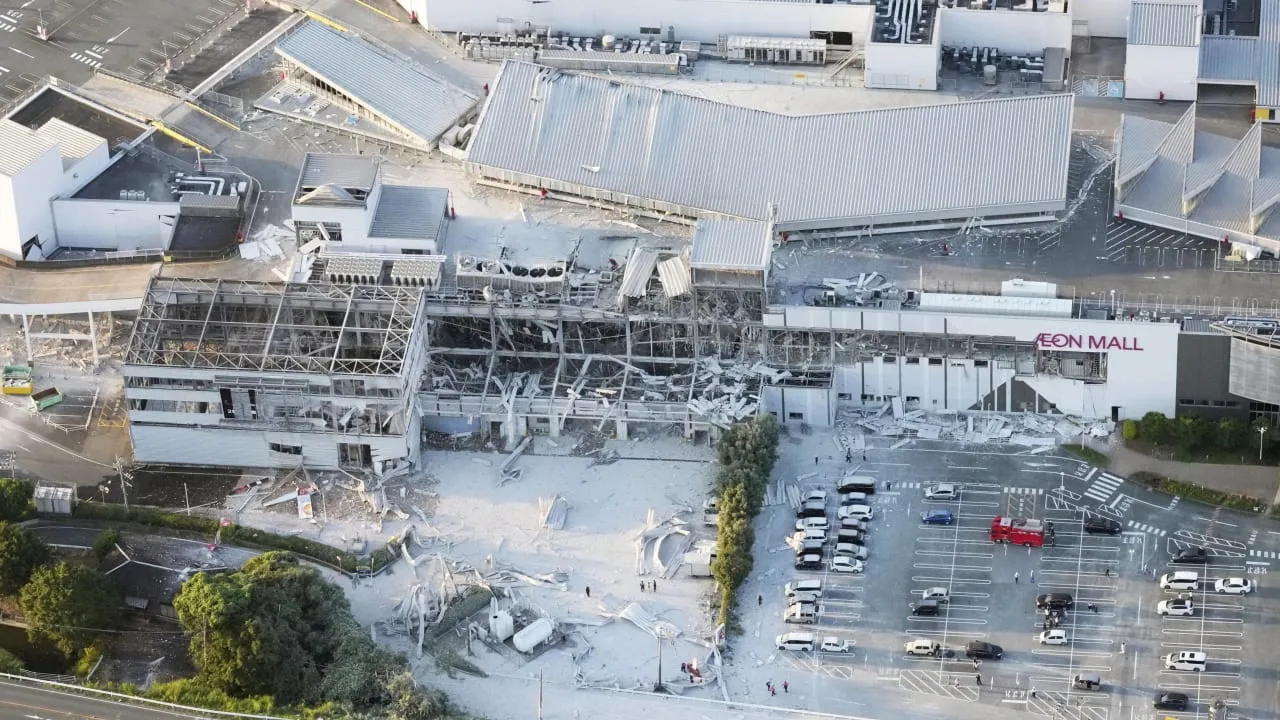
The Aeon Mall in the southern city of Kumamoto suffered an explosion following the earthquake, according to local media, with local authorities saying that multiple people were confirmed killed or trapped inside the site after the disaster.
Eight people were pulled from the rubble of the partially collapsed shopping mall, among them two dead women in their 20s.
Around 20 to 30 mall workers were unaccounted for on Tuesday, public broadcaster NHK said.
“Even now, there are people waiting to be rescued, and this is a race against time. We will marshal all available resources on the ground to save and rescue as many people as possible,” Prime Minister Sanae Takaichi told reporters in Tokyo.
One side of the mall, which houses around 200 stores, was torn away, exposing steel beams and strewing debris across a parking lot, footage showed.
Emergency fire rescue teams, police and around 170 army personnel were focusing on areas of the building where calls for help had been received. More than 4,500 soldiers have been deployed to help with recovery efforts across the quake zone.
A spokesperson for mall operator Aeon said customers and employees were evacuated right after the initial quake and that the exact cause of the ensuing explosion was unclear.
Authorities are investigating the source of the explosion at the Aeon mall. Rescuers reported smelling gas inside the building, but the cause of the incident was still under investigation, Japan’s top government spokesperson Minoru Kihara said.
Seven people are also missing after a chimney collapsed at a Nippon Paper Industries factory, while four others are seriously injured, a local government official said. Hospitals were reported to be treating dozens of patients.
UN keeps an eye on Japan’s nuclear sites
The UN nuclear watchdog said on Tuesday that Japan’s nuclear regulation authority has informed it that there is no damage or safety issues at the Sendai nuclear power plant following the earthquake. “The IAEA will continue to monitor the situation,” said the watchdog in a post on X.
Kyushu Electric Power said there were no reports of irregularities at its Sendai and Genkai nuclear power stations after the earthquake.
Hokkaido Electric Power Co and Tohoku Electric Power Co have several shut-down nuclear power plants in their respective regions.
Kyushu Electric Power said about 40,000 homes had lost power as a result of the latest quake, while railway company JR Kyushu said that it had suspended services, including its high-speed bullet trains. Kumamoto airport also shut its runway, as airlines diverted and canceled flights.
Major Japanese companies shut down, services disrupted
TSMC, the world’s largest contract chipmaker, evacuated workers from its plant in the area as a precaution, a spokesperson for the firm said.
A spokesperson for electronics firm Sony, which also has a plant there, said it was checking the situation.
Toyota said on Wednesday it would halt operations at three plants in southern Japan through Friday as it weighed the impact of an earthquake on suppliers and logistics, just hours after resuming production stopped the previous day.
“The situation, including aftershocks and recovery efforts, is changing daily,” the world’s biggest automaker said in a statement about the suspensions at its Miyata, Kanda and Kokura plants from Wednesday until July 31.
“We will continue to prioritize safety above all else.”
Honda said it would extend an operation suspension at its Kumamoto motorcycle plant, also until Friday, to allow repairs to quake-damaged parts of the factory.
Telecoms operators KDDI and Docomo said there was disruption to their mobile phone services due to power shortages and transmission-line failures.
Some hospitals overburdened
One hospital in Uki city, near the epicenter, said a power outage caused by the earthquake meant it was unable to function.
“It’s become like a field hospital,” the head of the administrative department told NHK.
Another hospital in the city said it had suspended admissions as it could no longer handle additional emergency cases after accepting 86 injured people following the quake, including three with serious injuries.
Second large-scale earthquake to hit Japan in 2026
Tuesday’s earthquake represents the second disaster of its kind to strike Japan this year, with a 7.5-magnitude event recorded off the coast of the islands, triggering tsunami alerts back in April.
In that instance, authorities urged residents to stay away from coastal areas where tsunami waves of up to 3 meters (9.84 ft) were expected.
The tremor had an epicenter in the Pacific Ocean and was 10 km deep, according to the Japan Meteorological Agency. The biggest waves were expected in the prefectures of Iwate, Aomori, and Hokkaido, authorities said.
The quake measured an ‘upper 5’ on Japan’s seismic intensity scale – strong enough to make it difficult for people to move around. In many cases, unreinforced concrete-block walls collapse.
Japan is one of the world’s most earthquake-prone countries, with a tremor occurring at least every five minutes. Located along the “Ring of Fire” of volcanoes and oceanic trenches that partly encircles the Pacific Basin, Japan accounts for about 20% of the world’s earthquakes of magnitude 6.0 or greater.
A massive earthquake in Kumamoto 10 years ago killed 275 people and injured a further 2,739, according to an official count, and damaged thousands of buildings, including the city’s castle, a top tourist site.
The Environment and Climate Change portal is produced in cooperation with the Goldman Sonnenfeldt School of Sustainability and Climate Change at Ben-Gurion University of the Negev. The Jerusalem Post maintains all editorial decisions related to the content.