Robert H. Jackson, an American Supreme Court justice who thought of himself as “anything but a warrior,” was drafted by FDR to prosecute leading Nazis
David Noonan November 2025
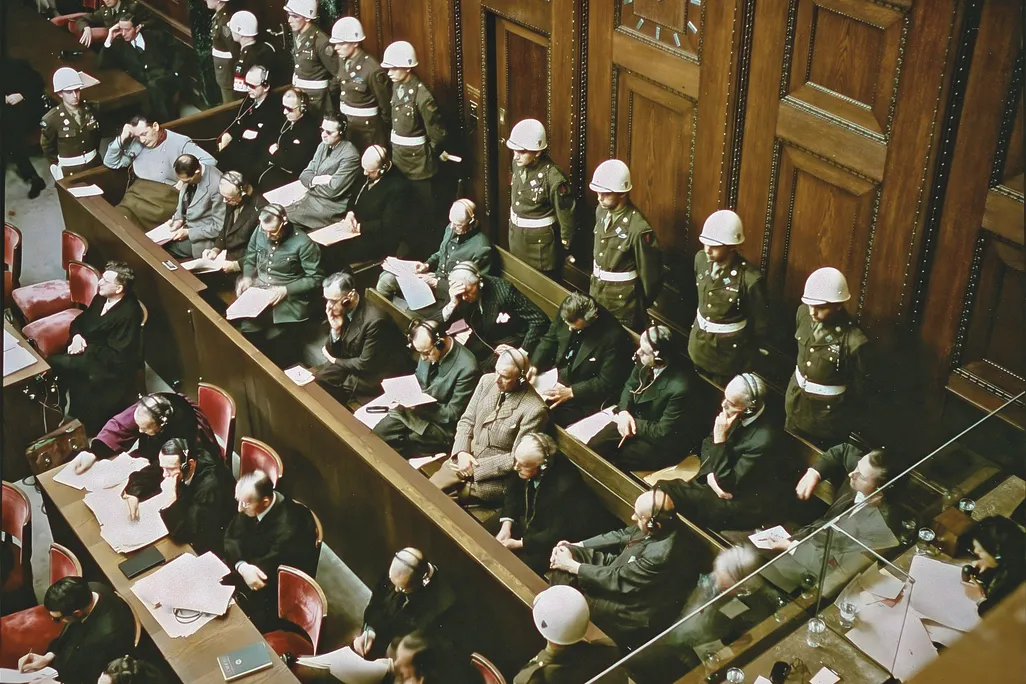
In the fall of 1945, a bit more than six years after Nazi Germany invaded Poland and started the biggest and deadliest conflict in history, a largely self-taught lawyer from a tiny hamlet in the southwest corner of New York State set out to convict the surviving Nazi leadership of crimes “so malignant, and so devastating, that civilization cannot tolerate their being ignored, because it cannot survive their being repeated.” In his roughly four-hour opening statement at the first Nuremberg trial, Robert H. Jackson, chief prosecutor for the United States, offered the first full public picture of how the Nazis had planned and carried out the many horrors that shock the world to this day, including the systematic murder of an estimated six million Jews.
The Untold Secrets of King Tut’s Tomb
The war in Europe had ended just six months earlier. But, as Jackson made clear to the International Military Tribunal, assembled to decide the fate of these higher-level Nazis, the Allies’ great victory would be incomplete without a legal reckoning suited to the scale of the offenses. “The common sense of mankind demands that law shall not stop with the punishment of petty crimes by little people,” he said, as 21 defendants, including Hermann Göring, commander in chief of the Luftwaffe, and Hans Frank, who had led the Nazi terror campaign in Poland, looked on from the dock. “It must also reach men who possess themselves of great power and make deliberate and concerted use of it to set in motion evils which leave no home in the world untouched.” The veteran litigator told the French, British, Soviet and American judges hearing the case—and the grieving world—what was to come: “We will give you undeniable proofs of incredible events.”
Jackson is little known today outside the legal world, where, says John Q. Barrett, a legal scholar at St. John’s University at work on a Jackson biography, “he’s a patron saint.” But if Jackson has been forgotten, he is arguably the most accomplished forgotten man of the 20th century. His remarkable career took him from a small private practice to a seat on the U.S. Supreme Court, and he remains the only person in U.S. history to serve as solicitor general, attorney general and Supreme Court justice.
Born in 1892 on his family’s farm in Spring Creek, Pennsylvania, Jackson grew up in Frewsburg, New York. He graduated at the top of his high school class of three in 1909 but did not attend college. Instead, he completed a super-senior year and apprenticed for a small law firm in nearby Jamestown, while developing his skills as a speaker and writer. “He read a lot of Shakespeare and poetry and great speeches,” Barrett says, and was involved in oratory and debate. Jamestown is now home to the Robert H. Jackson Center, dedicated to preserving his legacy and advancing his commitment to justice.
After completing a year at Albany Law School, in 1912, Jackson studied for the New York bar on his own. He passed in 1913 and by the 1920s was a star in the state’s legal community, appearing before, and impressing, future Supreme Court Justice Benjamin Cardozo.
Jackson, an active Democrat, first met Franklin D. Roosevelt in 1911, when the latter was serving in the New York State Senate. They grew closer as their paths kept crossing. “Roosevelt recognized Jackson’s multiple talents early on and included Jackson on many of his decisions,” says University of Virginia legal historian G. Edward White, whose biography of Jackson was published this year. It’s “one of the great president-adviser relationships.” In the late 1930s, despite his misgivings about aspects of Roosevelt’s attempt to pack the Supreme Court, Jackson, an assistant attorney general at the time, wrote a book-length defense of the plan. The Struggle for Judicial Supremacy was published in 1941, the same year Roosevelt appointed Jackson to the court.
Nuremberg would be Jackson’s biggest case, but his opinions for the court endure as a major legacy. White calls him “one of the greatest writers in the Court’s history.” His concurrence in Youngstown Sheet & Tube Co. v. Sawyer, a 1952 landmark in which the court ruled against President Harry S. Truman’s seizure of the steel industry during the Korean War, remains definitive today. In it, Jackson divides presidential authority into three categories: most power, where a president acts with congressional support; the “zone of twilight,” where a president acts with neither clear approval or disapproval from Congress; and least power, where a president acts against the will of Congress.
Yet when the war began in December 1941, just five months after his appointment, Jackson said he was ready to quit the Supreme Court for any government position that would help the war effort. Roosevelt talked him out of it, vaguely alluding to the possibility of Jackson becoming chief justice in the future. Jackson agreed to stay on the bench, admitting in a memoir—erroneously, as the world and the Nazis would learn soon enough—that he was ill-suited for the cause, “being anything but a warrior.”
At the end of World War I, Britain, France and the U.S. hadn’t been able to agree on the creation of an international court to try Kaiser Wilhelm II and others for war crimes. This time, the Allies had been discussing how to deal with enemy leaders for years. One option, favored by Winston Churchill, was to execute the top Nazis without trials. In his book The Anatomy of the Nuremberg Trials, Telford Taylor, a member of the U.S. prosecution team, wrote that British officials were making lists of candidates in May and June 1944 and arguing over who should be included. As late as April 1945, the British War Cabinet asserted its position that “a full trial under judicial procedure was out of the question” for the main Nazi leaders.
With now-President Truman, Charles de Gaulle and even Joseph Stalin in favor of trials, the British at last relented on May 3, three days after Adolf Hitler killed himself and four days before Germany first surrendered. As Barrett views it, putting Göring and others against a wall and shooting them “would have been a great, cathartic, popular thing. But would we have looked back on ourselves with pride? I doubt it.” Instead, thanks to the leadership of Jackson, appointed by Truman on May 2, a new standard in international law was established, and the worst criminal conspiracy in human history exposed, while granting the accused something they never gave their millions of victims: the chance to defend themselves.
The prosecutors presented the war as a yearslong criminal enterprise. The individual defendants, as well as the SS, the Gestapo, the General Staff and High Command of the German Armed Forces, plus four other Nazi-led entities, were indicted on four counts: conspiracy, crimes against peace, war crimes and, in its first-ever use in a prosecution, crimes against humanity, defined in part as “murder, extermination, enslavement, deportation and other inhumane acts committed against civilian populations before and during the war.”
The British prosecuted the second count, crimes against peace, while the French and the Soviets shared counts three and four. The U.S. handled count one, conspiracy, which, as Barrett points out, “included everything, because the [objectives] of the conspiracy were the crimes charged in counts two, three and four.”
/https://tf-cmsv2-smithsonianmag-media.s3.amazonaws.com/filer_public/ec/2a/ec2a5ab5-24a6-490e-b2f8-1577745c051a/nov2025_d09_prologue.jpg)
Over 403 open sessions between November 1945 and the end of August 1946, Allied prosecutors marshaled piles of Nazi documents to make their case. Some files had been captured by combat troops as they rolled up the German Army and liberated concentration camps; others by special teams who followed in the troops’ wake, arresting Nazi officers and securing important materials. Besides the tens of thousands of pages of reports, memos, letters, diaries, speeches and meeting minutes, the evidence included thousands of affidavits from defendants and witnesses, plus photos—and miles of film.
Jackson called the proofs “undeniable”; they were also unimaginable. As Jackson acknowledged in his opening statement, he himself had “received during this war most atrocity tales with suspicion and skepticism.” But now there could be no denying the stark evil of Hitler’s plan, rendered as it was in the chilling language of Nazi bureaucracy. Among the evidence Jackson cited—“one more sickening document,” he called it—was a report by SS leader Jürgen Stroop about the destruction of the Warsaw Ghetto. An excerpt from the translated passage that Jackson chose to read into the record is stunning in its depravity: “I, therefore, decided to destroy and burn down the entire ghetto….The Jews usually left their hideouts, but frequently remained in the burning buildings and jumped out of the windows only when the heat became unbearable. They then tried to crawl with broken bones across the street into buildings which were not afire….Countless numbers of Jews were liquidated in sewers and bunkers through blasting.”
Jackson set these dark declarations alongside examples of the Nazis’ merciless attention to detail, including a 1941 report from an SS unit: “In Kiev 33,771 Jews were executed on September 29 and 30 in retaliation for some fires which were set off there. In Zhitomir 3,145 Jews ‘had to be shot’ because, judging from experience, they had to be considered as the carriers of Bolshevik propaganda.” The Kiev event referred to so casually was the Babyn Yar massacre.
The International Military Tribunal issued its final opinion and judgment across two days, beginning on September 30, 1946. Three defendants were acquitted, seven received prison sentences ranging from ten years to life, and 12 were sentenced to death by hanging. Among the condemned were Göring, Frank, Julius Streicher—publisher of the rabidly antisemitic newspaper Der Stürmer—and the absent Martin Bormann, head of the Nazi Chancellery, who disappeared as the war ended and whose remains were not found until 1972. Göring dodged the gallows via a cyanide capsule just hours before he was to be executed. The others were hanged on October 16, between 1 and 3 a.m.
In his final report on the trial to Truman, filed a few days after the verdicts, Jackson reviewed the enormous undertaking and shared his thoughts on what had doomed the Third Reich. “It was really the recoil of the Nazi blows at liberty that destroyed the Nazi regime,” he wrote. “They struck down freedom of speech and press and other freedoms which pass as ordinary civil rights with us, so thoroughly that not even its highest officers dared to warn the people or the Fuehrer that they were taking the road to destruction.” Jackson closed the report by acknowledging his own role in bringing the Nazis to justice, thanking the president for giving him “perhaps the greatest opportunity ever presented to an American lawyer.”
Courtroom Closeup
Hollywood continues to draw inspiration from Nuremberg—and to shape our memory of the trials
By Sonja Anderson
/https://tf-cmsv2-smithsonianmag-media.s3.amazonaws.com/filer_public/7c/fd/7cfdb9a5-de95-4424-b1ca-7d70bfdf82a5/nov2025_d05_prologue.jpg)
In Verboten! (1959) Helga nurses David, a wounded American soldier, even as fraternization between G.I.s and German women is verboten—“forbidden.” After the war, her brother joins a Nazi revival group, and she takes him to the Nuremberg trials. He listens to Jackson and sees footage from the camps. Helga says: “This is something…the whole world should see.”
/https://tf-cmsv2-smithsonianmag-media.s3.amazonaws.com/filer_public/3a/1a/3a1a3a6e-a1e5-455d-82e1-20a065267e18/nov2025_d08_prologue.jpg)
Studded with stars—Burt Lancaster! Marlene Dietrich! Montgomery Clift!—Judgment at Nuremberg (1961) fictionalizes the trial of Nazi judges. Were the judges obeying orders, or were they themselves to blame? And what circumstances led Germans to follow Hitler on his genocidal path? In a climactic moment, a fictional defendant recalls sentencing a Jewish man to death for alleged sexual conduct with a gentile girl. “I would have found him guilty, whatever the evidence. … It was not a trial at all. It was a sacrificial ritual.”
/https://tf-cmsv2-smithsonianmag-media.s3.amazonaws.com/filer_public/6e/74/6e740699-253b-4162-b140-054681196cac/nov2025_d04_prologue.jpg)
A two-part miniseries aired on TNT, “Nuremberg” (2000) is a drama anchored by the testimonies of concentration camp survivors and Nazi higher-ups, plus a possibly fictional romance between Jackson, played by Alec Baldwin, and his secretary, Elsie L. Douglas (Jill Hennessy). Jackson is the hero, even commanding some inordinate glory: In this version, the prosecutor has the sole honor of posing climactic questions to Hermann Göring (Brian Cox), Hitler’s number two. (In real life, Jackson shared this task with his British and Soviet counterparts, David Maxwell Fyfe and Roman A. Rudenko.)
/https://tf-cmsv2-smithsonianmag-media.s3.amazonaws.com/filer_public/74/99/74997ff8-cc86-4005-9c2c-678ce5a2de76/nov2025_d07_prologue.jpg)
In theaters this fall, Nuremberg (2025) will bring the trials back to the big screen with an unprecedented main character: Douglas M. Kelley (played by Rami Malek), the real American Army psychiatrist who evaluated the Nazis on trial, including, most famously, Göring (Russell Crowe). Kelley interviewed the defendants, administered Rorschach tests and filled a book with their psychological profiles. He describes Göring as a “brilliant, brave, ruthless, grasping, shrewd executive.” As Kelley’s character says in the film’s teaser, “I know more about this man than anyone else on the planet.”