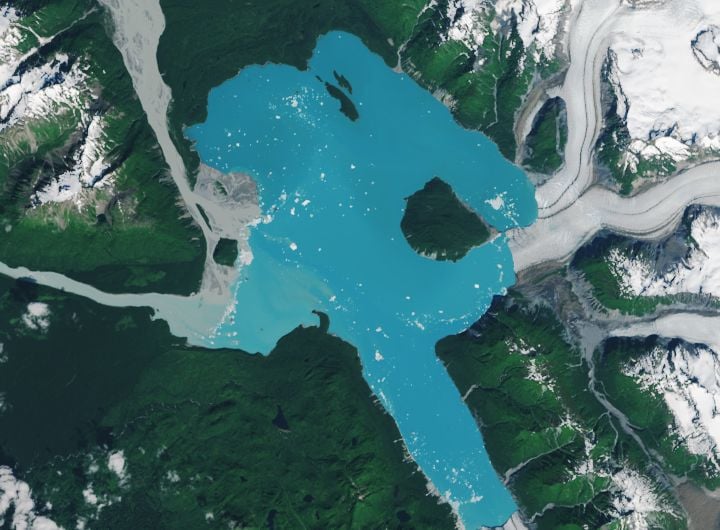
Alsek Glacier disconnected from a mountain called Prow Knob sometime this past summer, making way for Alsek Lake to surround the landmass
Margherita Bassi – Daily CorrespondentSeptember 17, 2025
Satellite images from NASA’s Earth Observatory have revealed that a new island appeared in southeastern Alaska over the summer. Unfortunately, it’s not the sort of appearance that calls for a celebration.
A small mountain called Prow Knob, once surrounded by Alsek Glacier, is now a roughly two-square-mile island. The transformation was finalized when the retreating, or melting, glacier lost contact with Prow Knob, surrounding it with Alsek Lake.
The late glaciologist Austin Post named the mountain after a ship’s prow, according to a NASA Earth Observatory statement. In the early 1900s, the Alsek Glacier reached all the way to Gateway Knob, around three miles west of Prow Knob, Nichols College glaciologist Mauri Pelto, who has studied the glacier for decades, writes in a blog post.
By 1984, part of the mountain’s edge bordered the advancing Alsek Lake. By 2016, two tributaries stopped supplying the glacier with ice. The lake had also continued growing, particularly in the south, where the Grand Plateau Glacier was also retreating. Prow Knob became fully surrounded by water sometime between July 13 and August 6 of this year. In the last 41 years, Alsek Lake has increased from around 17 square miles to approximately 29 square miles, according to NASA.
/https://tf-cmsv2-smithsonianmag-media.s3.amazonaws.com/filer_public/e5/ec/e5ec4db9-a1dc-4864-bb07-0841c8495435/ak_alsekglacier_tm5_19840705_lrg.jpg)
The new island comes as meltwater from rapidly thinning glaciers along the coastal plain of southeastern Alaska leaves behind lakes. “The lakes that are forming in this region are immense, starting at the mountains and spreading toward the coast, making this a new lake district that is unique in our nation,” Pelto told NASA last year.
Since 1984, Pelto reports, both arms of the Alsek Glacier have retreated more than three miles. Now that the glacier is no longer in contact with Prow Knob, the ice is more likely to calve. Notably, however, the separation occurred five years later than when Pelto and Post had estimated based on the glacier’s retreat between 1960 and 1990.
It’s no secret that climate change is accelerating glacial retreat. Alaska is warming at two to three times the global average rate. A United Nations resolution declared March 21, 2025, the first World Day for Glaciers, with the aim of conservation.
“Often we have this sense that glaciers are this really static thing,” changing over years and decades, Kiya Riverman, a glaciologist at Oregon State University, tells KTOO’s Alix Soliman. Their change happens much faster, she explains. “They’re almost like living, breathing creatures that change a little bit every day,” she adds. For example, they melt faster during the day than at night.
And sometimes the change is dramatic and all at once. Also in August, residents in Juneau, Alaska, had to evacuate when water burst through a glacial ice dam at Mendenhall Glacier, as reported by Outside’s Madison Dapcevich. The flooding was record-breaking for the third year in a row.
The event stands as a reminder that melting glaciers are not an abstract, faraway problem.
Editors’ note, September 17, 2025: A previous version of this article misstated the year when two tributaries stopped supplying the Alsek Glacier with ice; it has been updated to correct the error.