
By María de los Ángeles Orfila | September 22, 2025

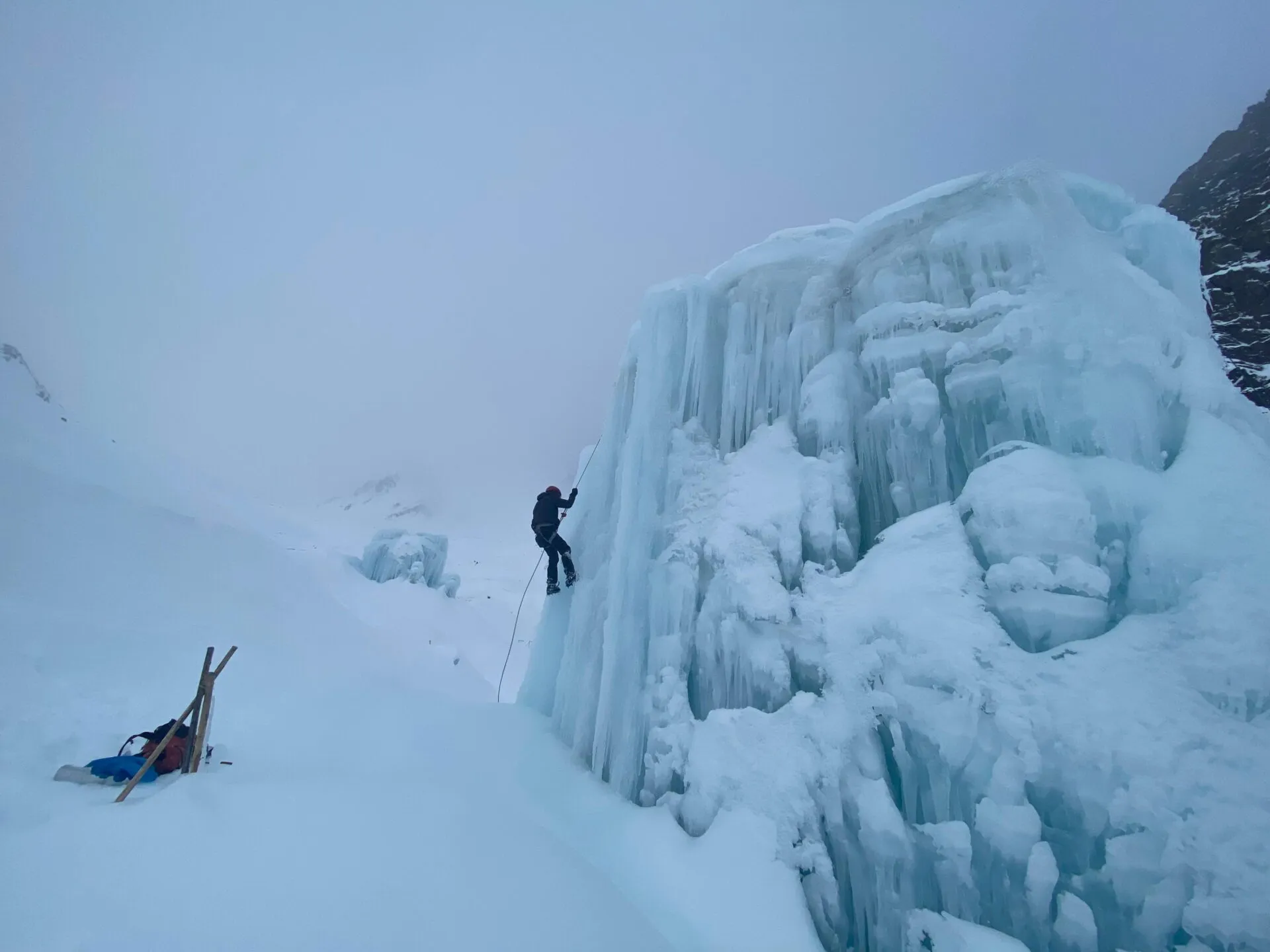
The icy air of the Andes slices like a double-edged knife. There, in the Cajón del Maipo valley, about 37 miles southeast of Santiago, a group of Chilean engineers is testing an unlikely idea: building the first “artificial glaciers” in the Americas to capture as much water as possible before it disappears. Inspired by the “ice stupas” of the Indian Himalayas, these manmade structures retain meltwater in winter and slowly release it during the scorching summer months.
Agriculture and the water supply for nearly 12 million people in central Chile depends on the annual melting of the glaciers that form its geological backbone. But the outlook is bleak: A persistent drought has plagued the country since 2010, and the rains of 2024 only provided brief relief. According to the country’s latest Public Inventory of Glaciers, published in January by the General Directorate of Water, Chile has more than 26,000 glaciers—the greatest number in South America, covering a total area of about 21,000 square kilometers (over 8,000 square miles). But although the number of ice bodies is increasing—a result of the fragmentation of larger glacier masses—the total amount of ice and the volume of available water has declined significantly in recent decades.
“We have a lot of drought and also many glaciers, but that doesn’t guarantee water availability,” says Sebastián Goldschmidt, CEO and co-founder of Nilus, a geoengineering startup.
Since 2021, the Nilus project has been experimenting with artificial glaciers at a site near the El Morado glacier, which lost 19 percent of its volume between 2010 and 2018. It is not the only victim: the neighboring Echaurren Norte glacier has already lost more than 60 percent of its mass and is expected to disappear within 30 years.
“It’s not an individual concern. Not even a national one. It’s a global concern,” says Goldschmidt, about the loss of glaciers. His “dream,” he adds, is “to give water a little more time in the mountain range.”
From the Himalayas to the Andes. In 2020, Nilus engineers came across a video that showed them something “out of this world”: an ice cone in the middle of the desert. It was one of the “ice stupas” of Ladakh, India, a region as beautiful as it is desert-like, where 90 percent of villages depend on glacial water, making them particularly vulnerable to changes in the cryosphere. In fact, it is estimated that 10 percent of Ladakh’s villages could be abandoned by 2050due to insufficient water during the summer months for irrigation and daily use.
These conical structures are created by channeling water from nearby streams and spraying it into the cold air during the winter months, where it freezes almost instantly—like a fountain turned to ice in slow motion. Unlike artificial snow used at ski resorts, ice stupas are designed to store meltwater and release it gradually during the warmer months, providing a vital water source for agriculture in arid regions.
First conceived in 2013 by Indian engineer, educator, and activist Sonam Wangchuk and his team, the stupas are not just engineering feats, but survival solutions. They emerged in response to droughts caused by climate change and the increasingly uncertain availability of irrigation water for farmers who depend on rivers flowing down the mountains.
Nilus thought this technique of capturing and conserving water in winter months for use in the summer months could be helpful in Chile, too.
The science of ice reservoirs. In the Trans-Himalayan mountain range of Ladakh, researchers like Marcus Nüsser, a geographer at the South Asia Institute at the University of Heidelberg, have observed that the frequent freeze-thaw cycles characteristic of these cold, arid mountains create ideal conditions for ice accumulation. There, structures called aufeis—a German term meaning “ice on ice”—form naturally: successive layers of meltwater that freeze one on top of the other during the winter, storing the water flow and releasing it gradually in the spring.
For the artificial version, the engineers chose a conical shape to minimize sun exposure and allow for a gradual release of water during the drier months. Wangchuk chose the name “ice stupas” because the silhouette recalls Buddhist reliquary monuments.
Technically, these are not “artificial glaciers” but “artificial ice reservoirs.” The difference, according to Nüsser, “is not minor,” as these seasonal reserves do not flow and lack well-defined accumulation and ablation zones. But they serve a purpose, improving irrigation and benefiting farmers by helping compensate for seasonal water shortages.
Scaling up the experiment. In its first season, the Chilean team built the first ice reservoir using a gravity-fed system. Meltwater from glaciers is channeled through elevated pipes, using gravitational pressure to move the water. At the end of the pipe, the water is sprayed into the cold winter air through a sprinkler when temperatures drop below freezing. Tiny droplets freeze almost immediately upon contact with the sub-zero air, forming a conical ice structure made of several layers of ice—like a frozen fountain. This structure preserves water until spring and summer, providing a reliable source during periods of scarcity.
In that first attempt, the prototype collected approximately 550 cubic meters of water, or about 14,500 gallons—almost a fifth of an Olympic-sized swimming pool. It took two months to melt, demonstrating its potential to supply water well into the warmer season.
In subsequent iterations, Nilus increased the volume of stored water. The team also refined the structure, adding metal modules for assembly and disassembly, with remotely operated automatic valves and sprinklers. Automation not only saves time and effort, but also allows for rapid response to changes in environmental conditions, optimizing the freezing process and reducing water loss while monitoring variables such as temperature, structural integrity, and water flow.
In 2024, Nilus made seven ice stupas, storing 15,000 cubic meters of water, or 3.96 million gallons—equivalent to six Olympic-sized swimming pools—30 percent more than the previous year.
This winter, Nilus is working with eight reservoirs about 33 feet high, even though snowfall has been scarce and fleeting.
“Our goal is to have a park of 50 ice stupas in the next two years,” Goldschmidt says.
After that, they plan to expand their operations to even higher elevations.
Today, the facility is located 6,234 feet above sea level, in an area where the mountains exceed 19,685 feet in altitude. Moving the project to even higher elevations, where temperatures are colder and there is more snow accumulation, will help increase the size and longevity of the ice stupas.
Promise and limits of artificial ice. Nüsser emphasizes that innovations like Ladakh’s ice stupas show how water geoengineering solutions can be adapted successfully in the Andes, proving that local experiments can inspire global approaches. Nonetheless, it is important to recognize that the solution is only partial: These artificial ice cones retain meltwater from glaciers, but do not add water to the system. In other words, they solve the water shortage each season, but they will be useless if the glaciers disappear entirely.
Nüsser warns that while ice stupas can help manage water shortages, their long-term success depends on ongoing maintenance by local staff and reliable funding. Funding for the Nilus Project comes from a combination of corporate partners, including the Orica Impact Fund, Copec, Coca-Cola, and Ecocopter. The exact investment figures are not publicly disclosed, but the initial setup of a single ice stupa in India cost approximately $1,500. Larger or more complicated artificial ice reservoirs would entail higher construction and maintenance costs.
Nüsser also stresses the need to monitor potential environmental impacts, which could include disruption of local ecosystems, changes in water flow patterns, soil erosion around the structures, and increased energy or resource use during construction and operation.
The ice stupas in Chile are still experimental and there’s room for improvement. “Our laboratory is the Andes,” Goldschmidt says. But they are also a sign that adapting to climate change will require ingenuity, cooperation, and persistence.
In a warming world, these artificial ice towers may help to steal another winter from the thaw and give communities a fragile but vital lifeline during the droughts of the future.