Since 1863, archaeologists have made more than 100 plaster casts, which show how victims died after Mount Vesuvius erupted in 79 C.E. A new exhibition displays 22 of the best-preserved examples
Christian Thorsberg – Daily CorrespondentMarch 16, 2026
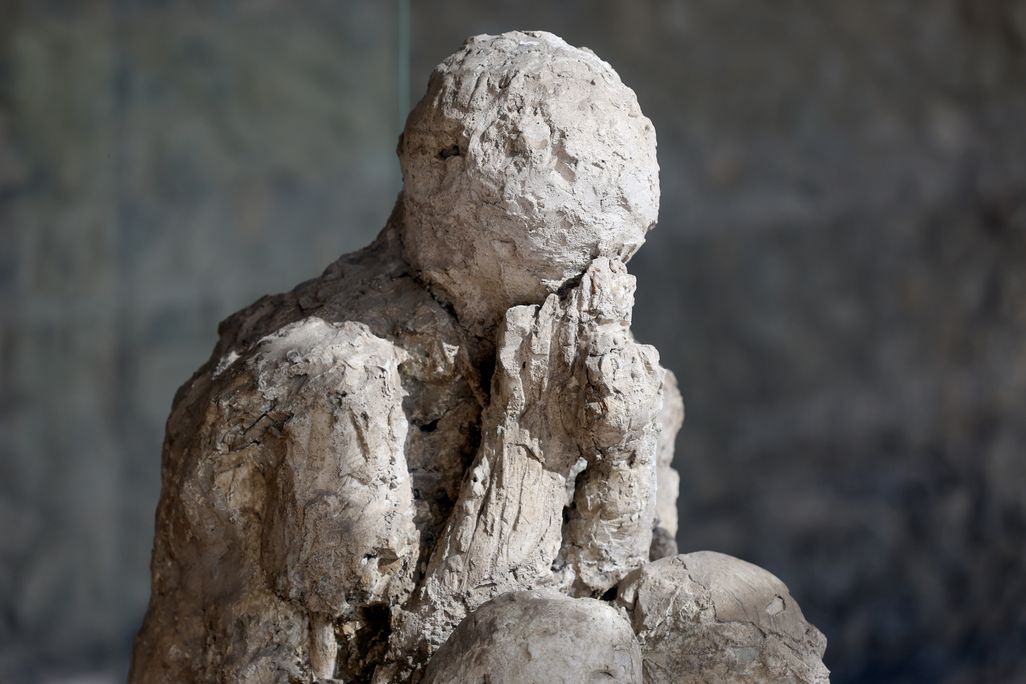
The plaster casts of more than 20 victims of Mount Vesuvius’ eruption in 79 C.E. are now on display in a permanent exhibition at the Archaeological Park of Pompeii in Italy.
The casts preserve residents’ final moments before the eruption covered Pompeii in thick layers of ash and volcanic debris, freezing the ancient city in time. Some were lying down, while others were huddled or sitting. One appears to have been a small child.
“We want to tell the story of a tragedy that destroyed a city, the biggest natural disaster in antiquity, but also left us with an archaeological and historical treasure,” Gabriel Zuchtriegel, director of the park, said at the exhibition’s opening, per the London Times’ Tom Kington.
/https://tf-cmsv2-smithsonianmag-media.s3.amazonaws.com/filer_public/9f/4c/9f4cf9fd-b846-4550-bf04-abed7f1f4920/calchi_sv-5-1-1200x801.jpg)
Though the exact death toll is unknown, historians think around 2,000 peopledied in Pompeii. Falling pumice and rock trapped many residents in their homes and shelters, and roofs quickly collapsed under the weight of debris. Scientists think many victims died immediately or within minutes.
The disaster wasn’t confined to just Pompeii. As many as 16,000 people in the general area, including the city of Herculaneum, are thought to have died during the devastating eruption.
Alessandro Giuli, Italy’s culture minister, commended the exhibition for its empathetic and respectful portrayal of the lives and tragic deaths of those who once called Pompeii home, per a statement from the park. The show opened to the public on March 12.
/https://tf-cmsv2-smithsonianmag-media.s3.amazonaws.com/filer_public/b7/52/b752f8b5-531d-4dee-9bf0-797f3c1df187/calchi_sv-15-1200x801.jpg)
“[The casts] have a strong emotional impact on visitors and can be very moving,” Silvia Martina Bertesago, an archaeologist at the park, tells the Associated Press’ Francesco Sportelli and Giada Zampano. “Through the analyses we can carry out today with increasingly advanced techniques, we can also understand their age and sex, but also whether they had particular diseases or particular types of diet.”
Italian archaeologist Giuseppe Fiorelli developed the technique of creating castsin 1863. The process involves pouring liquid plaster into the cavities where bodies had been trapped by volcanic ash. The bodies decomposed over thousands of years, leaving empty space behind.
The hardened imprints faithfully reproduce not only the deceased’s final positions, but also their facial expressions. Researchers have made more than 100 casts over the years, and the 22 on display are the best-preserved examples.
/https://tf-cmsv2-smithsonianmag-media.s3.amazonaws.com/filer_public/9e/5a/9e5a3382-06b3-46cc-8676-ab4be494b438/pompei_11marzo2026_6.jpeg)
“I have worked at Pompeii for more than 20 years and I will never get over the emotional impact of these casts, which depict pain and death,” archaeologist Tiziana Rocco tells the London Times.
The exhibition is divided into two parts. One part features the casts of victims, while the other displays the remains of plants and animals preserved by the eruption. A turtle shell and part of a tree are among the items on display behind glass.
Quick fact: The graffiti of Pompeii
This year, archaeologists announced they’d identified traces of 79 graffiti inscriptions—including a 2,000-year-old love note—on a wall in the ancient city.
Pompeii was a thriving town in the Roman Empire prior to the disaster. But after the eruption, not all residents could afford to build new lives elsewhere. A studypublished in the summer of 2025 suggests that some of these residents returned to Pompeii in the aftermath of the eruption and resettled amid the city’s ruins.
The goal of the new exhibition is to help people “understand what really happened in Pompeii,” Zuchtriegel tells the AP. Curators hope to “give dignity to these people who are like us—women, children, men—who died during the eruption, but at the same time make it understandable.”