Researchers studied Old Norse literature and archaeological evidence to shed new light on women’s experiences of pregnancy during the Viking Age
Sonja Anderson – Daily Correspondent May 28, 2025
“Bellyfull.” “Unlight.” “A woman walking not alone.” These are all terms once used to describe pregnancy in the Viking Age, which has been a long-neglected subject in the study of Viking history.
Now, in a recent study published in the Cambridge Archaeological Journal, researchers shed new light on Viking women’s experiences of pregnancy by examining archaeological findings and historical literature.
“Despite its central role in human history, pregnancy has often been overlooked in archaeology, largely because it leaves little material trace,” lead author Marianne Hem Eriksen, an archaeologist at the University of Leicester in England, writes in the Conversation. “We argue that questions such as ‘When does life begin?’ are not at all natural or private, but of significant political concern, today as in the past.”
The researchers began by examining Old Norse writings that depict pregnancy. The Vikings, the Scandinavian warriors who expanded through Europe between roughly 800 and 1050 C.E., did not leave written records. As such, the researchers looked at texts dating to a few centuries later: histories circulated by their descendants, which “may have their roots in the earlier Viking period,” says co-author Katherine Olley, a scholar of Viking studies at England’s University of Nottingham, in a statement.
The researchers found that Viking pregnancies were described with words such as “swollen,” “bellyful” and “unlight.” One phrase, “a woman walking not alone,” may indicate that the fetus was considered a separate person. Additionally, a legal text revealed that when an enslaved woman was being sold, her pregnancy was considered a defect.
“In one saga, a fetus still in his mother’s womb is fated to avenge his father, being inscribed even before birth into complex social and political dynamics of kinship, feuds and violence,” Olley says in the statement. “Another saga tells the story of the woman Freydís, who in a violent encounter can’t run away due to her late-term pregnancy. Undaunted, she picks up a sword, bares her breast and strikes the sword against her chest, scaring the assailants away.”
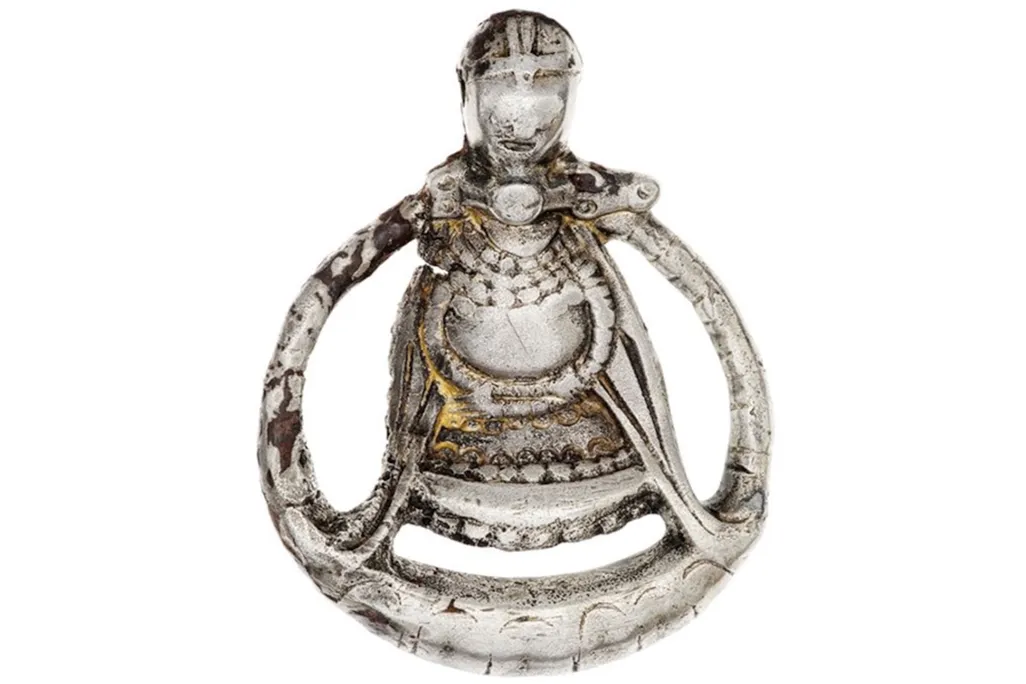
This story is linked to an artifact analyzed in the study: a figurine depicting a pregnant woman, arms encircling her belly, wearing “what appears to be a helmet with a nose guard,” Olley adds. Found in a tenth-century woman’s grave in the Swedish town of Aska, the object is the “only known convincing depiction of pregnancy from the Viking Age,” Eriksen writes in the Conversation. Per the study, Freydís’ story and the Aska figurine “tell us that a pregnant woman in arms was not an unthinkable concept for contemporary audiences.”
“Although we avoid falling into simplistic narratives of ‘pregnant warrior women,’ it is undeniable that, at least in art and stories, there were circulating ideas about pregnant figures associated with the martial,” says Olley, per La Brújula Verde’s Guillermo Carvajal. “These are not passive or pacified bodies.”
/https://tf-cmsv2-smithsonianmag-media.s3.amazonaws.com/filer_public/52/65/5265e1e8-6dfd-49a6-ae63-6e9e587c69de/photos_and_plans_of_potential_motherfetus_burials_ab_grave_294_and_228_kopparsvik_after_t.jpeg)
Finally, the researchers studied Viking graves containing mothers with infants. However, out of thousands of known burials, they identified only 14 mother-infant graves. Eriksen notes that this number is strangely low. While some women who presumably died in childbirth were buried with their infants, other newborns were found buried with adult men and older women.
“Indeed, infants are underrepresented in the Viking Age burial record overall,” says Eriksen in the statement. “Some infants crop up in other places, such as in domestic houses, but otherwise we’re not quite sure what is happening to the infants, or whether they were afforded burial in the same way as adults.”
Still, though few depictions of pregnancy from the Viking era survive, it was not an “invisible or private” phenomenon, Erikson writes in the Conversation. Instead, it was “crucial to how Viking societies understood life, social identities and power.”