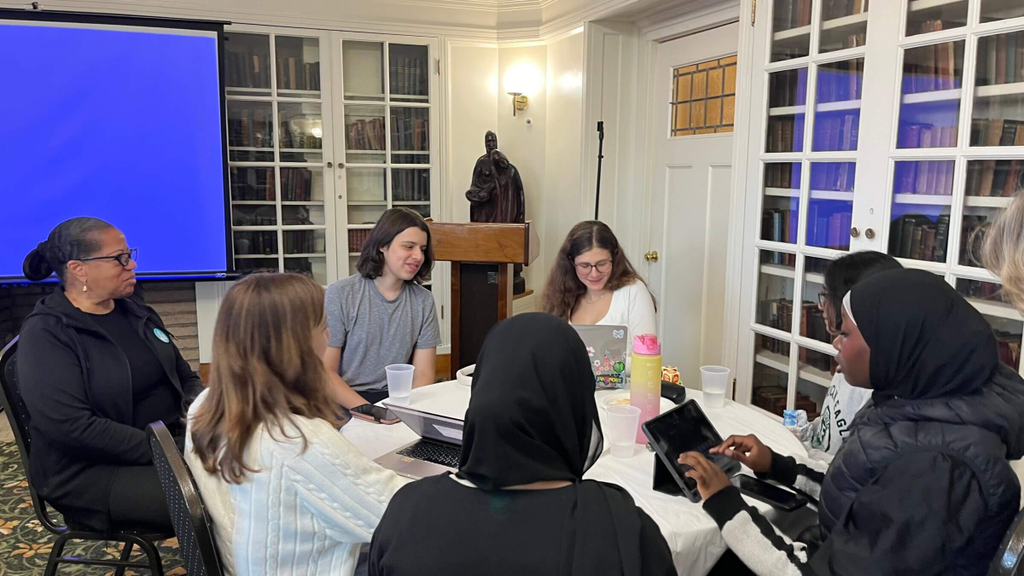
Post Oct. 7, New York City teens created The Together Project to foster dialogue about the Israel-Palestine conflict. Now, they’ve started a summer fellowship to broaden the community
Sarah Diaz July 31, 2026

For Jewish student Maxanne Wallace-Segall and Muslim student Nabila Rahman, the months after the Hamas-led Oct. 7 attacks on Israel were filled with a tense quiet.
Then freshmen at Stuyvesant High School, a public school on Manhattan’s southern tip, the two girls had only been friends for a few weeks. As their social media feeds became inundated with polarizing content from across the spectrum, neither of them knew how to bring up what had happened.
“I felt like I couldn’t talk about the war with one of my closest friends in the world, just because I was terrified about what I would say and what she would say,” Wallace-Segall said.
That tension ended when Wallace-Segall interviewed Rahman for an article in their high school paper about the pain many students were experiencing in the first months of the Israel Hamas War. Broaching the subject for the first time, they realized that — despite coming from different perspectives — both were primarily concerned that their friends were OK.
“It wasn’t a question of ‘do you support Israel or Palestine?’. It was a question of [if you were] OK; if your family was OK. That was what mattered at the moment; her opinion didn’t matter, even if it differed from mine,” Rahman told Wallace-Segall for the article.
Sorry to interrupt…
You can help keep the Forward free for the 1.5 million readers who visit our site monthly looking for trusted Jewish journalism.
Now rising high school seniors, the duo runs The Together Project, a citywide organization dedicated to dialogue between Muslim and Jewish teens — Zionists and anti-Zionists alike. This summer, that dialogue has deepened and the reach has widened with the launch of a twice-weekly program called the Ohel/Ahl Fellowship, named after Hebrew and Arabic words for friendship. Since June, Jewish and Muslim teens from public, private, religious, and secular schools in the New York area have come together around sacred texts, swapped stories, consulted experts and explored each other’s neighborhoods and perspectives.
Emboldened by their first conversation, Wallace-Segall and Rahman began speaking about the conflict with Muslim and Israeli friends. But, when starting the organization, those friends opted not to participate. The Muslim friend’s family refused to let them talk to people who supported Israel, while the Israeli friend wasn’t allowed to talk to anti-Zionists. The organization continues to face this challenge, with some criticizing its inclusive nature. On one Instagram reel posted by the project, a user commended the concept, but pointed out the number of Palestinian deaths and disagreed with participants working alongside Zionists.
“i was like yessss this is what we need!!” they wrote at first. “only for u to include zionists 💀absolutely not. none of you are truly anti-zionists if you agree to work closely with zionists, especially at this time.”
But that misses the point, Wallace-Segall said. “To exclude the Zionist narrative would be to exclude the issue itself.” That widespread opposition toward dialogue highlights “the necessity and urgency of starting it even more,” she added.
To expand citywide, the girls drew upon their previous connections — someone with whom Wallace-Segall often debated about the subject, another who had written poetry about her religious identity. Currently, the organization has branches at four public high schools in three of the city’s five boroughs.
The Together Project also established a partnership with the New York Society for Ethical Culture, a social activism organization that offers meeting space for several grassroots organizations and hosts all branches of the Together Project, and other interested students, for a citywide conference three times a year in winter, spring and summer.
At those seasonal meetings, students go over historical timelines, read books, articles, sacred texts, and poetry and push themselves to grapple with hard topics. The conversation subjects range from comparisons of the Torah and Quran to what Muslim and Jewish teachings say about queerness, and how being a member of the LGBTQ community informs support for Israel, given its comparatively tolerant culture, and support for Palestinians in Gaza, given the nature of their collective struggle.
Sign up for Forwarding the News
Get the Forward’s essential morning briefing bringing you trusted, nonpartisan news and analysis, curated by Senior Writer Benyamin Cohen.
Wallace-Segall’s favorite conversations are those that question “why do you believe what you believe?”
“It really gets everyone to think about the specific moments with their families and their friends and reading the news in which different aspects of their opinions have been shaped,” she said.
Last November, members of the group attended a United Nations conference on establishing a Middle East zone free of weapons of mass destruction. As she listened, Wallace-Segall was inspired by those “dedicating their lives to committing to peace.” At the end, four of The Together Project members were given the opportunity to speak about their organization and share their thoughts on the solutions that had been presented.
“So often in the UN, when we see discussions of rebuilding communities … it’s decades or years after the conflict happened,” Wallace-Segall said in her speech. “I think the time to start rebuilding communities is now.”
At Ramaz Upper School, a Jewish day school in Manhattan, now rising senior Gabriel Flatto-Katz found himself in a Jewish bubble. Amidst the tensions of the New York City mayoral election, he realized that he “didn’t have any Muslim person that I could call a friend,” and sought to start an interfaith student organization.
Despite reaching out to many Muslim organizations, however, he wasn’t able to find any interested partners. Then he discovered the Together Project and helped Wallace-Segall and Rahman develop this summer’s Ohel/Ahl Fellowship.
The fellowship has enabled students who were already involved, along with many new ones like Flatto-Katz, to engage more deeply with meetings twice a week. So far, the fellows have hosted speakers from the Rose Castle Foundation, which helps equip leaders to navigate conflict; explored the Islamic wing of the Metropolitan Museum of Art and analyzed poetry by Israeli and Palestinian writers.
Rather than jump right into sensitive political discussions, students explored each other’s religious identities and established trust in initial meetings, so they have felt more comfortable sharing sensitive opinions in the latter half of the fellowship.
According to Gershon Rozenberg, a rising senior at SAR High School, a co-ed modern Orthodox yeshiva in Manhattan, that turning point arrived during a recent discussion the students had about war. Participants shared conflicts that felt most personal to them and their families and how this might impact their thoughts on the Israeli-Palestinian conflict. Some mentioned the Vietnam War, the Bangladesh Civil War and the Holocaust.
Rozenberg called it “the most vulnerable conversation we’ve had among fellows.”
For Rahman, this conversation helped her realize just how personal the Israeli-Palestinian conflict is for Jews. “For people like Gabi who literally have family in Israel, there was so much more at stake,” said Rahman, who doesn’t know anyone who is Palestinian.
Along with speakers, the fellowship has a board of mentors from Jewish and Muslim organizations, including Rose Castle, the Tannenbaum Foundation, Jewish Theological Seminary, and a Palestinian representative from Debate for Peace.
“We’re still kids running a kids’ program,” Flatto-Katz said. Mentors provide necessary guidance on how to run an interfaith organization, advise on ground rules during sessions and recommend texts to study. To build a consistent base of students at each meeting, mentors also have helped recruit teenagers they had worked with previously.
Flatto-Katz recruited Rozenberg after reading Rozenberg’s piece in SAR’s campus newspaper arguing that the school “should do a better job of understanding the Palestinian perspective.”
To complement the students from private Jewish day schools, leaders have been reaching out to private Muslim schools. But they’ve encountered difficulty.
“A lot of the kids have never met a Jewish person before, so it’s hard for them to make that first step,” Rahman said.
Many of the students from private Jewish schools say they have been moved by the contributions of Muslim participants, including rituals like chanting from the Qur’an or talking about their religion. “People have enjoyed the ability to hear something so different than what they’re used to,” Flatto-Katz said.
Within Jewish youth spaces, Flatto-Katz said students strongly support Zionism, but also crave hearing new perspectives. It’s not always easy for Flatto-Katz to “have really hard conversations,” as he has family in the region, but he senses and shares a “hunger for understanding.” Agreement or consensus is not required, he said.
“This is my friend Nabila who doesn’t agree with me on 99% of things, and I think it’s really cool that we get frozen yogurt together,” Flatto-Katz said.
To Rahman, the diversity of high school environments and the formative teenage years are what makes the work they are doing now so significant.
“Making sure younger people are involved in this kind of things is so important,” she said, “because they are the ones who are going to be shaping the future.”