
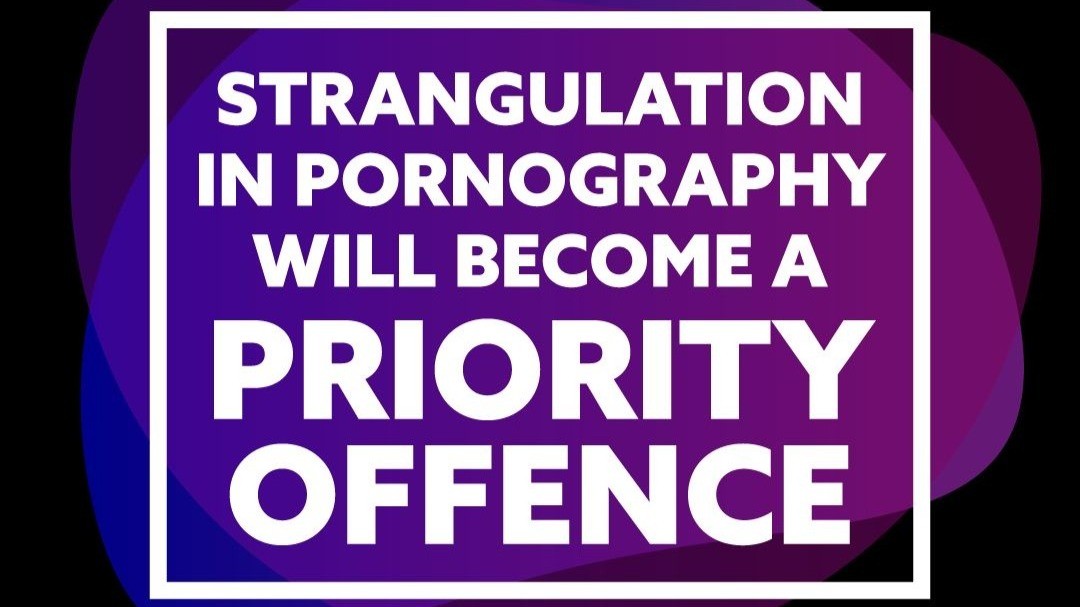
This week, the UK Government announced important measures to better protect women and girls across the country.
Key changes include:
- Pornography featuring sexual strangulation or suffocation will now be explicitly criminalised.
- Survivors of intimate image abuse will have up to three years to report incidents, instead of just six months.
- Online platforms will face new duties under the Online Safety Act to prevent harmful sexual content from spreading.
These are significant steps, and we commend the Ministry of Justice, the Department for Science, Innovation and Technology and all involved for taking action to protect women and girls… but what do they actually mean for women and girls across the UK, and for all of us?
For the first time, sexual strangulation in pornography is being recognised for what it is: violence, not “fantasy.”
And in addition, survivors of intimate image abuse now have three years to report incidents, instead of just six months. That means stronger protections against abuse, recognition that online harms have real-world consequences, and the chance for survivors to seek justice without being constrained by arbitrary deadlines.
This new timeframe gives survivors space to process what’s happened, reach out for support, and act when they’re ready. But to truly protect women and girls, we must also stop harmful sexual content from spreading — and hold platforms accountable for the harm they host.
These changes aren’t just legal technicalities. They mean stronger protections against abuse and the acknowledgement that online harms have real-world consequences.
We welcome these reforms as a vital recognition of something we’ve been saying for years: violent sexual content online is not entertainment — it is abuse.
Ok, that all sounds good, but why is criminalising sexual strangulation in pornography such a big deal? and why should we care?
Sexual strangulation is not rare or ‘fringe’ – it is mainstream, fuelled in by online pornography. What was once uncommon is now regularly normalised on high-traffic pornography platforms, often presented as desirable or expected. This normalisation has crossed from online content into real-life sexual behaviour.
You might be thinking – “This doesn’t affect me.” But the reality is closer than you think:
- In one US study, over 50% of women surveyed reported being strangled during sex – often non-consensually, sometimes by men they had just met.
- Another study found that 27% of female students had been choked during their last sexual encounter.
- Research shows that nearly two in three young women experience sexual strangulation during sex, with 40% of these incidents occurring before the age of 18.
And the scale of the problem is growing. In 1996, two women a year were killed or seriously injured in what defendants described as “sex games gone wrong.” By 2016, that number had risen tenfold to 20 women per year. Studies also show that more than half of women subjected to domestic abuse have been strangled, and up to one in five women who have been sexually assaulted report strangulation.
This is not just an abstract danger – it affects people we know. Violent pornography fuels aggressive behaviour, shaping sexual expectations and putting women and girls at serious risk. Medical experts report that strangulation is the second most common cause of stroke in women under 40.
The impact is devastating.
Strangulation isn’t a “kink” or something that can be done safely – that’s a dangerous myth. Research from Bangor University and the North Wales Brain Injury Service shows that even brief strangulation can cause cardiac arrest, stroke, miscarriage, seizures, paralysis, speech disorders, and long-term brain injury. As one of the study’s authors warns, this research “synthesises the medical evidence in its terrifying and convincing entirety.” Even when someone survives, the psychological and neurological consequences can be profound, including impact on mental health, PTSD and in some cases, death. There is simply no safe way to strangle.
Our Profits Before People report found that pornography platforms have normalised strangulation, showing it in mainstream, high-traffic videos and often presenting it as desirable or expected. Some education materials have even suggested strangulation is acceptable if consented to – a notion experts rightly call “atrocious” and “the opposite of safeguarding.”
This is what normalisation looks like. The line between “online” and “offline” no longer exists. When platforms profit from pain, that pain shows up in real lives.
Even for those who haven’t been directly affected, the risks extend to the next generation. Reports show that schoolchildren as young as 11 are asking teachers how to “strangle a partner safely,” often without parents’ knowledge. Early exposure to violent sexual content puts children at real risk and highlights the urgent need for safeguarding and prevention.
Violent pornography is fuelling these behaviours, turning harm into a sexual script. Shaping relationships, expectations, and what young people believe is “normal” in sex.
So, we should care, because this matters – it matters to you, it matters to us, it matters to every woman and girl we care about. Only by recognising the scale of the harm, challenging the culture that normalises it, and standing together can we prevent sexual violence and exploitation and make the UK a safer place for everyone.
Alright then, so, how do we make sure these laws actually work?
That’s the real test, isn’t it.
The new laws send a strong message – but they’re only as effective as their enforcement.
Tech platforms have a long history of promising change without delivering it. They must now be proactively responsible, not just reactive when harm occurs.
Questions remain:
- Will companies actually prevent violent content from spreading – or simply rebrand it to evade detection?
- Will regulators have the teeth to enforce strict rules when platforms fail?
- And will survivors finally see justice beyond words on paper?
Without strong oversight and strict enforcement of penalties, violent online pornography could continue to circulate – and continue to cause real-world harm.
So … What’s next?
This is progress – a long-overdue recognition that violent sexual content online causes real-world consequences and harm offline. But it’s only the beginning.
As Dr Elly Hanson, our Strategic Director, explains:
“This is one step of many we need to take to build a culture free from porn-fuelled abuse. I am hopeful that this criminal offence is the first of a number that the Government will bring in to achieve ‘offline-online parity’ in pornography regulation – what is already effectively illegal offline must be made illegal online.”
The key takeaway? Passing a law is just the start.
Real change happens when the rules are strictly enforced, and platforms that fail to comply are held accountable.
Here’s what we want to see next:
- Rigorous enforcement – ensuring platforms cannot profit from violent sexual content without consequence.
- Offline-online parity – what’s illegal in the real world must be illegal online too.
- Cultural shift – stopping the normalisation of sexual violence and creating online spaces where women and girls are genuinely safe.
This isn’t just about legislation. It’s about creating accountability and changing culture, so protections reach the people they’re meant to protect.
We’ve talked about it… We’ve laid it all out – now, what do you think?
We’ve shared why these new laws are such a big step forward, and why protecting women and girls from sexual harm online and offline matters so much. Now, we want to hear from you.
What do you think about these changes?
Do you feel they go far enough to protect survivors and challenge harmful sexual content online?
How do you see this affecting real-life behaviours and culture?
And remember, creating laws is just the first step – enforcement is crucial. We’ll be keeping a close eye on how these laws are applied, and whether platforms are doing their part to prevent harm.
Share your thoughts in the comments – your voice matters, and together we can keep the conversation going, hold the system accountable, and push for a safer online world.
Source: https://www.linkedin.com/pulse/lets-talk-new-laws-sexual-strangulation-pornography-ceaseuk-kstpf/?trackingId=vD%2F2i1E3QB%2BdKkUA3z76Ug%3D%3D