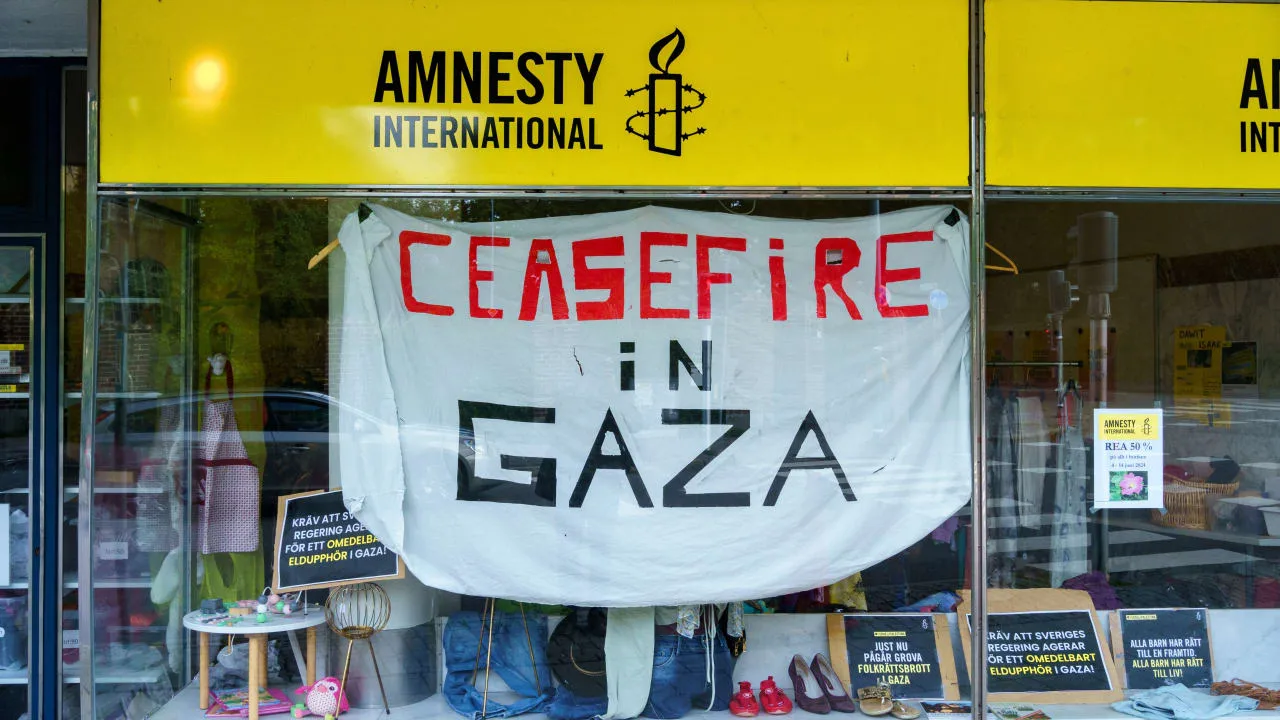
Amnesty International released a report accusing Hamas of crimes against humanity, including murder and torture, for the October 7th massacre and the treatment of the hostages taken
Updated: DECEMBER 11, 2025 18:13
After two years, Amnesty International has concluded for the first time that Hamas and other Palestinian armed groups committed war crimes and crimes against humanity, including murder and torture on and after October 7, 2023.
Amnesty’s unequivocal condemnation of Hamas’s crimes against humanity is striking considering its historical reticence to outright condemn Palestinian actors. This 173-page report applies the ICC’s Article 7 criteria and concludes Hamas leadership intended to attack civilians.
Based on video, testimonial and other evidence, Amnesty International found that, while some civilians were killed by Israeli forces on October 7, the vast majority of those who died were killed by Palestinian fighters. Amnesty also said it considers that all those taken to Gaza were “unlawfully detained as hostages and that all were subjected to psychological abuse.”
However, while it admitted there is documented evidence of sexual violence, “it could not reach conclusions on the scope or scale of the sexual violence.” Amnesty also said it found no evidence that Hamas or other Palestinian armed groups gave orders to their fighters to commit acts of sexual violence during the attacks. Nevertheless, the admission that Hamas and other groups committed rape, gang rape, sexual assault, sexual violence stands out, given Amnesty’s relative silence on the matter over the last two years.
Amnesty also noted that multiple parties participated in the atrocities on October 7, including Al-Qassam Brigades, the Al-Quds Brigades, and the Al-Aqsa Martyrs’ Brigades, as well as hundreds of Palestinians in civilian clothing. The explicit naming of the actors involved differs from Amnesty’s previous comments.

Hamas’s Izzadin al-Qassam Brigades ‘chiefly responsible’ for massacre, Amnesty Intl. finds
The report placed the blame for the massacre “primarily” on Hamas’s so-called military wing, the Izzadin al-Qassam Brigades, accusing them of being “chiefly responsible.”
Amnesty did however condemn Israel for its alleged refusal to cooperate with the investigation, including blocking access to sites, victims, medical professionals, and evidence. It also noted that the reluctance of many survivors and witnesses to speak to Amnesty International researchers and the limited forensic evidence collected by Israeli authorities impacted the success of the investigation. However, Amnesty said it still managed to collect a large amount of evidence that informed its analysis.
Amnesty calls on Hamas to investigate serious violations of international humanitarian law, including crimes under international law, committed by their forces during the 7 October 2023 attacks and since, including with respect to hostages. It also asks Hamas to identify and remove from their ranks anyone suspected of involvement in such violations and crimes, and to publicly acknowledge and denounce the serious violations of international humanitarian law.
Amnesty asks Israel to “end violations of international law against Palestinians in the OPT and Palestinian citizens of Israel and take concrete steps towards ensuring justice and accountability for violations and crimes committed by Israeli forces, including genocide and apartheid.”
Differences with the UN findings
In contrast to the UN’s Report on the 7 October attacks and their aftermath (June 2024), Amnesty’s report is much more explicit when it comes to sexual violence committed by Hamas. For example, it concludes that Hamas used sexual violence against hostages in captivity, and that sexual violence including rape and gang rape were perpetrated on October 7. While the UN reports have acknowledged possible cases of sexual violence on October 7, it has not concluded it to be widespread or systematic.
Additionally, Amnesty explicitly stated that Hamas committed crimes against humanity, whereas the UN said that some of Hamas’s actions may have amounted to crimes against humanity.
Amnesty also uses video evidence, insignia, weapons identification, and Hamas’s own media to attribute actions on and after October 7 to Hamas, whereas the UN often more vaguely attributes actions to “armed Palestinian groups.”
Lastly, Amnesty concluded that Hamas intentionally targeted civilians in a coordinated, multi-location attack, and rejected Hamas’s claim that civilians were killed by “rogue civilians.” The UN report said some of the killings were “Indiscriminate” and it was “not always possible to determine intent.”
Source: https://www.jpost.com/international/article-879982?utm_source=jpost.app.apple&utm_medium=share