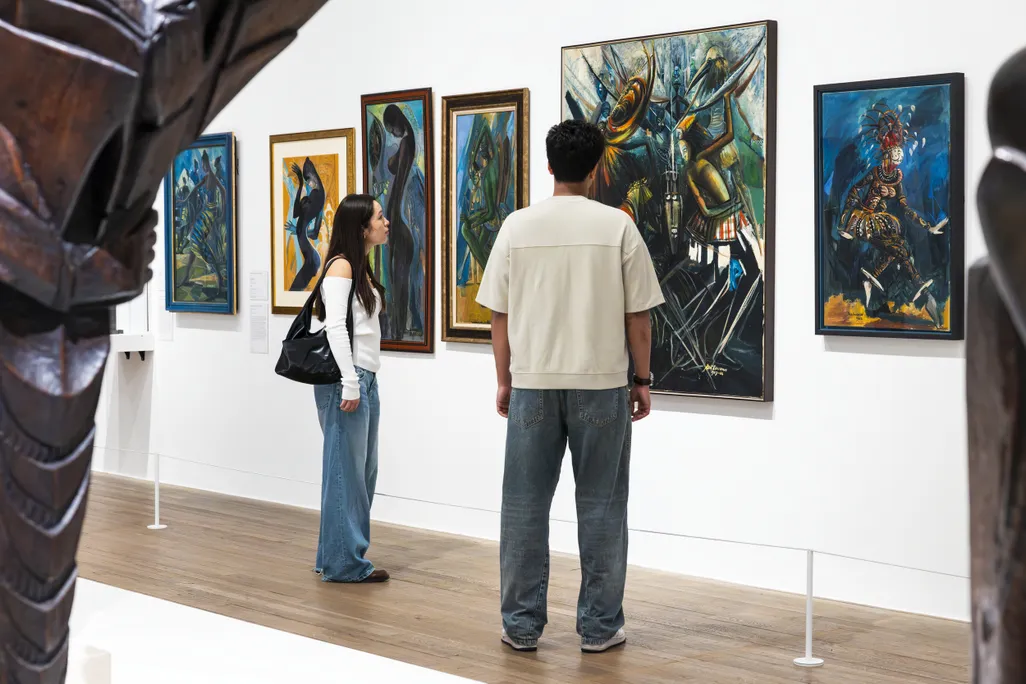
“Nigerian Modernism,” a new exhibition at the Tate Modern, celebrates 50-plus artists spanning more than half a century
Mary Randolph – Staff ContributorOctober 9, 2025 2:26 p.m.
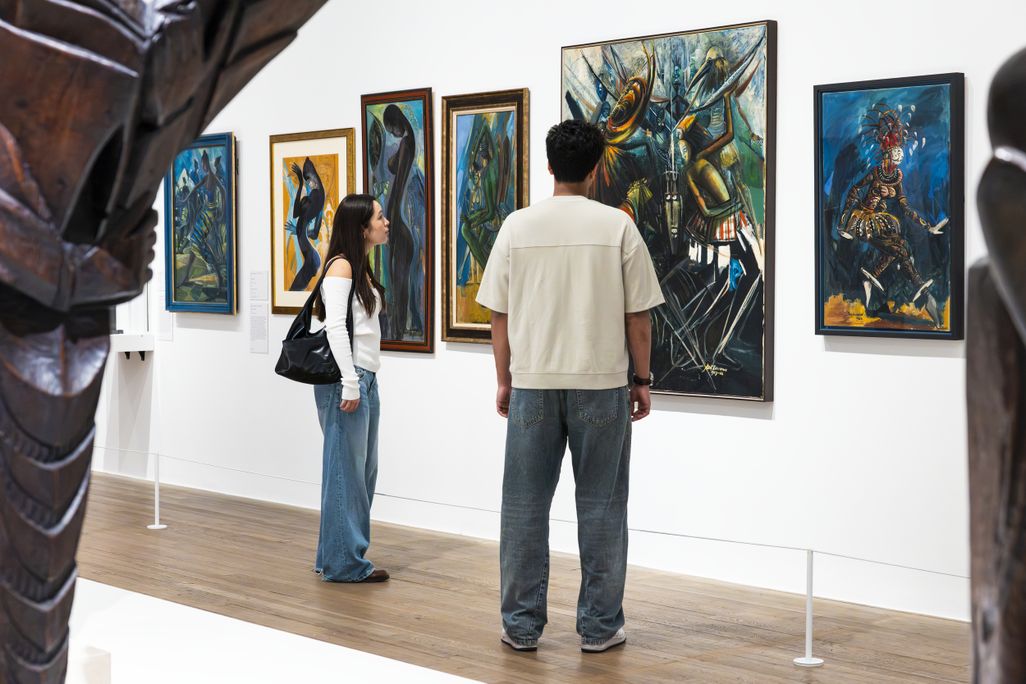
In the years leading up to and following Nigeria’s declaration of independence from England in 1960, colonialism, civil war and long-sought sovereignty fueled artistic innovation. Now, for the first time, the United Kingdom is spotlighting this cultural period of its former colony.
“Nigerian Modernism,” an exhibition of more than 250 Nigerian works spanning from 1940 to 1990, went on display Wednesday at the Tate Modern in London.
Osei Bonsu, the exhibition’s curator, chose to showcase more than 50 artists across a range of mediums in hopes of reflecting the “many facets of artistic expression” in this era, he tells Christie’s.
“The output of these figures was quite diverse, but the common thread running through the exhibition is of artists synthesizing different influences to generate a bold new language for art in Nigeria,” he says.
Among the artists on display are Uzo Egonu, Ladi Kwali and El Anatsui, all of whom created work before, during and after the Nigerian independence movement. The earliest works in the exhibition are from the 1940s, as Nigerians called for decolonization from England. Then, others span through the country’s independence in 1960, its civil war at the end of that decade, and its development of a national identity throughout the 1970s, ’80s and ’90s.
Several of the artists featured in the exhibition spent time outside of Nigeria, and some gained global accolades at the time, including sculptor and painter Ben Enwonwu, who studied in London and was commissioned for a sculpture of Queen Elizabeth II in 1957.
/https://tf-cmsv2-smithsonianmag-media.s3.amazonaws.com/filer_public/27/0f/270fcb95-bd76-492a-841a-e305ebd34d4a/1_ben_enwonwu_the_dancer_agbogho_mmuo_-_maiden_spirit_mask_1962__ben_enwonwu_foundation_c.jpg)
Enwonwu remained connected to his Nigerian roots, however, and prioritized them in his work, Sylvester Okwunodu Ogbechie, professor at the University of California, Santa Barbara, and Enwonwu’s biographer, tells CNN’s Suyin Haynes.
“He foregrounded African cultural registers in his work,” Ogbechie says. “He was very insistent on the fact that if Monet could paint church facades and hay bales and water lilies and be considered a modern artist, there was no reason why he couldn’t paint masquerades and African market scenes and have them received in the same manner.”
Bruce Onobrakpeya is a painter and sculptor whose work is also on display in the exhibition. He was a member of the Zaria Art Society in the 1960s, a radical group of artists formed after Nigeria declared independence. Onobrakpeya describes Nigerian Modernism to BBC’s Wedaeli Chibelushi as “a transfer of the old ideas, old items, old technologies, old thought into a different, modern time.”
/https://tf-cmsv2-smithsonianmag-media.s3.amazonaws.com/filer_public/96/6c/966ce68a-2444-4325-9cf8-c4b3ebd21284/6_bruce_onobrakpeya_the_last_supper_1981__reserved_tate.jpeg)
Onobrakpeya, 93, visited the gallery to see his and his peers’ work. “[The exhibit is] one of the greatest things to have happened, not only to my art, but to Nigerian artwork,” he tells BBC.
Bonsu hopes the exhibition will help center African art and stories in broader global histories. He also, however, cautions against viewing Nigerian Modernism as reflections of a more general African artistic identity.
“The artists in Nigeria can—and, in my view, should—be located within specifically local traditions and networks,” he tells Christie’s. “They made work at the country’s distinctively fraught intersection of colonialism and modernity, work [that ought] to be understood on its own terms.”
Onobrakpeya, whose career has spanned over 70 years, tells BBC the exhibition is not only a celebration of the past but an inspiration for future Nigerian artists.
“It comes with a message that we can take home,” Onobrakpeya says. “It gives us hope, it gives us strength, and we’re going to work harder and we’re going to produce something even greater than this.”