Lead exposure may have spelled evolutionary success for humans—and extinction for our ancient cousins—but other scientists are casting doubt on the headline-making study
Sara Hashemi – Daily CorrespondentOctober 17, 2025
When you think of lead exposure, you might think of old pipes or paint on antique dishes. But a new study suggests that our relationship with lead goes way back—by almost two million years.
Lead exposure may have played a role in human evolution, a new study suggests. The research hints at an evolutionary advantage that helped humans outcompete their ancient counterparts: Lead-protective genes.
Over the centuries, humans developed a gene that makes the body more resilient to lead, which in turn enabled better communication that gave them an evolutionary advantage over Neanderthals and other human cousins, the study suggests. The findings were published in the journal Science Advances October 15.
Key takeaway: Lead is a silent pollutant
Even small amounts of lead exposure can harm humans, research shows. However, lead poisoning doesn’t have visible symptoms, so blood lead testing is the only reliable way to determine whether a person has been exposed to lead, according to the Centers for Disease Control and Prevention.
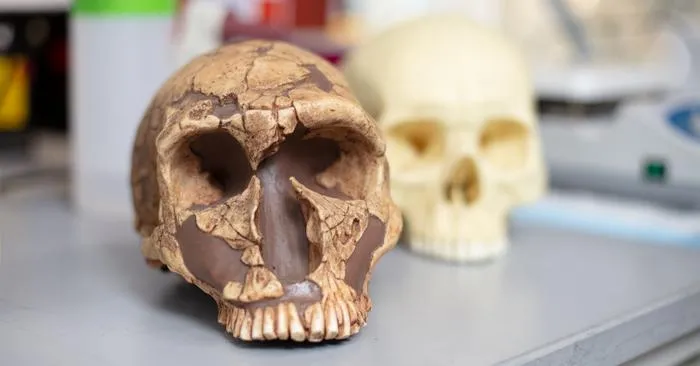
An international team of researchers analyzed 51 fossilized teeth from Homo sapiens and Neanderthals, as well as ancient great apes and monkeys. These specimens were recovered from Africa, Asia, and Europe and were up to two million years old.
Using ultra-fine lasers in a technique called high-precision laser-ablation geochemistry, they scanned each layer of the teeth. The analysis showed evidence of lead exposure in 73 percent of samples. Lead was present in multiple layers of teeth, suggesting the exposure happened over time. Unlike today’s industrial polluters, the ancient exposure likely came from natural sources like soil, volcanic dust and water contamination.
Renaud Joannes-Boyau, a geochemist at Southern Cross University in Australia, tells James Woodford at the New Scientist he was especially surprised by the amount of lead in Gigantopithecus blacki, a giant extinct ape that lived in what is now China until about 300,000 years ago.
“If it was a modern human that had this amount of lead in their body, then I would say this person was facing high exposure from industry or anthropogenic [manmade] activities,” Joannes-Boyau, the study’s lead author, adds.
The researchers next examined how lead exposure may have impacted brain evolution. They created two sets of brain organoids—small lab-grown tissues that mimic the human brain. One set had the modern gene NOVA1, which plays an important role in both neural development and the body’s response to lead. The other had an extinct variant of NOVA1 found in Neanderthals and other human ancestors.
The researchers exposed both versions of the organoids to “very small, realistic amounts of lead that ancient humans might have encountered naturally,” explains study co-author Alysson Muotri, a neuroscientist at the University of California San Diego to Michael Price at Science. When they compared neuron development in both brain organoids, they found that the organoid with the modern gene could tolerate lead exposure much better than the ancient one.
Lead exposure also disrupted a gene linked to language complexity and speech development in those with the ancient NOVA1variant. But it didn’t seem to affect those with the modern variant—even though the ancient and modern NOVA1genes varied by just one base pair of DNA.
The more lead-resilient modern humans could engage in more sophisticated communication, giving them an evolutionary advantage over Neanderthals, Denisovans and others who weren’t as resilient to environmental lead exposure, the researchers hypothesize. Better communication meant “social cohesion and survival” for humans, they conclude—and extinction for their ancient counterparts.
/https://tf-cmsv2-smithsonianmag-media.s3.amazonaws.com/filer_public/c3/f4/c3f46569-7101-4b4d-af8d-a5f0dece8917/low-res_illustration_of_organoids_to_test_the_influence_of_lead_exposure_to_modern_and_archaic.jpg)
“It’s bold. It’s a creative hypothesis,” Shara Bailey, a biological anthropologist at New York University who specializes in ancient teeth, tells Science. Bailey says the analysis does not definitively show lead exposure during ancient hominins’ early childhood, when it would have had the strongest impact on brain development. “At this stage, the evidence doesn’t really convince me,” she tells the outlet.
Tanya Smith, an evolutionary biologist at Griffith University who also specializes in ancient teeth, echoes that skepticism. “This is a really complex paper that makes some highly speculative claims,” she tells the New Scientist. While the fact that ancient humans and primates were exposed to lead is not surprise given previous research on this topic, Smith adds, “the limited distribution, number and type of fossils included simply does not demonstrate that human ancestors were consistently exposed to lead over two million years.”
It will take more research to show if and how lead exposure affected the course of human evolution, the researchers write. But the hypothesis may explain how environmental stressors like lead caused humans to eventually outcompete their ancient cousins, Muotri says in a statement.
“Language is such an important advantage, it’s transformational, it is our superpower,” Muotri adds. “Because we have language, we are able to organize society and exchange ideas, allowing us to coordinate large movements. There is no evidence that Neanderthals could do that.”