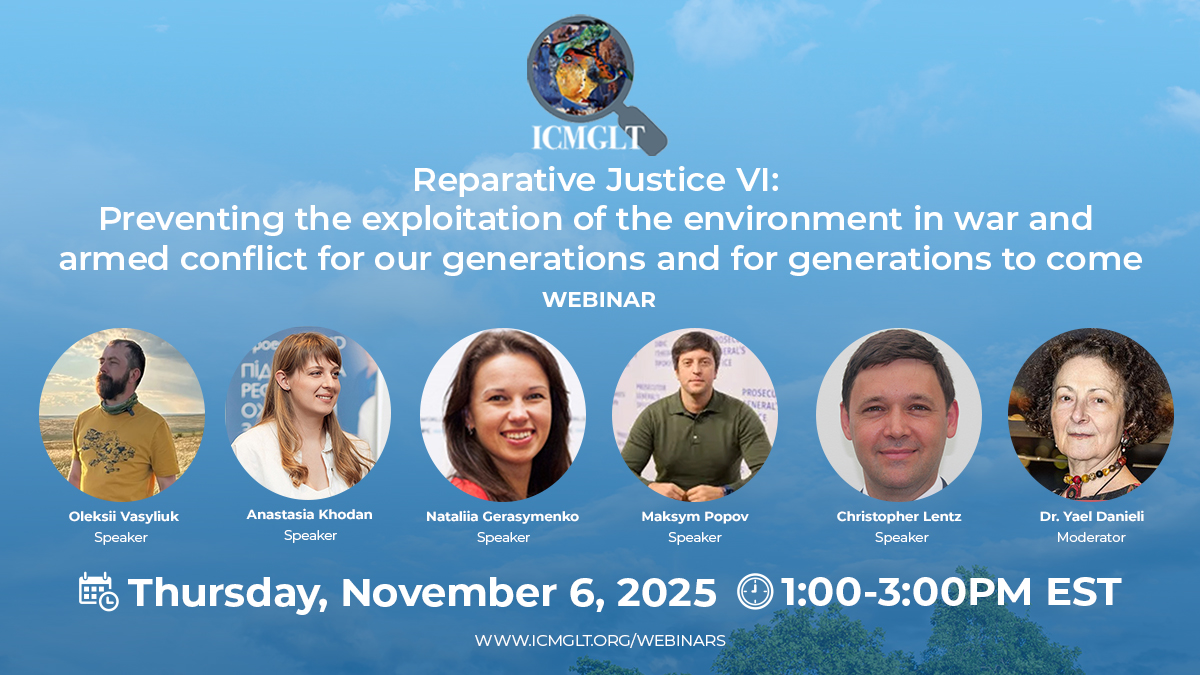
Thursday, November 06, 2025, 1:00–3:00 PM EST / 10:00 AM–12:00 PM PST / 11:00 AM–1:00 PM MST / 12:00–2:00 PM CST / 6:00–8:00 PM GMT / 7:00–9:00 PM CET, CAT & CMT / 8:00–10:00 PM EET
Held on the International Day for Preventing the Exploitation of the Environment in War and Armed Conflict, today’s International Center for MultiGenerational Legacies of Trauma (ICMGLT) webinar aims at raising awareness about the critical intersection of environmental protection and armed conflict, focusing specifically on the devastating consequences of the war in Ukraine. As our national and international experts would discuss, war and armed conflict have numerous damaging effects on the physical, natural and human environment. Environmental damage in times of armed conflict impairs ecosystems and natural resources long after the period of conflict. The damage often extends beyond the limits of national territories and today’s generation. New technologies used for war mean that the destruction and damage of the environment are more serious and their long-term and multigenerational consequences would be worse.
Continuing ICMGLT’s webinar series on Reparative Justice, today’s webinar follows Reparative Justice I: a conceptual introduction to reparative justice, II. key groups of traumatized victims, III. Difficulties in listening and hearing traumatized victim/survivors/witnesses, IV: Challenges in engaging, interviewing and supporting child victims of war and terror, and Reparative Justice V: Challenges in Engaging, Interviewing and Supporting Victims/Survivors/Witnesses of Torture, all answering the call for specialized training in reparative justice for professionals and others working with them. Participants are urged to view the four earlier webinars of this series prior to attending this one.
Ukrainian-English interpretation will be provided
English:
Ukrainian:
Speakers:
Oleksii Vasyliuk
Oleksii Vasyliuk is a Ukrainian environmentalist specializing in protected areas and biodiversity conservation. He graduated from Taras Shevchenko University of Kyiv with a zoology degree. Since 2004, Oleksii has served in the Animal Monitoring and Conservation program at the Institute of Zoology (Ukrainian National Academy of Sciences). He is the author of over 700 publications, dedicated to environmental protection. He is the initiator of the creation of over 60 new nature conservation areas.
Anastasia Khodan
Co-founder and family physician at Svoyi.ridni, member of NGO Academy of family medicine of Ukraine. Anastasia graduated from the Danylo Halytsky Lviv National Medical University and specialized in family medicine and healthcare organization and management. From January 2020 until December 2021 she served as Coordinator of the Mental Health for Ukraine Project. Anastasia is a national master-trainer in mental health (MhGap program).

Nataliia Gerasymenko
A Senior Expert at GRID-Arendal, Nataliia Gerasymenko specializes in advancing the environmental dimensions of conflict, disaster risk and food security. Nataliia’s work aims to strengthen environmental resilience and governance through collaboration with international partners and science-based solutions. She has extensive experience working in international United Nations programs, including Food and Agricultural Organization (FAO) and International Financial Corporation (IFC) and was highly involved in analytical work and preparing reports and recommendations.
Maksym Popov
An attorney at law, human rights defender and environmental justice expert in accountability for wartime environmental damage, Maksym was advisor to the Prosecutor General of Ukraine (October 2022 – April 2025), leading efforts to prosecute ecocide and environmental war crimes resulting from the Russian aggression against Ukraine. His work has included law enforcement in conservation and protected areas, promoting citizens’ and NGOs’ right to access information and justice in environmental matters.
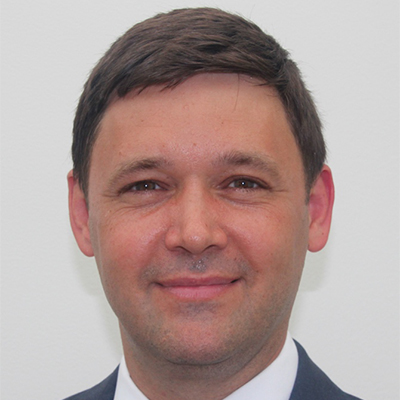
Christopher Lentz
A Legal Advisor in the Register of Damage for Ukraine and Lecturer in Law at the University of Chicago Law School, Christopher previously served at the International Criminal Tribunals for Rwanda and for the former Yugoslavia, Special Tribunal for Lebanon, and International Residual Mechanism for Criminal Tribunals. He holds a Doctor of Law degree and is an active member of the International Union for Conservation of Nature’s World Commission on Environmental Law.
Moderator:
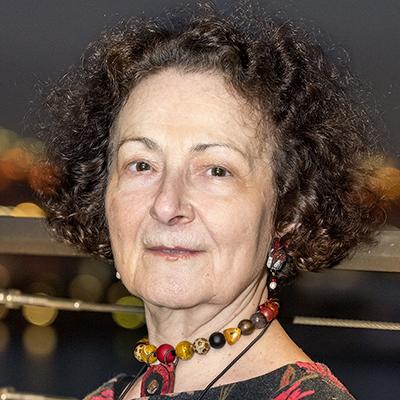
Dr. Yael Danieli
A Clinical psychologist, traumatologist, victimologist and psychohistorian, Dr. Danieli is Founder, Executive Director and Senior Representative to the United Nations of the International Center for MultiGenerational Legacies of Trauma (ICMGLT); Director, Group Project for Holocaust Survivors and their Children and Past-President, International Society for Traumatic Stress Studies.