On the eve of World War II, in 1939, one of Romania’s leading historians, George Potra, published a book titled “Contribuțiuni la istoricul țiganilor din România”(Contribution to the History of the Gypsies in Romania), in which he asserted:
“Throughout all times, there have been stronger people and weaker ones, regardless of whether the strength of the powerful lay in the size of their fists, the agility of their limbs, the number or perfection of their weapons, or the accumulation of wealth. There has always been one who commands and one who obeys. The Gypsies have belonged to the category of the weak, and since they have been known in history, they have never enjoyed even a minimally humane condition. Their ancestors from India belonged to that class of wretched people – the pariahs; their more recent ancestors were slaves, and although today they may no longer be slaves, they are still not treated equally with the inhabitants of the countries in which they live.”
Potra’s work reflects the dominant European views on Roma origins at the time, shaped largely by British colonial and orientalist narratives that portrayed Gypsies as descendants of Indian “pariahs”, drawing solely on the linguistic connection between the Romani language and the languages of India. The “pariahs” were imagined in Europe as subjugated outcast people within a racialized framework, constructed by colonial scholarship on the basis of the “Aryan invasion theory”. This theory posited that fair-skinned invaders from the North conquered the darker-skinned indigenous people of India, sized their lands, and subordinated them through the caste system, from which “pariahs” were excluded due to the ritually impure professions they were forced to practice. The Aryan invasion theory, though widely discredited today, onceserved to legitimize British colonial rule as a continuation of a civilizing mission in India. At the same time, however, it influenced the perceptions of the Gypsies within Europe – as an inherently defeated and displaced Asian people, stripped of land and history, and cast into a state of perpetual exile. Seen from European perspective these were strangers deserving their own lot and doomed to disappear.
Narratives describing Roma as “European pariahs” influenced early Gypsology in Britain and Nazi racial theories in Germany yet remain largely unchallenged even in our days
The book of George Potra demonstrates how Western academic and ideological frameworks were interpreted through the lens of Eastern European racism, reinforcing the notion of oppression as an “inherited” and thus legitimized condition of Roma people who had endured five centuries of enslavement in the Romanian principalities Wallachia and Moldavia (between 14th and 19th century). As Potra starkly summarized:
“From the Pariahs, the Gypsies inherited the gaze of a beaten dog, the resignation of a slave, and the absence of that final trace of dignity.”
Eighty-six years after the publication of this book, the Roma people have not disappeared from Europe. On the contrary, their absolute numbers have grown significantly, especially in countries like Romania, Bulgaria, Hungary, and Spain, but so too have the threats they face. In this regard, a coalition of Roma civil society organizations from Europe and the Americas – the Global Roma Alliance for Strategic Security – sent a letter to European Council President António Costa and European Commission President Ursula von der Leyen, warning that
While the Roma population in Europe is growing, their collective security is increasingly under threat
The letter emphasized that not only ordinary Roma citizens, but even former Roma Members of the European Parliament, such as Viktoria Mohácsi from Hungary and Peter Polak from Slovakia, have faced threats and intimidation in their home countries (in Mohácsi’s case, the severity of these threats led her to seek asylum in Canada). In this context, the letter criticized the exclusion of Roma from the EU’s newly adopted internal security strategy, which explicitly includes Jewish and Muslim communities but fails to address the protection of Europe’s largest traditional minority. According to the ProtectEU Strategy:
“Given manifest vulnerabilities, the EU Strategy on combating antisemitism and fostering Jewish life (2021-2030) will continue guiding Commission’s actions on protecting the Jewish community. The Commission will equally ensure that appropriate tools are in place to support Member States in combatting anti-Muslim hatred.”
The implication is haunting: eighty years after the end of the World War II and the Holocaust, 12 million Roma remain the outcasts of Europe – unseen, unprotected, and politically expendable. As if the promise of “Never Again” was never meant for Europe’s Roma.
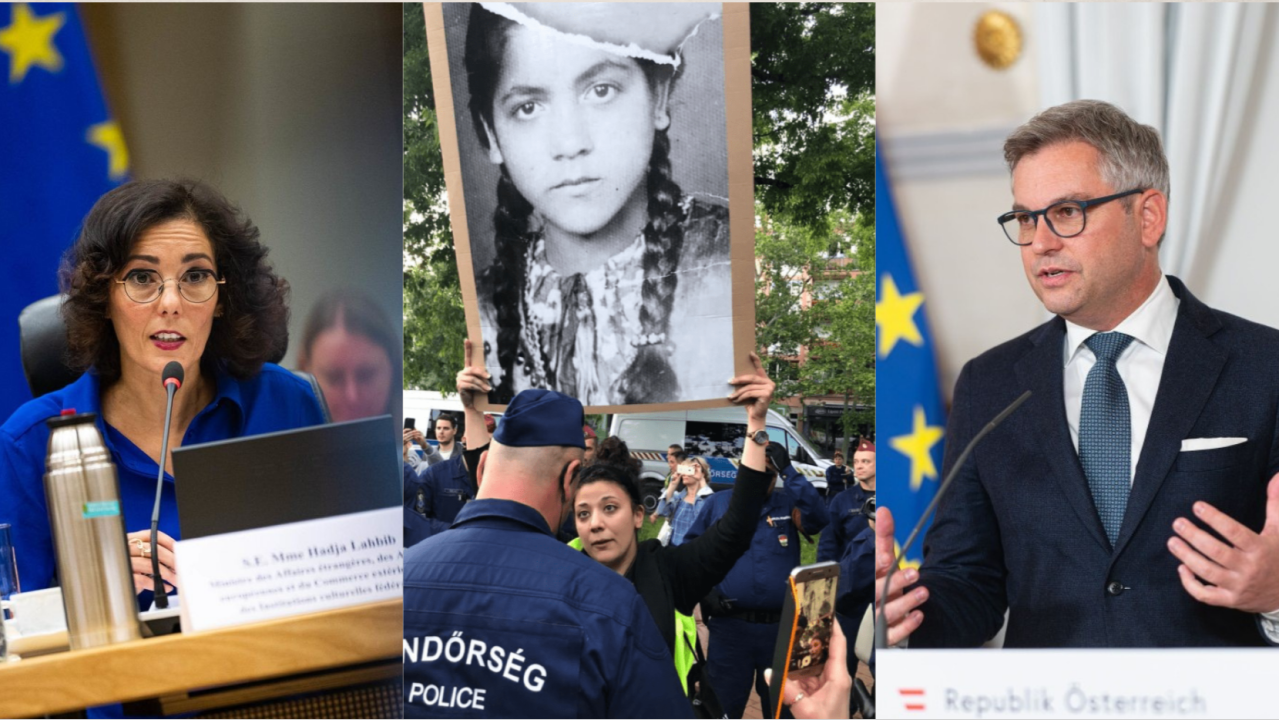
In response, on 8 September 2025, Commissioners Hadja Lahbib and Magnus Brunner acknowledged in a joint letter that Roma security is a “priority concern” for the European Commission
This recognition may signal a fundamental shift in how European institutions perceive and engage with Roma-related issues – especially since the term “Roma security” has, until now, been notably absent from EU strategic documents and public statements. Below is an excerpt from the letter:
“We would like to reassure you that the security of the European Roma is a priority concern for the European Commission… We hope that through the effective implementation of the ProtectEU Internal Security Strategy and the EU Roma Strategic Framework for Equality, Inclusion and Participation 2020–2030, as well as through the development of both the EU Agenda for preventing and countering terrorism and violent extremism and the Anti-racism strategy, to which you are welcome to contribute, we will be able to help tackle the security challenges affecting the European Roma community.”
For the first time, Roma are being recognized not simply as targets of social integration in schools and the labour market, but as a community whose security demands institutional protection
Whether the Commission’s commitment to Roma security will translate into concrete actions depends also on the persistence and strategic engagement of Roma organizations and Roma political parties across Europe. It is true that the EU is currently grappling with multiple urgent crises – including the wars in Ukraine and Gaza, economic instability, and climate challenges – which risk sidelining minority issues, as became evident in President von der Leyen’s recent State of the Union address. In such a critical situation, passivity and silence will not be rewarded. Remaining invisible in political debates, despite being the most numerous and visibly present minority in every European country, is both unwise and dangerous. The Roma are now the elephant in the room. They need to adjust their political behaviour in line with their own demographic potential.
By acknowledging Roma security as a legitimate concern, the Commission opens new pathways toward the emancipation of Roma from their historically imposed “pariah status” among the nations
For centuries, Roma have been treated as outsiders, deemed inferior and unworthy of protection. The wars in Yugoslavia and Ukraine made this painfully clear, as Roma communities were repeatedly left behind – often unprotected and overlooked. In both conflicts, they were disproportionately exposed to violence and displacement, while Roma refugees were consistently discriminated: racial profiling at borders, segregation in shelters, and, in many cases, exclusion from basic humanitarian aid.
As the war in Ukraine risks spilling into neighbouring countries with much larger Roma populations, the same scenario could repeat itself with even more devastating consequences
Without targeted protections and proactive policies, Roma communities across the region may be thrust into an escalating humanitarian emergency – one that could erode their demographic foundations, undermine their wellbeing, and trigger a new refugee crisis in Europe, all while rendering the suffering of Roma invisible due to the mainstream antigypsyism and media censorship.
This pattern of neglect is not new – it has been reinforced by historical narratives, such as those of George Potra, which described Roma inequality as inherited and inevitable. Such narratives laid the groundwork for the Holocaust, during which between half a million and two million Roma were exterminated across Europe. The exact number remains unknown, obscured by decades of institutional neglect and under-documentation.
By recognizing Roma security as a priority, the European Commission is making a symbolic and practical break from that legacy. The new realities in Europe demand not incremental adjustments to old policies but a fundamental rethinking of entire approach to “Roma inclusion”.
Roma security must be integrated into the new European security architecture; otherwise, the securitization and alienation of Roma will only intensify – it is not just a matter of policing or protection, it is a matter of belonging and recognition
When a state commits to safeguarding a community, it affirms that community’s right to exist and thrive. It signals that Roma are no longer seen as a marginal problem to be managed, but as full citizens whose lives matter and whose safety and equality are non-negotiable. A shift from marginalization to membership – from invisibility to institutional affirmation. It is a tool of empowerment that Roma elites must now learn to wield, so that Roma people can reclaim their long-denied dignity and break free from the entrenched “pariah” condition – a condition not rooted in India, but in Europe, where the struggle for recognition continues to this day.
P.S. Even with the historic recognition of Roma security as a priority concern in the EU, it is remarkable that not a single mainstream European media has reported on it. Instead, we rely on small but vital Roma-led platforms such as EU Romapress in France, Magasin DIKKO in Sweden, and Romedia in the Czech Republic. That is why sharing on social networks also matters: it allows these stories to overcome censorship and reach a wider public. This is how change begins – with small but confident steps and the courage to speak and stand together in spite of everything.