July 21, 2025 at 6:00 a.m. EDTYesterday at 6:00 a.m. EDT
Istanbul’s history lies on a fault line


Efforts to protect the city’s landmarks may not be enough when the next big earthquake strikes.
Pressure continues to build along the North Anatolian Fault, putting Istanbul at risk.
Istanbul is where East meets West, where history and modernity collide. The city was also built along one of the world’s most active fault lines.
In the next 30 years, geophysicists predict Istanbul has a 40 to 60 percent chance of a major earthquake, which could imperil its ancient architecture.
There are roughly 40,000 historical sites in Istanbul that need to be protected from earthquakes; in addition, thousands of residential buildings are condemned or at high risk. Up to 700,000 people could die if a major earthquake strikes the city, according to the Istanbul Metropolitan Municipality.
But preserving and reinforcing these buildings has been impeded by the split between the Republican People’s Party (CHP)-led opposition, which controls Istanbul’s city government, and the central government, led by President Recep Tayyip Erdogan and his party, the Justice and Development Party (AKP).
“Devastating earthquakes have happened in this region before, and they will happen again. The question is when, not if,” said Wendy Bohon, a geologist. “We can’t stop earthquakes from happening, but we can dramatically improve the outcome of these earthquakes through planning and mitigation.
“The clock is ticking, and the time to act is now.”
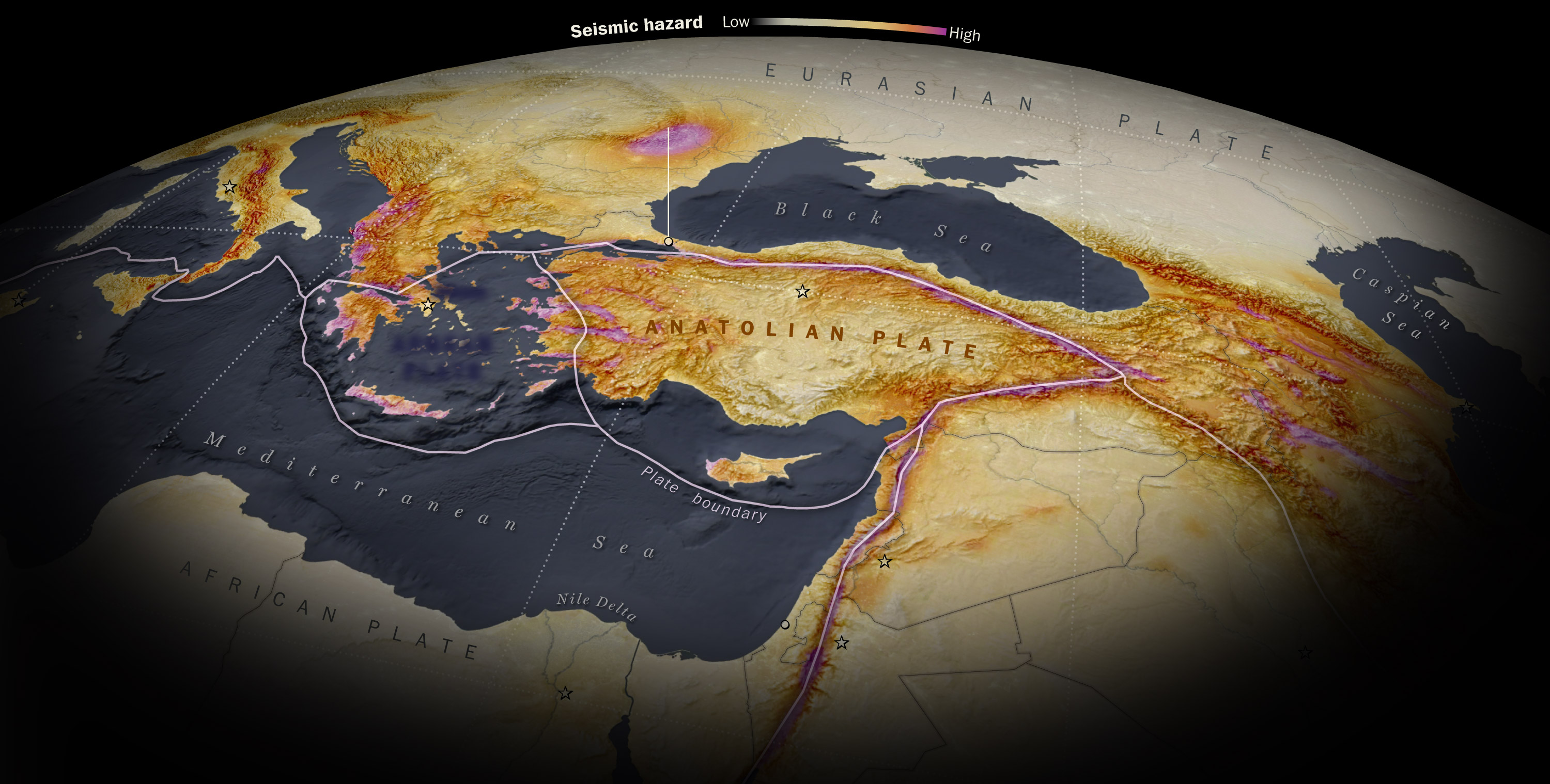
The Anatolian plate, which encompasses almost the entire country of Turkey, is squeezed between the African, Arabian and Eurasian plates.
“Eventually, the plate will crack under the increasing pressure and lurch westward,” said Thomas Parsons, a research geophysicist at the U.S. Geological Survey. That pressure triggered the February 2023 earthquakes in the region, which killed nearly 54,000 people in Turkey.
The Anatolian fault line has produced many major earthquakes since 1900, but a 70-mile stretch — located 10 miles from Istanbul — remains dormant. It is this part of the fault line that worries experts.
Story continues below advertisement
Turkish authorities have taken some steps to protect the buildings that are most at risk. But fully fortifying them comes at a huge cost.
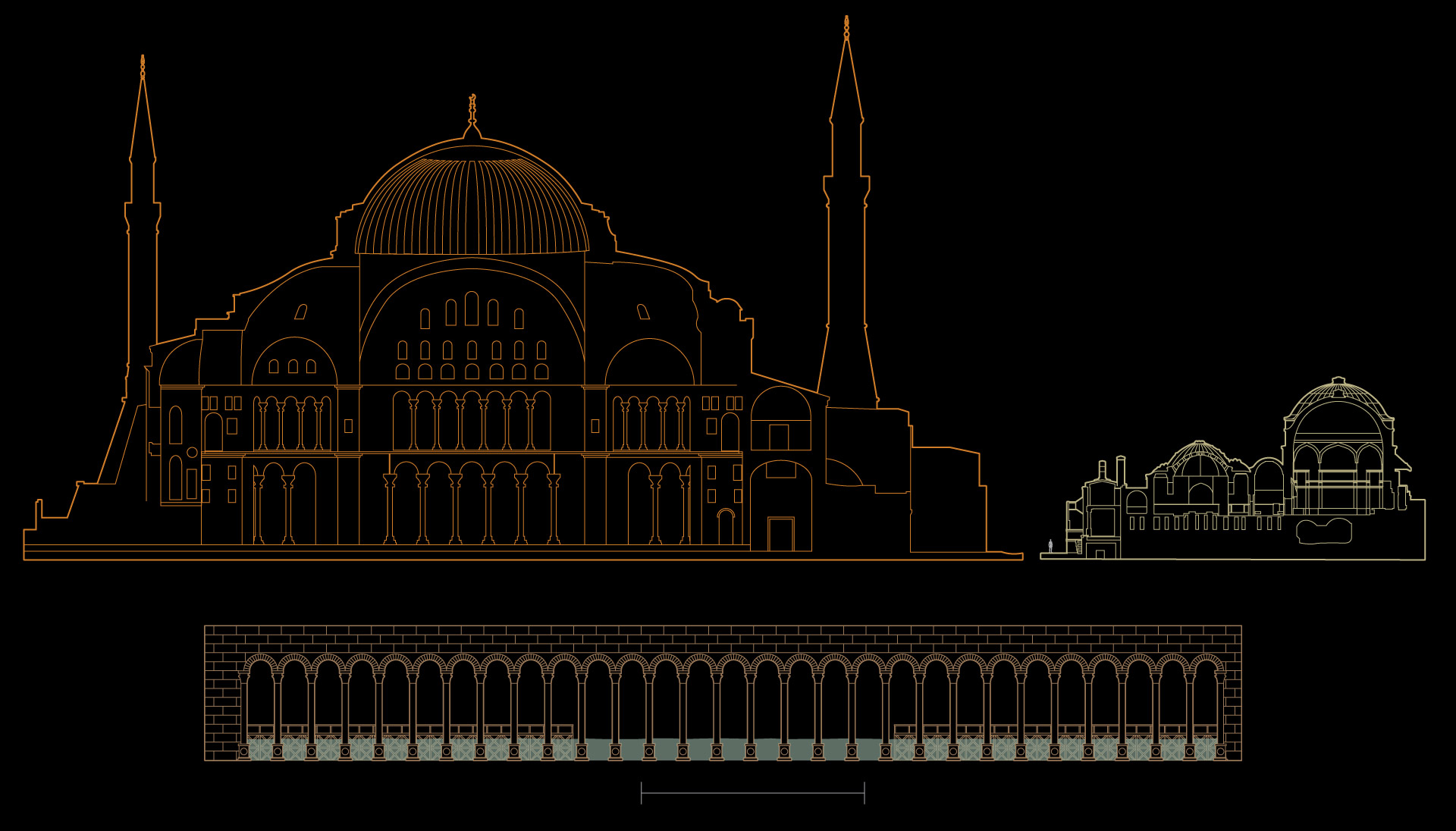
The Washington Post studied three examples from minimal to maximum intervention: The Hagia Sophia has seen the least amount of mitigation efforts because of historic preservation laws. The Basilica Cistern has been strengthened using several conventional methods. And lastly, there’s the privately owned Zeyrek Cinili Hamam, which has been extensively reinforced all the way down to its foundation.
ZEYREK CINILI HAMAM
Hagia Sophia
The Hagia Sophia, which was built as a cathedral in the 6th century and is now a mosque, has been standing for almost 1,500 years. Constructed with intersecting stone, brick and mortar, the structure can absorb some seismic shock.

To withstand a major earthquake, however, it needs “seismic isolators or base isolators,” said Oguz Cem Celik, a professor in the architecture department at the Istanbul Technical University (ITU) who studies earthquakes. But installing them would require lifting the entire building and placing it on moving, shock-absorbing devices that reduce the amount of energy that moves through the structure, similar to what Japan has done for many new and old buildings, Celik said.
“It is too big of an intervention,” Celik said, adding that such work is difficult because it’s very expensive and restricted by historic preservation rules.
Story continues below advertisement
Restoration of religious structures such as the Hagia Sophia is overseen by the Directorate General of Foundations, which is part of the central government. This means even minor preservation efforts can create tension between the central government and city officials in Istanbul.
Earlier this year, the central government launched some of the things that can be done to reinforce the Hagia Sophia. Workers began replacing the lead coatings on the domes, upgrading the steel framework and reinforcing the exterior to protect the ancient mosaics on the inside.
Previously, central government and city officials have taken different approaches to renovation and restoration work in Istanbul. In 2020, the AKP-controlled central government took over restoration of the Galata Tower from the city; the municipality later accused it of mismanagement.


LEFT: The Hagia Sophia was the principal mosque of Istanbul from 1453 to 1616. Most of the buttresses were added by Mimar Sinan in the Ottoman era. RIGHT: The upper gallery is where tourists visit to see mosaics, and the lower gallery is used as a mosque.
“There are 36,000 historical buildings in Istanbul,” said Mahir Polat, the cultural head of the Istanbul Metropolitan Municipality. “Those that we do try to protect, we want to do it as a model for the rest of Turkey.”
(Polat was recently placed under house arrest as part of a broader crackdown on figures close to Istanbul Mayor Ekrem Imamoglu, a key political rival of Erdogan. The Post interviewed him before his detention.)
“We want to preserve this place forever,” Polat said.
Basilica Cistern
The Basilica Cistern, the largest ancient cistern beneath the city, is held up by more than 330 massive columns and was built in the 6th century. Some of these columns come from older Roman structures. To help protect this architectural marvel, the local Istanbul municipality lowered water levels to reduce the weight on the columns and removed excess concrete from the roof and arches, Polat said.

Between 2020 and 2022, the municipality also installed a steel system at the cistern, adding 630 bearings to reinforce the columns.
Story continues below advertisement

But experts say it’s not enough. The government needs to “use more advanced technology to retrofit the structure,” said Celik, the ITU professor. But these steps are prohibitively expensive and run into the same political and historic preservation hurdles as the Hagia Sophia.LEFT: The Istanbul municipality, an opposition municipality led by Ekrem Imamoglu and the CHP party, has undertaken restoration of many buildings, including the Basilica Cistern, since it was elected in 2019. RIGHT: To protect the cistern, the municipality removed the platforms that had been put in place in previous restorations, removed excess concrete from the walls and the columns, filled in cracks using injections, and supported the columns using metal ties.
Zeyrek Cinili Hamam
The Zeyrek Cinili Hamam, a historic bathhouse (hammam) in Istanbul, was designed by architect Mimar Sinan around 1530. Although it has gone through a series of renovations and restorations in its lifetime, the hammam’s biggest intervention occurred between 2010 and 2023, when the Marmara Group, a Turkish real estate and hospitality company, acquired it and initiated a 13-year restoration.

The hammam was restored and then a second, modern structure was built beneath and around it to support it, said Yavuz Suyolcu, who was in charge of the bathhouse’s restoration for the Marmara Group.
The group worked to preserve everything from the tiles to the paintings on the wall, Suyolcu said. Lime mortar — which strengthens as it gets wet over time, unlike cement — was used in the original construction as well as for the restoration.

It includes a well foundation consisting of 20 wells, each of which is 6.5 feet deep with 31-inch-thick walls.

The restoration also included removing excess cement, repairing cracks in walls and domes with material used in the original construction, and replacing the ancient wooden bands around the domes with steel belts.
“If you make a reinforced concrete structure, it will deteriorate after 80 years,” Suyolcu said. “But if you use brick and stone and bind it with a lime mortar, it will withstand 2,000 years, 3,000 years.”

The support structure was designed to stop the structure from sliding downhill during or after an earthquake or because of groundwater movement, Suyolcu said.
The cost was in the “tens of millions of euros to fix the structure,” Suyolcu said.
Acquiring and restoring a classical Ottoman hammam was a long-standing desire of Bike Gursel, part of the Marmara Group. She saw it as an opportunity to diversify the company’s investment portfolio and later handed over the project to her daughter, Koza Gureli Yazgan.
“We try to preserve every layer in its place,” Suyolcu said. “So there is some kind of patchwork, old and new together, from old to older to oldest.”
Story continues below advertisement

correction
A previous version of this article incorrectly stated the name of the Zeyrek Cinili Hamam as Cinili Hamam.
About this story
Map sources: Global Earthquake Model (GEM) Global Seismic Hazard Map via K. Johnson, M. Villani, K. Bayliss, C. Brooks, S. Chandrasekhar, T. Chartier, Y. Chen, J. Garcia-Pelaez, R. Gee, R. Styron, A. Rood, M. Simionato, M. Pagani (2023). Disaster and Emergency Management Authority (AFAD), General Directorate of Mineral Research and Exploration (MTA), USGS and NASA.
Reporting by Maham Javaid and Erin O’Brien. Additional reporting by Ruby Mellen. Photos by Salwan Georges. Graphics by William Neff and Leslie Shapiro. Maps by Laris Karklis. Design and development by Yutao Chen and Leslie Shapiro. Editing by Reem Akkad and Manuel Canales. Additional editing by Peter Finn. Photo editing by Olivier Laurent. Design editing by Joe Moore. Copy editing by Jill Martin and Emily Morman.