A new study asserts that the Bronze Age goblet may be one of the earliest known depictions of cosmology, featuring gods creating celestial order from chaos
Mary Randolph – Staff ContributorNovember 13, 2025 11:37 a.m.
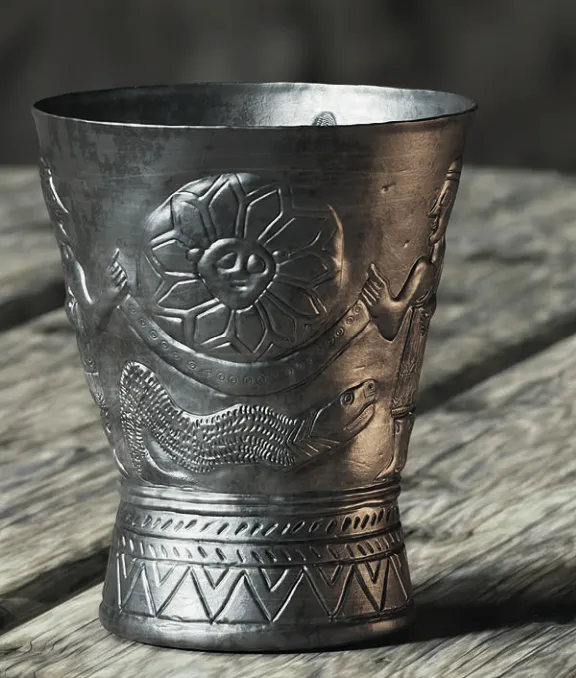
Do the illustrations on a 4,000-year-old silver goblet tell a Babylonian creation myth? Scholars have thought so for the last five decades, ever since the artifact was first unearthed. Now, new research on the rare object offers a fresh claim about its illustrations—and is rekindling a debate about their meaning.
The Untold Secrets of King Tut’s Tomb
Published in the Journal of the Ancient Near Eastern Society “Ex Oriente Lux” on November 13, the new paper claims the goblet actually reflects an ancient tale about the creation of order and structure in the cosmos, which would make it one of the earliest known cosmological depictions.
/https://tf-cmsv2-smithsonianmag-media.s3.amazonaws.com/filer_public/88/82/8882d77e-1176-4ead-a870-191010332709/screenshot_2025-11-12_at_113727am.png)
Discovered in the Judean Hills of the West Bank in 1970, the artifact is called the ˁAin Samiya goblet, named for the Palestinian village near where it was found, and dates to the Intermediate Bronze Age, which spanned from about 2500 to 2000 B.C.E.
Most of what historians know about this era comes from artifacts unearthed at burial grounds. Because evidence of settlements in the Intermediate Bronze Age is scant compared to the previous and following periods, researchers think it was a nomadic era in the region.
The only luxury good found in the southern Levant from this period, the goblet has generated just fragmented scholarship since its discovery 55 years ago. Nevertheless, “everyone who works in the Bronze Age of the southern Levant knows about this object,” Susan Cohen, an archaeologist at Montana State University who specializes in the region and was not involved in the study, tells Smithsonian magazine. “It’s in every textbook, mostly because it’s unique.”
/https://tf-cmsv2-smithsonianmag-media.s3.amazonaws.com/filer_public/50/b5/50b5ad5b-2ea9-438e-ad9a-7116b0818d3d/screenshot_2025-11-12_at_113548am.png)
The roughly three-inch-tall goblet features two scenes: one of a human-animal hybrid and a snake, and a second of two human-like figures, a snake and the sun, which sits above a crescent-shaped object. The archaeologists who found the goblet wrote that the scenes mirror those in Enuma Elish, a Babylonian creation myth. But the research team points out that the myth dates back only to 1200 B.C.E., around 1,000 years after the goblet’s creation.
In the paper, the researchers suggest the goblet’s crescent-shaped object is a celestial boat—a symbol identified at other archaeological sites that represents a vessel thought to carry the sun and moon across the sky.
Eberhard Zangger, a geoarchaeologist at the Luwian Studies Foundation and lead author of the paper, tells Smithsonian magazine he was introduced to the goblet by his co-author, University of Toronto Biblical studies researcher Daniel Sarlo, who brought it to him because of Zangger’s previous research on cosmic myths. While looking at reliefs cut into rock at the Hittite rock sanctuary Yazılıkaya in Turkey, Zangger says he had seen a depiction of a cosmic boat.
“It’s a sheer coincidence that I had worked on this subject and had this picture in mind and then saw it on the right scene of the cup,” Zangger says.
Though the goblet was excavated outside Mesopotamia, the authors write that its cosmological depictions fit into “notions of cosmogenesis that were prevalent in the ancient Near East” during the period. They suggest the human-animal figure represents chaos and that “the scenes depict a transition from chaos to a structured universe, protected from chaotic disturbances by deities.”
Fun fact: Bronze Age writing
Writing was invented during the Bronze Age—but by whom? The tool seems to have developed independently in multiple cultures at the time, spanning from China to the Near East and Mesoamerica.
Other experts aren’t convinced. Mark Smith, a Biblical scholar at Princeton Theological Seminary who was not involved with the study, tells Smithsonianmagazine that the goblet could reflect other narratives, including the Baal Cycle, a series of conflicts involving the storm god, which Smith studies. From his research on Biblical myths and the ancient Near East, Smith argues there’s “data that they don’t really address” in the paper.
“I think the objection to assuming that it’s a Babylonian creation story is correct, but it’s not clear that this is a creation myth at all,” Smith says.
The study also maps out a possible path the goblet could have taken to the southern Levant, as silver was not common in the area. The researchers argue that the cup was produced in northern Syria and suggest its illustrator was likely from the Akkadian Empire.
/https://tf-cmsv2-smithsonianmag-media.s3.amazonaws.com/filer_public/eb/2f/eb2f0492-80f0-4255-9071-9f94f2069294/screenshot_2025-11-12_at_113654am.png)
To support this interpretation, they cite a 3,800-year-old prism found in Turkey. The prism contains similar cosmological imagery to the goblet, including a celestial boat, says Zangger, boosting the team’s theory about the goblet’s geographical origins. Though first excavated in the 1980s, the prism had not been studied before the current paper.
“It has been sitting there for almost 40 years, and if you can put it into context, it’s telling a story,” Zangger says.
But Cohen suggests it’s very hard to find that information for this goblet. “A unique object might be fabulous to look at … but you can’t put it into any context or compare it to anything,” Cohen warns.
Without new information on the context in which the rare goblet was produced and buried, she says, there’s no way to confidently interpret its meaning or identify its maker. “I would disagree with the absolutism of their conclusions,” Cohen says.
If the new research prevails, the goblet and the prism could represent the earliest depictions of deities creating order from chaos—a theme the researchers say recurs throughout Near East cosmology. Was the goblet intended “to connect the soul of the deceased with the journey of the sun, ultimately to heaven,” as the team writes in the paper? Or was it created for another reason? Either way, the artifact seems poised to continue to intrigue—possibly even vex—researchers interested in the elusive era.
Editors’ note, November 13, 2025: This article has been updated to correct the age of the prism.