Because the drought followed a prolonged war, farmers who were already financially stretched have had little ability to cope with its effects, said Jalal Al Hamoud, national food security officer for the U.N.’s Food and Agriculture Organization in Syria.
Before the uprising-turned-civil war that began in 2011, Syrian farmers produced an average of 3.5 million to 4.5 million tons of wheat per year, which was enough to meet the country’s domestic needs, according to Saeed Ibrahim, director of agricultural planning and economics in Syria’s Agriculture Ministry.
That annual yield dropped to 2.2 million to 2.6 million tons during the war, and in recent years, the government has had to import 60% to 70% of its wheat to feed its roughly 23 million people. This year’s harvest is expected to yield only 1 million tons, forcing the country to spend even more of its strained resources on imports.
Mudar Dayoub, a spokesperson for Syria’s Ministry of Internal Trade and Consumer Protection, said this year’s wheat crop will only last for two or three months and that the government is “currently relying on signing contracts to import wheat from abroad” and on donations, including from neighboring Iraq.
But in a country where the World Food Program estimates that half the population is food-insecure, Ibrahim warned that “total reliance on imports and aid threatens food security” and is “unsustainable.”
The drought isn’t the only major issue facing Syria, where postwar reconstruction is projected to cost hundreds of billions of dollars. Since Assad fled, the country has been rattled by outbreaks of sectarian violence, and there’s growing doubt about whether the new authorities will be able to hold it together. Without jobs or stability, millions of refugees who fled during the war are unlikely to come home.
A dam on the Litani River in neighboring Lebanon’s fertile Bekaa Valley forms Lake Qaraoun, a reservoir that spans about 12 square kilometers (4.6 square miles).
Over the years, climate change has led to a gradual decline in the water flowing into the reservoir, said Sami Alawieh, head of the Litani River National Authority.
This summer, after an unusually dry winter left Lebanon without the water reserves its usually banks through snow and rainfall, it has shrunk to the size of a pond, surrounded by a vast expanse of parched land.
Although an average of 350 million cubic meters (12.4 billion cubic feet) of water flows into the lake during the rainy season each year, meeting about one-third of Lebanon’s annual demand, this year the incoming water didn’t exceed 45 million cubic meters (1.6 billion cubic feet), he said.
Lebanon’s water woes have further exacerbated the drought in Syria, which partially relies on rivers flowing in from its western neighbor.
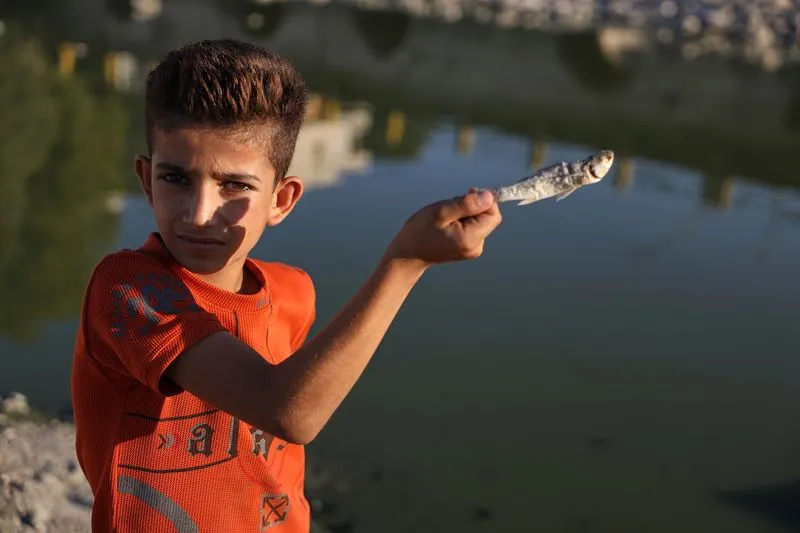
The largest of those is the Orontes, also known as the Assi. In Syria’s Idlib province, the river is an important source of irrigation water, and fishermen make their living from its banks. This year, dead fish littered the dried-out river bed.
said Dureid Haj Salah, a farmer in Idlib’s Jisour al-Shugour. Many farmers can’t afford to dig wells for irrigation, and the drought destroyed not only summer vegetable crops but decades-old trees in orchards, he said.
“There is no compensation for the loss of crops,” Haj Salah said. “And you know the farmers make just enough to get by.”
Mostafa Summaq, director of water resources in Idlib province, said the groundwater dropped by more than 10 meters (33 feet) in three months in some monitoring wells, which he attributed to farmers over-pumping due to a lack of rain. Local officials are considering installing metered irrigation systems, but it would be too expensive to do without assistance, he said.
Source: https://apnews.com/projects/syria-middle-east-drought-climate-change/