
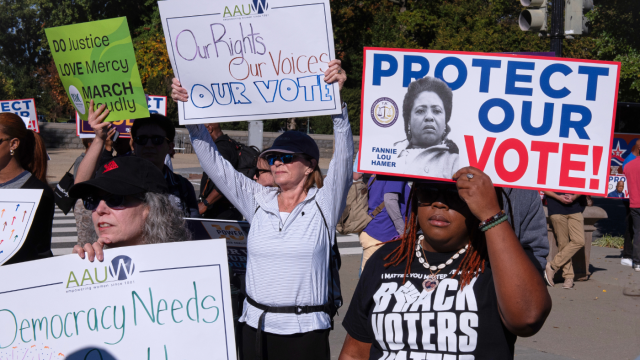
In 1965, there were only six Black lawmakers in the U.S. House and none in the Senate. There are now 60 Black voting members in the House (plus two nonvoting delegates) and five in the Senate. But this long-overdue progress could be reversed if the Supreme Court further weakens the Voting Rights Act of 1965.
The looming threat to the landmark civil rights law makes it vital for Congress to pass legislation protecting the voting rights of all Americans. Measures such as the Freedom to Vote Act and the John Lewis Voting Rights Advancement Act, which have been blocked by Republicans, are now needed more than ever.
Unfortunately, Republicans in Congress and President Trump have shown they are more interested in winning elections than in protecting the right of every adult American citizen to vote.
The Voting Rights Act was enacted to protect Americans against discrimination that denies them the right to cast ballots for candidates of their choice. It outlawed poll taxes, literacy tests and other methods that had long been used in the South to bar millions of Black people from voting — among them my parents, grandparents and other relatives.
A Supreme Court decision expected in the next few months involves Section 2 of the Voting Rights Act. This section was designed to prevent the voting power of racial minorities from being diluted by gerrymandering state legislative and congressional districts to minimize the number of Black candidates who could be elected. Section 2 has played a key role in increasing the number of Black elected officials at every level of government.
Section 2 has been challenged in court by a group of self-described “non-African Americans” contending that congressional districts in my home state of Louisiana have been drawn to discriminate against them.
If upheld by the Supreme Court, as seems likely, the challenge to Section 2 would turn the Voting Rights Act on its head, transforming it from a law to protect people of color from discrimination into a weapon to make it harder for Black candidates nationwide to be elected. This would perpetuate centuries of racial injustice that began with slavery.
Republicans are eager to see the Supreme Court rule that Section 2 is unconstitutional racial discrimination, because this could help them redraw electoral districts to put many more Republicans in office.
The advocacy group Black Voters Matter says that overturning Section 2 could help Republicans win at least 19 additional House seats in the 2026 midterm elections, since the vast majority of Black voters support Democrats (only 15 percent of Black voters cast ballots for Trump in 2024). This would greatly expand the slim Republican House majority.
Under the Constitution, voters are supposed to select the politicians they want to serve in government. But the Republican assault on the Voting Rights Act is designed to enable Republican-controlled state legislatures to select the voters they want, to put more Republicans in office.
The Voting Rights Act originally required all or part of 15 states with a history of voting discrimination against people of color to get federal approval to change the way they hold elections. The Supreme Court eliminated this important provision in a 5-4 ruling in 2013. Some of the states then changed their laws to make voting harder for non-white voters and others, including elderly, low-income and young people.
Some 33 mostly Republican-controlled states have enacted more than 100 restrictive voting laws since 2020, in response to Trump’s false claims that Democrats rigged the election that year, when he was defeated for reelection by former President Joe Biden.
When Black people were barred from voting, candidates for elected office throughout the South often ignored our needs, focusing on white voters. This led to the election of segregationists, such as Alabama’s Democratic Gov. George Wallace, whom Rev. Martin Luther King Jr. called “perhaps the most dangerous racist in America” after Wallace was elected in 1962.
Wallace later renounced his racist views and won Black support when he was elected to a fourth term in 1982. Other Democratic candidates in the South joined Wallace in rejecting anti-Black policies and supporting racial justice.
The Voting Rights Act was approved with strong bipartisan support in Congress and signed into law by President Lyndon Johnson, in a ceremony with King standing behind him. Johnson, King and other civil rights champions lobbied hard for passage of the legislation, and Johnson gave a powerful speech to Congress to gain support for the measure.
“Allow men and women to register and vote whatever the color of their skin,” Johnson implored lawmakers in his speech, adding: “Every American citizen must have an equal right to vote.”
Johnson’s words are just as true and relevant today as they were 60 years ago. All citizens who back free and fair elections and believe in democracy should demand Congress pass legislation to preserve the voting rights of us all.
Donna Brazile is a political strategist, a contributor to ABC News and former chair of the Democratic National Committee. She is the author of “Hacks: Inside the Break-ins and Breakdowns That Put Donald Trump in the White House.”
Source: https://thehill.com/opinion/judiciary/supreme-court/5676416-supreme-court-voting-rights/