From Cap-Haïtien to Bombardopolis, Les Cayes and back, a ‘dyaspora jounalis’ chronicles 13 days inside his homeland, where daily life swings between quiet beauty and constant hardship
by Fritznel D. Octave Nov. 28, 2025

Overview:
Fritznel D. Octave, Haiti editor at The Haitian Times, reflects on his first return to the country in eight years. In this three-part report, Octave relives scenes and shares interviews as he travels across four departments, capturing his homeland’s stark contrasts.
CAP-HAÏTIEN — My first return to Haiti in eight years began not with a shock, but with a jarring sense of familiarity. The same contradictions that define Haiti, serene beauty filled with opportunities and constant breakdowns, struck me from the moment the Sunrise Airways flight touched the cracked tarmac of Cap-Haïtien’s Hugo Chavez International Airport.
Goats wandered the airport’s entrance, unchecked. Mounds of trash piled high near the departure gates. Taxi drivers, vendors and beggars fought for space on the slivers of concrete that pass for sidewalks. Yet amid the chaos, the city’s lush mountains stood high in postcard-perfect stillness, inviting us mere mortals to breathe in their majesty.
Sign up for our free newsletters.
Over 13 days, I would travel through the North, Artibonite, Northwest and South departments of my homeland. Unable to resist, I documented the realities of a country enduring one of the worst crises in its history. What emerged are seven patterns visible everywhere, shaping daily life, possibilities and Haiti’s uncertain future.
Part one highlights first impressions and the seven recurring storylines from day 1 to 13 of my trip.
Haitians eager to get home—baffling airlines and all
Flying with Sunrise Airways, the only Haiti-based airline standing, most travelers assume they will find its counters at Miami International Airport’s terminals. But Sunrise flies under other names, literally. Inside the airport, the search leads to Global X or Eastern Air Express desks at Door 14.
Even inside Haiti, the brand confusion leaves passengers baffled.

Still, ever since the United States banned flights to Port-au-Prince Toussaint Louverture International Airport last November, flights are packed to Cap-Haïtien, Haiti’s safer gateway of choice in the North, and to Les Cayes in the South. For a year, Haitians relied solely on Sunrise for connections to the U.S. until Nov. 10, when IBC Airways, a Florida-based carrier, launched its first Miami-Les Cayes flight.
Daily life hums along, despite the country’s crises
Markets fill every roadside curve. Schools stay open. Churches remain active. Elections, many say, can be held—even as armed groups control much of the capital and some parts of the Artibonite and Centre departments.
“The country keeps going not because conditions get better, but because Haitian resilience and the necessity to move forward—despite all—leave us no other choice,” Paul Enock Henry, a socio-entrepreneur in Bombardopolis, says.


Safety does not factor into everyday life
Motorcyclists speed helmetless across bumpy terrain, carrying people and all sorts of loads at once.
Children and teenagers drink alcohol openly in neighborhoods.
Construction workers build multi-story homes, barefoot and without personal protective equipment.
Hazards, like inflation, are simply background noise.
 Men working with no protective gear on a construction site in Gonaïves on Tuesday, October 28, 2025, without any personal protective equipment. Photo by Fritznel D. Octave/The Haitian Times
 Three passengers ride a motorcycle taxi on Haiti’s National Road 1 in Morne Puilboreau, Ennery, Artibonite, on Monday, November 3, 2025. Photo by Fritznel D. Octave/The Haitian Times
Motorcycles, anywhere and everywhere
On roads destroyed by hurricanes, erosion, neglect or neglect disguised as “policy,” motorcycles reach places cars cannot. They carry schoolchildren, families of four or more, sacks of charcoal, merchandise and provisions, corpses in coffins, construction materials and even goats.
 Residents in the streets of Limbé, a neighboring commune of Cap-Haïtien, on Monday, November 3, 2025. Photo by Fritznel D. Octave/The Haitian Times
  Residents of a rural area of Camp-Perrin, near the Saut-Mathurine waterfall, on Friday, November 7, 2025. Photo by Fritznel D. Octave/The Haitian Times
 A motorcyclist on the Darbonne road in Léogâne, about 25 miles southwest of Port-au-Prince, transports a mattress on Monday, November 3, 2025. Another motorcycle taxi driver, carrying a passenger, follows nearly bumper to bumper. Photo by Daniella Saint-Louis for The Haitian Times
Wi-Fi is both a lifeline and a luxury
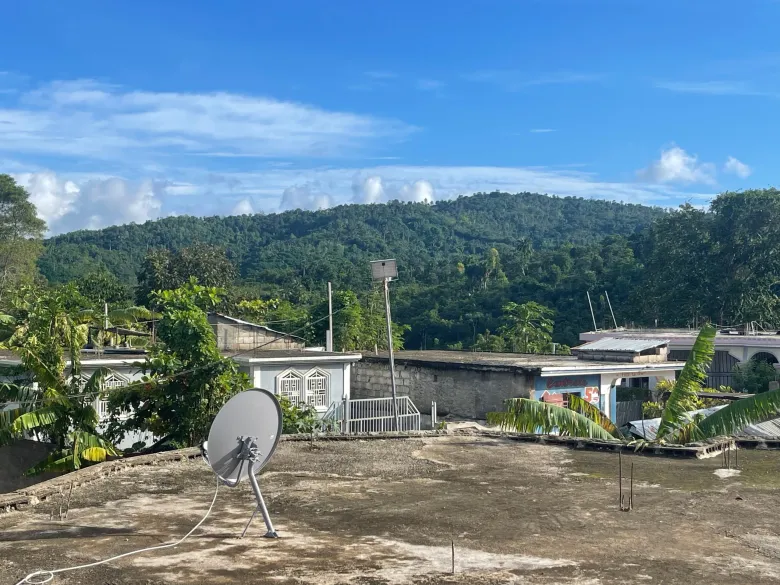
People flock everywhere for a network signal. On hilltops, near unfinished houses, on public squares, behind roadside trees—groups of people cluster any and everywhere, raising their phones to the sky as they search for a bar of connection.

Haiti is becoming green again
Reforestation is visible across the country. It’s literally a breath of fresh air to see their unsung success driven by necessity, not policy. Tropical fruit trees—especially avocado, mango and orange—thrive. Rural plateaus, hills and valleys, once dry, now burst with vegetation.
“Most people here no longer cut down trees to make charcoal for quick cash,” Gesnel Auguste, a 65-year-old farmer from the Bondieudit locality in Bombardopolis, told The Haitian Times. “They now prefer to buy a motorcycle and use it as a taxi to transport people and goods everywhere.”
Climate damage persists, certainly, but Mother Nature, with help from the people, pushes back.
 Pigs devouring avocados felled by heavy winds from Hurricane Melissa in Bombardopolis in late October. Fruits, produced in large quantities in the region, often go to waste due to a lack of reliable transportation and processing infrastructure. Photo by Fritznel D. Octave/The Haitian Times.
 A young man on Sunday, November 2, 2025, passing by a house surrounded by trees in Citerne Rémy, a village bordering Baie-de-Henne and Bombardopolis in the lower Northeast. Photo by Fritznel D. Octave/The Haitian Times.
Source: https://haitiantimes.com/2025/11/28/fritznel-octave-haiti-travel-diary-reporters-notebook/