Growing up, I was sold the story that our transition to democracy was a “global model.” It wasn’t until I started working on transitional justice across Asia and Latin America that I realized how hollow that claim actually was.
No criminal accountability. Limited truth-telling. Institutional reform that largely waited for collaborators to die of old age. We chose silence over truth. We mistook the absence of conflict for reconciliation.
Most damning of all is the number we rarely say out loud: over 114,000 people were forcibly disappeared in Spain.
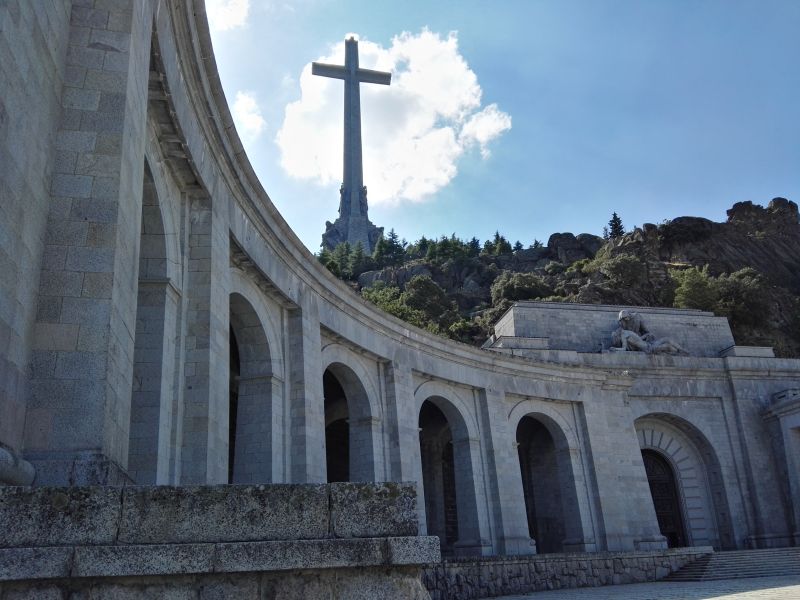
I took this photo in 2016 at Valle de los Caídos (today Cuelgamuros)—a massive monument built by Republican prisoners through forced labor, where Franco lay buried and still venerated, surrounded by mass graves. Standing there, I felt my skin crawl. I’m grateful that place, as it was, no longer exists, and that exhumations are finally underway to return victims to their families.
But the process is incomplete, and we continue to see the consequences. Data published this week should alarm us all:
📊 36% of Spaniards now view Franco favorably
📊 Among young people (17-35): 41% view the dictatorship positively
📊 45% of under-35s describe the dictator as “a suitable leader for turbulent times”
📊 53% believe the Civil War’s wounds remain open
Unsurprisingly, these numbers vary dramatically depending on political sympathies. It is deeply troubling that History itself has become a source of political division.
While we debate narratives, the physical evidence remains. RTVE’s new map documents ~6,000 mass graves and former mass graves across Spain.
You are never more than 50km from one of these sites anywhere in the country. (Explore the map: https://lnkd.in/dfkTpYcz)
There are no shortcuts in transitional justice. The work of truth, accountability, and memorialization cannot be postponed indefinitely without cost. We are living proof.
“Mi querida España” was written by Cecilia in 1975—a song about Spain awakening from its “santa siesta,” roused by poets’ verses after decades of imposed slumber. Fifty years on, it seems in some ways we’re still asleep.
P.S. If you know the song, you might not know that Cecilia penned the original lyrics as “Esta España viva, esta España muerta” (This Spain alive, this Spain dead)—a raw reference to the Civil War’s unhealed divide. Censors blocked it, forcing her to record “Esta España mía, esta España nuestra” (This Spain of mine, this Spain of ours). Ironically, the sanitized version became an anthem for reconciliation.
Song: https://lnkd.in/dRiMeWxv