Think about that.
Microplastics are everywhere. In our bloodstreams. In unborn babies. In the water we drink. Most particles are so small they slip through even the finest filters.
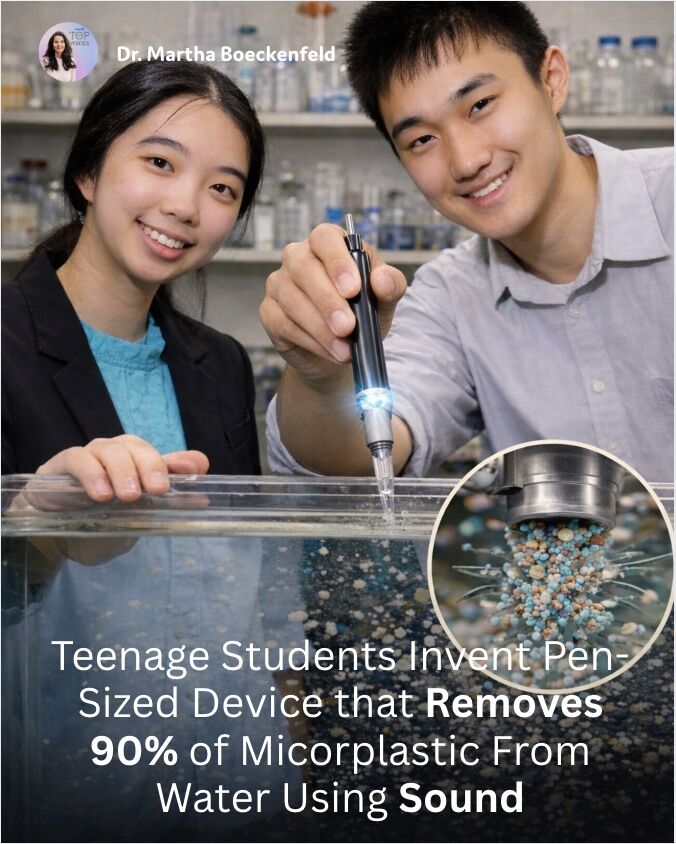
In a small community near Houston, two high schoolers from The Woodlands, Texas — Victoria Ou and Justin Huang — stared at cloudy water samples.
No government lab. No corporate funding. Just curiosity and a bold hypothesis.
What water filtration usually requires:
↳ Expensive membranes that clog and fail
↳ Chemical treatments with side effects
↳ Massive infrastructure
↳ Budgets most communities can’t afford
What these teenagers built instead:
↳ High‑frequency ultrasound waves tuned to push microplastics away from the water outflow
↳ A “wall of sound” that forces particles into a tight region, like iron filings around a magnet
↳ Once concentrated, the plastics become much easier to block and collect
↳ A pen‑sized device—compact, low‑power, and designed to be affordable if scaled
Here’s the part that stopped me:
In lab tests, their prototype removed around 84–94% of suspended microplastics in a single pass. No chemicals. No expensive membranes. Just physics.
Their project, “Acoustic Filtration: Harnessing Ultrasonic Technology for the Streamlined Removal of Microplastic Particles from Water Flow,” earned them the $50,000 Gordon E. Moore Award at Regeneron ISEF 2024 and international recognition.
But the real breakthrough is what it opens: a realistic path toward removing the plastics we can’t see from the water we drink.
Picture a village in a remote region. No access to industrial filtration. A small, affordable ultrasound device integrated into a local system, using sound waves to strip invisible pollution from the only water source they have.
That’s the vision sitting behind this innovation — still early‑stage, but full of potential.
We spent decades building billion‑dollar filtration systems.
Two teenagers, Victoria and Justin, asked a simpler question: what if we let sound do the work?
Follow me, Dr. Martha Boeckenfeld, for innovations where young minds rewrite what’s possible.
♻️ Share if you believe the future of clean water might come from your own curiosity.
Resources: Huang & Ou (Regeneron ISEF 2024) – “Acoustic Filtration: Harnessing Ultrasonic Technology for the Streamlined Removal of Microplastic Particles from Water Flow”
ACS ES&T Water – “A Novel Application of Ultrasound for Removal of Aqueous Microplastics” (2025)