
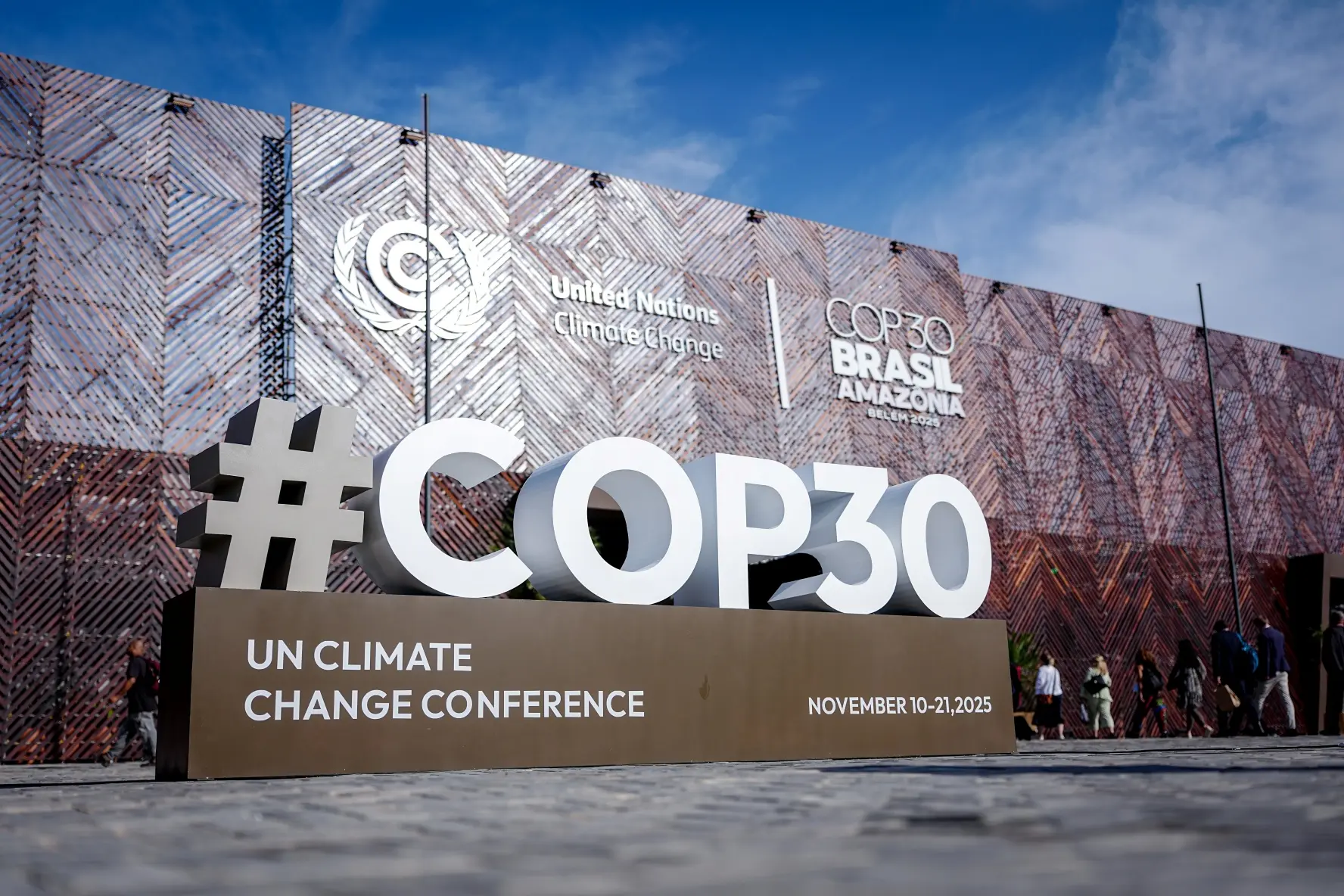
Summary report, 10–21 November 2025
UN Climate Change Conference – Belém, November 2025
The 2025 Climate Change Conference convened against a difficult backdrop. Geopolitical tensions around the world reached new levels, 2024 was confirmed to be the warmest year on record at about 1.55°C above pre-industrial levels, and the third round of nationally determined contributions (NDCs) under the Paris Agreement was not up to expectations. Most NDCs were submitted significantly later than expected, their collective ambition remains insufficient to meet the objectives of the Agreement, and several countries have yet to submit their plans altogether.
Before the Conference started, various groups and countries proposed, in total, no less than eight items for inclusion on the already packed negotiations agenda. The Brazilian Presidency managed to successfully launch substantive negotiations on the understanding that it would hold Presidency consultations on four of these items: implementing developed countries’ finance obligations under Paris Agreement Article 9.1; unilateral trade-restrictive measures; and responding to the latest NDCs and biennial transparency reports to address the 1.5°C ambition and implementation gaps. These bundled consultations eventually led to the adoption of the “Mutirão” decision. Many delegations advocated for some form of reference to fossil fuel phaseout in this context, possibly in the form of developing roadmaps. But neither this, nor provisions on halting and reversing deforestation, which also enjoyed wide support, made it into the adopted decision.
The closing plenary of the Conference of the Parties (COP) convened on Saturday, 22 November, despite the Presidency’s determination to wrap up proceedings ahead of time. The plenary was characterized by significant turmoil, with various groups and Parties interrupting the adoption of decisions to raise points of order, voice objections, and make comments on various negotiation issues. Pointing out that fossil fuels are by far the largest driver of climate change, Colombia questioned what message the Conference is sending to the world, underscoring that the “COP of truth cannot support an outcome that ignores science.” Panama, Uruguay, and several others in turn denounced the gavelling of the decision on the Global Goal on Adaptation (GGA) in spite of their delegations having raised their flags and signalling points of order, which were not acknowledged by the dais. They lamented that the indicators included in the final text erase two years of technical work conducted with expert input.
After plenary was suspended for over an hour, President André Corrêa do Lago: stated his regrets that he had not been made aware of the points of order; noted the Secretariat’s confirmation that the decisions were adopted; suggested that work on these issues continue at the 2026 June meeting of the Subsidiary Bodies; and invited the Secretariat to prepare best practices to ensure the predictability and legitimacy of the process.
By contrast, other decisions were adopted more smoothly. Participants applauded the adoption of the new Gender Action Plan as well as the decision to develop a just transition mechanism. Parties also: operationalized the Technology Implementation Programme; launched new work on finance flow alignment (Paris Agreement Article 2.1(c); updated the type of information to consider in ex ante climate finance reporting (Paris Agreement Article 9.5); concluded the review of the Warsaw International Mechanism on loss and damage; and agreed on activities aimed to support developing countries’ reporting, among others. Settling a long stalemate, the COP accepted Türkiye’s offer to host COP 31 and welcomed an arrangement between Türkiye and Australia to share the COP 31 Presidency. The COP also accepted Ethiopia’s offer to host COP 32 in 2027, which will be the first time the governing bodies meet in a least developed country.
The Brazilian Presidency also announced that, in response to the lack of consensus on addressing fossil fuels and deforestation in the “Mutirão” decision, they will develop two roadmaps: one on the transition away from fossil fuels in a just and equitable manner and the other on halting and reversing deforestation, with outcomes to be reported at COP 31.
The Belém Climate Change Conference convened from 10–22 November 2025 in Belém, Brazil. The Conference consisted of the 30th session of the Conference of the Parties (COP 30) to the UN Framework Convention on Climate Change (UNFCCC), the 20th meeting of the Conference of the Parties serving as the Meeting of the Parties to the Kyoto Protocol (CMP 20), the 7th meeting of the Conference of the Parties serving as the Meeting of the Parties to the Paris Agreement (CMA 7), and the 63rd sessions of the Subsidiary Body for Scientific and Technological Advice (SBSTA 63) and the Subsidiary Body for Implementation (SBI 63).
In total, 56,118 people were registered for on-site attendance, including 23,509 delegates from Parties, 13,402 observers, 3,920 members of the media, and 13,948 support and Secretariat staff. Of the observers, 1,007 were guests of the host country, Brazil. Another 5,141 people, comprising 277 delegates from Parties and 4,823 observers, registered for online participation.
A Brief History of the UNFCCC, the Kyoto Protocol, and the Paris Agreement
The international political response to climate change began with the 1992 adoption of the UNFCCC, which sets out the basic legal framework and principles for international climate change cooperation with the aim of stabilizing atmospheric concentrations of greenhouse gasses (GHGs) to avoid “dangerous anthropogenic interference with the climate system.” The Convention, which entered into force on 21 March 1994, has 198 Parties.
To boost the effectiveness of the UNFCCC, Parties adopted the Kyoto Protocol in December 1997. It commits industrialized countries and countries in transition to a market economy to achieve quantified emission reduction targets for a basket of six GHGs. The Kyoto Protocol entered into force on 16 February 2005 and has 192 Parties. Its first commitment period took place from 2008 to 2012 followed by the second commitment period from 2013 to 2020.
In December 2015, Parties adopted the Paris Agreement. The Agreement aims to limit the global average temperature increase to well below 2°C above pre-industrial levels, and pursue efforts to limit it to 1.5°C. It also aims to increase Parties’ ability to adapt to the adverse impacts of climate change and make financial flows consistent with a pathway toward low GHG emissions and climate-resilient development. It provides that each Party shall communicate, at five-year intervals, successively more ambitious NDCs, which are at the core of the Agreement. As later decided in 2021 in Glasgow, each NDC will last ten years, but will be updated every five years. The Agreement further sets out an Enhanced Transparency Framework (ETF) for national reporting by all Parties. Collective progress toward implementing the Agreement is to be reviewed every five years through a Global Stocktake (GST). The Paris Agreement entered into force on 4 November 2016 and currently has 195 Parties.
Recent Highlights
Katowice: The Katowice Climate Change Conference convened from 2–14 December 2018 in Poland. Parties adopted decisions to facilitate the interpretation and implementation of the Paris Agreement with regard to the mitigation section of NDCs, adaptation communications, ETF, GST, and financial transparency, among others. Work on cooperative implementation, under Article 6 of the Agreement, was not concluded, and Parties agreed to conclude this work in 2019. The COP was unable to agree on whether to “welcome” or “note” the Intergovernmental Panel on Climate Change’s (IPCC) Special Report on 1.5°C of Global Warming.
Chile/Madrid: The Chile/Madrid Climate Change Conference convened from 2–13 December 2019 in Spain, under the Presidency of Chile. Delegates established the Santiago Network aimed at catalyzing technical support on loss and damage, and adopted the enhanced five-year Lima Work Programme and its Gender Action Plan (GAP). On many issues, notably Article 6 and long-term finance, Parties could not reach agreement.
Glasgow: The Glasgow Climate Change Conference convened in Scotland from 31 October – 12 November 2021, following the COVID-19 pandemic-related interruption to the annual rhythm. Parties finalized the outstanding Paris Agreement rulebook issues, adopting guidelines, rules, and a work programme on Article 6 and agreeing on the format of reporting under the ETF. Parties adopted three cover decisions that, for the first time, included a reference to phasing down unabated coal power and phasing out inefficient fossil fuel subsidies. They also: established work programmes on the GGA, and on urgently scaling up mitigation ambition and implementation in this critical decade; created a dialogue on loss and damage funding; established a process toward defining a new collective quantified goal on climate finance; and launched an annual dialogue on ocean-based climate action.
Sharm El-Sheikh: The Sharm El-Sheikh Climate Change Conference convened in Egypt from 6–20 November 2022. For the first time, Parties recognized the need for finance to respond to loss and damage associated with the adverse effects of climate change and established a fund and funding arrangements, with details to be worked out in 2023. Key elements in the package leading to this agreement were the operationalization of the mitigation work programme (MWP) and initiating the development of a GGA framework. Parties also adopted two cover decisions, which among others: established a work programme on just transition to discuss pathways to achieve the goals of the Paris Agreement; and launched a dialogue to enhance understanding of the scope of Article 2.1(c) of the Paris Agreement (finance flow consistency), and its complementarity with Article 9 (climate finance).
Dubai: The United Arab Emirates Climate Change Conference convened in Dubai from 30 November – 11 December 2023. The major outcome was the adoption of a decision concluding the first GST (GST-1) under the Paris Agreement. It encourages Parties to ensure their next NDCs are 1.5°C-aligned and have ambitious, economy-wide emission reduction targets, covering all GHGs, sectors, and categories. Among other things, the decision also calls on Parties to contribute, in a nationally-determined manner, to global efforts on: tripling renewable energy capacity globally and doubling the global average annual rate of energy efficiency improvements by 2030; and transitioning away from fossil fuels in energy systems, in a just, orderly, and equitable manner, accelerating action in this critical decade, so as to achieve net zero by 2050 in keeping with the science. Parties also: operationalized the loss and damage fund; adopted the GGA framework, including thematic and dimensional targets; agreed on a host for the Santiago Network; and operationalized the just transition work programme (JTWP).
Baku: The Baku Climate Change Conference convened in Azerbaijan from 11–22 November 2024. Parties adopted a new collective quantified goal (NCQG) on climate finance, in extension of the previous goal of USD 100 billion per year by 2020. The NCQG sets a goal of at least USD 300 billion per year by 2035 for developing countries’ climate action from a wide variety of sources, with developed countries taking the lead. It also calls on all actors to work together to scale up financing to developing countries for climate action from all public and private sources to at least USD 1.3 trillion per year by 2035. The decision also: acknowledges the need for public and grant-based resources and highly concessional finance, particularly for adaptation and responding to loss and damage, especially for those most vulnerable to the adverse effects of climate change and with significant capacity constraints, such as the least developed countries (LDCs) and small island developing states (SIDS).
In Baku, Parties also: advanced the operationalization of the market-based cooperative implementation of the Paris Agreement (Articles 6.2 and 6.4); extended the work programme on gender; provided guidance on defining indicators for assessing progress toward the GGA; adopted arrangements with the Fund for Responding to Loss and Damage; and extended the mandate of the working group facilitating the implementation of the Local Communities and Indigenous Peoples Platform.
Report of the Meetings
The Belém Climate Change Conference opened on Monday, 10 November. During the first week, negotiations were largely conducted under the Subsidiary Bodies (SBs). The closing plenary of the SBs took place on Saturday, 15 November, during which Parties adopted a number of conclusions and forwarded draft texts to the governing bodies for further consideration during the second week.
Procedural Matters
Rules of procedure: Parties agreed to apply the draft rules of procedure (FCCC/CP/1996/2), except draft rule 42 on voting. Presidency-led consultations did not lead to agreement on the adoption of the rules of procedure.
Adoption of the agendas: During the opening plenary on Monday, 10 November, Parties debated the meeting agendas. A record of eight agenda items were proposed by Parties, with Honduras, Papua New Guinea, and Suriname later withdrawing their proposal to address the scaling up of finance to halt and reverse deforestation in line with the decision on the first Global Stocktake (GST-1). Parties agreed on the way forward proposed by the Presidency to conduct open consultations on the following items:
- implementation of Paris Agreement Article 9.1 (developed countries’ finance provision obligation), proposed by the Like-Minded Developing Countries (LMDCs);
- unilateral trade-restrictive measures (UTMs), proposed by the LMDCs;
- responding to the NDC Synthesis Report (FCCC/PA/CMA/2025/8) and addressing the 1.5°C ambition and implementation gaps, proposed by Alliance of Small Island States (AOSIS); and
- synthesis of biennial transparency reports (BTRs), proposed by the EU.
The Presidency said it would also convene consultations on the special needs and circumstances of Africa and the annual expert dialogue on mountains, with outcomes reflected in the meeting report. Parties adopted the agendas of the COP, CMP, CMA, SBI, and SBSTA.
Admission of observers: The COP agreed to admit all listed observers and took note of organizations that changed their names (FCCC/CP/2025/3).
Decision-making: During the closing plenary, the Presidency reported that Parties continued to hold divergent views on this matter, and had therefore agreed to continue its consideration at COP 31.
Dates and venues of future sessions: This matter was addressed in Presidency consultations, with extensive discussions also held within the Western European and Others Group to settle the gridlock around the region’s nomination of a host for COP 31. During the closing plenary, TÜRKIYE thanked Parties for accepting its offer to host COP 31 in partnership with Australia. AUSTRALIA expressed appreciation for being entrusted with the “Presidency of negotiations,” and invited participants to attend the pre-COP in the Pacific. ETHIOPIA thanked Parties for the trust placed in them to host COP 32, emphasizing it will be the first to convene in a least developed country.
Final Outcomes: In its decision (FCCC/CP/2025/L.13), the COP:
- accepts Türkiye’s offer to host COP 31, CMP 21, and CMA 8, requesting the Secretariat to conclude a Host Country Agreement with Türkiye;
- welcomes the arrangement between Türkiye and Australia in terms of sharing the COP 31 Presidency;
- accepts Ethiopia’s offer to host COP 32, CMP 22, and CMA 9, requesting the Secretariat to conclude a Host Country Agreement with Ethiopia; and
- invites Parties from the Asia-Pacific Group to come forward with offers to host COP 33, CMP 23, and CMA 10, noting the need for the Secretariat to conduct fact-finding missions to the host country in a timely manner.
Report of the Subsidiary Bodies: The Co-Facilitators of the 2025 Ocean and Climate Change Dialogue reported on the outcomes of the dialogue convened during SB 62 and highlighted the pending entry into force of the High Seas Treaty, urging Parties to ratify and implement the latter.
The COP, CMP, and CMA took note of the reports of SBSTA 62 (FCCC/SBSTA/2025/4 and Add.1), SBSTA 63 (FCCC/SBSTA/2025/L.7), SBI 62 (FCCC/SBI/2025/11 and Add.1–2), and SBI 63 (FCCC/SBI/2025/L.20).
Presidency Consultations
NDCs, BTRs, Article 9.1, UTMs: Presidency consultations on this basket of issues were facilitated by Túlio Andrade, COP 30/CMP 20/CMA 7 Presidency, on 10, 11, 12, 13, 14, 15, and 17 November. Following general support by Parties for an outcome or package in the form of a “Mutirão decision,” Parties convened in the format of a “Mutirão mobilization for the Belém package” on 17 and 18 November.
During the consultations, AOSIS called for space to discuss the mitigation gap and identify means to close it, expressing willingness to do this through a cover decision. Supported by NORWAY, AUSTRALIA, and others, they proposed a “response plan” that calls for, among others: Parties who have submitted NDC ranges to move to the higher end of their ranges, and support for such Parties to enable this move; and donor countries to include finance in their NDCs. The EU suggested deepening international cooperation to enable a transition away from fossil fuels, including cooperation on carbon market mechanisms and linking the private and public sectors.
The ENVIRONMENTAL INTEGRITY GROUP (EIG) proposed an “NDC roadmap,” similar to the Roadmap to USD 1.3 trillion, that aims to mobilize collaboration to “achieve more and faster.” CANADA supported discussing a concrete policy response on enhancing collaboration and ambition, and identifying concrete next steps without setting new targets.
The INDEPENDENT ALLIANCE OF LATIN AMERICA AND THE CARIBBEAN (AILAC) supported a delivery plan that ensures a balanced outcome between ambition and means of implementation (MoI) by: providing a dedicated space for addressing the NDC Synthesis Report; and operationalizing the NCQG through, among others, burden-sharing arrangements, support for the tripling of annual finance outflows from the operating entities of the Financial Mechanism, and removal of disenablers.
The ARAB GROUP called for an Article 9.1 action plan that includes common accounting methodologies and the LMDCs proposed a work programme to foster discussion of the relationship between Article 9.1 and other elements of the Convention and Paris Agreement, including Convention Article 3.5(supportive and open international economic system).
The AFRICAN GROUP proposed: an Article 9.1 work programme that includes work on a burden-sharing arrangement; and a system for Parties wishing to adopt UTMs to provide advance notice to the UNFCCC, with the Secretariat to compile such notifications to inform Parties’ consideration thereof. The LMDCs supported a dedicated agenda item on UTMs and TUVALU proposed a dialogue on UTMs.
On 14 and 15 November, the Presidency invited Parties’ views on three broad themes to guide discussions: united in celebration of the 10th anniversary of the Paris Agreement; from negotiations to implementation: the Paris Agreement policy cycle fully in motion; and response to urgency, accelerating implementation, solidarity, and international cooperation.
Most Parties supported acknowledging the achievements of the Paris Agreement and the importance of multilateralism. The AFRICAN GROUP, ARAB GROUP, and CHINA called for also recognizing the importance and achievements of the UNFCCC and Kyoto Protocol. AOSIS and the LDCs called for welcoming the climate change-related advisory opinions issued by the International Tribunal for the Law of the Sea, International Court of Justice (ICJ), and Inter-American Court of Human Rights over the last two years. The EIG suggested acknowledging the role of science and science-based action, and AUSTRALIA proposed recognizing record levels of renewable and clean energy investment.
On gaps, AOSIS emphasized that, because of insufficient short-term action since 2015, the goal of limiting warming to 1.5°C without some overshoot is becoming less likely. The AFRICAN GROUP highlighted the ambition and implementation gaps, noting the need for international cooperation and predictable finance to support developing countries’ climate action.
AOSIS, supported by the LDCs, UK, PANAMA, GEORGIA, and others, proposed strengthening the COP 28, COP 29, and COP 30 Presidencies’ “Roadmap to Mission 1.5°C.” The AFRICAN GROUP called for tripling adaptation finance in line with the amounts set out in the NDC Synthesis Report and stressed that any roadmap must include not only mitigation but also adaptation and finance. The EIG supported a “Belém 1.5°C action plan” on ambition, which is bottom-up, collaborative, and respects countries’ sovereignty.
On Monday, 17 November, Andrade explained that subsequent consultations would focus on Parties’ priorities for a “Mutirão decision,” as well as key outstanding items Parties consider important for a balanced outcome from COP 30.
On Friday, 21 November, President Corrêa do Lago convened another “Mutirão” consultation, to provide Parties an opportunity to respond to the new draft “Mutirão” decision that had been published early that morning. Most Parties expressed dissatisfaction with the text. The EU, AILAC, and EIG opposed the text because it lacked a reference to fossil fuel phaseout. The EU stated that if COP 30 delivers on mitigation, they would be willing to “move beyond their comfort zone” regarding adaptation finance, provided all the elements of the NCQG are respected.
AOSIS expressed concern with the overall ambition of the text, calling for a focused response to the NDC Synthesis Report. The COALITION FOR RAINFOREST NATIONS (CfRN) lamented lack of reference in the text to reversing deforestation and avoiding forest removals.
The AFRICAN GROUP questioned implementation that comes with conditionalities and increases developing countries’ debt burdens. The ARAB GROUP emphasized that text targeting any sector of their economies is “off the table.” Underlining that developing countries’ energy needs will grow, the LMDCs called on developed countries to achieve net zero by 2030 and net negative shortly thereafter to free up carbon space for developing countries.
GRUPO SUR denounced the latest draft GGA text that had also been published as part of the “Belém Political Package,” lamenting that it disregards two years of joint technical work that involved many experts. Rejecting the draft, they highlighted that it contains a new list of 59 indicators that Parties were not involved in elaborating and that were not selected from the list compiled by the experts.
Thereafter, President Corrêa do Lago continued to hold consultations with Parties on the way forward. These consultations continued throughout the night until the early morning hours of Saturday, 22 November.
During the closing plenary, President Corrêa do Lago announced the creation of two Presidency roadmaps: one on the transition away from fossil fuels in a just and equitable manner, and one on halting and reversing deforestation by 2030. He explained these roadmaps will be science-based and inclusive, and feature high-level dialogues with a broad range of stakeholders. President Corrêa do Lago said he would report back on the outcomes of this roadmap at COP 31 and referenced the First International Conference on the Just Transition Away from Fossil Fuels scheduled to convene in Colombia in April 2026.
Marina Silva, Minister of the Environment and Climate Change, Brazil, highlighted roadmaps for reversing deforestation and for transitioning away from fossil fuels as the Presidency’s response to the lack of consensus.
ARGENTINA: reiterated their view that references to human rights should be interpreted in line with national legislation and legally-binding international human rights treaties, as applicable; said any reference to “enabling environments” should be understood as referring to the international enabling environment; and stated its position that NDC alignment is a matter of national sovereignty. President Corrêa do Lago confirmed these views will be reflected in the meeting report.
Final Outcome: In its decision “Global Mutirão: Uniting humanity in a global mobilization against climate change” (FCCC/PA/CMA/2025/L.24), the CMA, inter alia:
- recalls with concern that the carbon budget consistent with achieving the Paris Agreement temperature goal is now small and being rapidly depleted;
- recognizes that limiting global warming to 1.5°C with no or limited overshoot requires deep, rapid, and sustained reductions in global GHG emissions and reaching net zero carbon dioxide emissions by 2050;
- recognizes the centrality of equity and the best available science for effective climate action and policymaking, as provided by the IPCC;
- reaffirms the Paris Agreement temperature goal of holding the increase in the global average temperature to well below 2°C, and pursuing efforts to limit the temperature increase to 1.5°C above pre-industrial levels;
- underscores that the risks and impacts of climate change will be much lower at the temperature increase of 1.5°C compared with 2°C and reiterates its resolve to pursue efforts to limit the temperature increase to 1.5°C;
- acknowledges that significant global progress has been made over the last decade, including rapid advancements in and declining costs of technologies and record levels of global renewable energy capacity and clean energy investments, and highlights the economic and social benefits and opportunities of climate action, including economic growth, job creation, improved energy access and security, and improved public health;
- acknowledges that the global transition towards low GHG emissions and climate-resilient development is irreversible and the trend of the future; and
- recognizes the need for a manifold increase in financial support provided to and mobilized for developing countries for ambitious adaptation and mitigation action aimed at achieving Article 2 of the Paris Agreement, noting that the cost of inaction would significantly outweigh the cost of timely and effective climate action.
The CMA further, inter alia:
- recognizes the need for urgent action and support for achieving deep, rapid and sustained reductions of GHG emissions in line with 1.5°C pathways, noting that finance, capacity-building, and technology transfer are critical enablers of climate action;
- calls on Parties to enhance their enabling environments, in a nationally determined manner, with a view to increasing climate financing;
- recognizes the efforts of the COP 30 Presidency in launching voluntary initiatives and the work of non-Party stakeholders in supporting Parties in implementing their NDCs;
- decides to launch the Global Implementation Accelerator to accelerate implementation across all actors to keep 1.5°C within reach and supporting countries in implementing their NDCs and National Adaptation Plans (NAPs);
- decides to launch the “Belém Mission to 1.5,” aimed at enabling ambition and implementation of NDCs and NAPs;
- decides to convene a high-level ministerial roundtable to reflect on the implementation of the NCQG, including on the quantitative and qualitative elements;
- reaffirms the doubling of adaptation finance provided by developed countries, calls for efforts to at least triple adaptation finance by 2035, and urges developed countries to increase the trajectory of their collective provision of climate finance for adaptation to developing country Parties;
- decides to establish a two-year work programme on climate finance, including on Article 9.1, in the context of Article 9 as a whole;
- reaffirms that Parties should cooperate to promote a supportive and open international economic system that would lead to sustainable economic growth and development in all Parties, particularly developing countries, thus enabling them to better address the problems of climate change and also reaffirms that measures taken to combat climate change, including unilateral ones, should not constitute a means of arbitrary or unjustifiable discrimination or a disguised restriction on international trade; and
- requests SB 64, SB 66, and SB 68, with the participation of Parties and other stakeholders, including the International Trade Centre, the United Nations Conference on Trade and Development, and the World Trade Organization, to consider opportunities, challenges, and barriers in relation to enhancing international cooperation related to the role of trade, decides to exchange experiences and views on related matters at a high-level event in 2028, and requests the SBs to present a report summarizing the discussions at the high-level event.
Mountains: As part of the compromise to enable the adoption of the agenda, Parties agreed that the Presidency would hold consultations on this matter, which had been proposed by Kyrgyzstan. Presidency consultations convened on 14 and 17 November, facilitated by Pedro Brancante, COP 30/CMP 20/CMA 7 Presidency.
The MOUNTAIN GROUP, NEPAL, BHUTAN, PERU, and CHILE supported an annual dialogue to be jointly convened by the SBs from 2026 onwards, that builds on the experience of the expert dialogue held at SB 60. The MOUNTAIN GROUP, supported by GEORGIA and NEPAL, but opposed by SWITZERLAND, JAPAN, and CHILE, also called for a dedicated mountain agenda item that would consider progress, challenges, and opportunities related to mountain-related climate action, consider findings from the annual dialogue, and identify actionable next steps.
The EU, SWITZERLAND, and JAPAN preferred to address mountains under existing workstreams, such as the research dialogue and the Nairobi work programme on adaptation. GEORGIA and LIECHTENSTEIN supported an annual dialogue to feed into the GST.
Final Outcome: In its decision (FCCC/CP/2025/L.4), the COP requests:
- the SB Chairs to convene a dialogue on mountains and climate change in conjunction with SB 64, to address, among others, the need to hold an annual dialogue;
- the SB Chairs to jointly appoint co-facilitators, in consultation with Parties; and
- the co-facilitators, with the assistance of the Secretariat and under the guidance of the SB Chairs, to prepare a summary report on the dialogue, inter alia, on the outcomes of the discussions on the need to hold an annual dialogue on mountains and climate change, and requests the SB Chairs to make an oral presentation of the summary report in their reports to COP 31.
Special needs and circumstances of Africa: Pointing to their recognition in Convention Article 4.1(e), the African Group advocated for the recognition of the special needs and circumstances of Africa in the lead up to the adoption of the Paris Agreement and raised the matter several times since then, including as a proposed agenda item at COP 30. As part of the compromise to enable the adoption of the agenda, Parties agreed that the Presidency would hold consultations on this matter, with the outcome of the consultations to be reflected in the meeting report.
During Presidency consultations on 17 November, the AFRICAN GROUP noted the limited progress made on this matter at COPs 28 and 29. As actionable ways forward, they pointed to, among others: a CMA cover decision that recognizes the special needs and circumstances of developing countries; the submission of views on the apex of climate change in developing countries, especially Africa; and for the Secretariat to compile views from African Parties for consideration by the CMA.
AILAC lamented the regional bias this consultation raises, and, with GRUPO SUR, cautioned against reopening this sensitive issue. They pointed to Convention Article 3.2 on giving full consideration to the specific needs and special circumstances of developing countries, especially those that are particularly vulnerable to the adverse effects of climate change. AOSIS noted that of 54 African countries, 33 are categorized as LDCs and 21 fall into diverse categories including high to upper middle income economies, pointing to the greater access to financing this provides. They stated that such a regional approach risks obscuring the vulnerabilities of specific countries and called for equitable and fair treatment. PAKISTAN, BHUTAN, URUGUAY, and ECUADOR raised similar concerns, with PAKISTAN expressing dismay at the creation of competition among developing countries.
Final Outcome: During the closing plenary on 22 November, President Corrêa do Lago noted that Parties were unable to reach consensus on this matter and that this will be reflected in the report of CMA 7. He further reported that a special event was held on 19 November and that a summit on the special needs and circumstances of Africa is planned for 2027, to take place in Africa.
Enhanced engagement of local communities: The Local Communities and Indigenous Peoples Platform (LCIPP) was established by the COP in 2015 and operationalized at COP 23 to support exchanging experience, knowledge sharing, and accelerating the inclusion of Indigenous Peoples and local communities within the UNFCCC. Its Facilitative Working Group (FWG) is composed of 14 members, seven each from Indigenous Peoples organizations and Parties. In 2018, the COP requested the SBSTA to consider the addition of at least three representatives in the FWG to represent local communities. Originally, a decision on this matter was supposed to be adopted in 2021, but due to pandemic-related delays, the COP decided to consider this in the context of the FWG’s review in 2024. Without much substantive progress on this matter, the COP, in its decision on the review, encouraged Parties and relevant constituted bodies, in particular the FWG, to consider ways to further engage local communities and invited the COP 30 Presidency to convene a thematic workshop and relevant dialogues at COP 30.
Presidency consultations, facilitated by Marco Túlio Scarpelli Cabral, were held on, among others, 19 and 20 November. AOSIS, the EU, NORWAY, AUSTRALIA, CANADA, and NEW ZEALAND emphasized that the participation of local communities in the FWG needs careful deliberation and called for consideration of the matter during the 2027 review of the FWG. BENIN called for more resources, training, regional exchanges, and cooperation to promote the inclusion of local communities in decision-making processes.
Final Outcome: In its decision (FCCC/CP/2025/L.3), the COP:
- notes with appreciation the two dialogues and thematic workshop convened by the COP 30 Presidency on ways to further engage local communities in the UNFCCC process, and requests the Secretariat to prepare an informal report thereon, which will serve as an input to the 2027 review of the FWG; and
- requests the Secretariat to hold an in-session workshop at SBSTA 64 and to prepare an informal report thereon, which will serve as an input to the review of the FWG.
Finance
Long-term finance: The long-term finance work programme was established in 2011 to consider arrangements for pre-2020 finance. The mandate was extended in 2016 to consider post-2020 finance. In its opening plenary, the COP decided to defer the consideration of this item to COP 31.
Standing Committee on Finance (SCF): Established in 2010, the SCF provides recommendations related to a wide range of issues, including: providing draft guidance to the operating entities of the Financial Mechanism; maintaining the coherence and coordination of the operating entities; providing expert input into the review of the Financial Mechanism; and preparing a biennial overview of climate finance flows.
The COP and the CMA considered: the SCF report (FCCC/CP/2025/9–FCCC/PA/CMA/2025/13); and summary of the 2025 SCF Forum on accelerating climate action and resilience through financing for sustainable food systems and agriculture (Add.4). Consultations, led by Hendrikje Reich (Germany) and Debra-Lee Swanepoel (South Africa), convened on 12 and 15 November, among others.
Many delegations welcomed steps taken by the SCF toward monitoring the NCQG, with AILAC emphasizing the need to respond to all elements of the NCQG decision and the AFRICAN GROUP underlining the need for an ex-post assessment of NCQG delivery. The LDCs supported developing a joint work plan toward delivering the NCQG and reporting on this in the next biennial communications. The EU and CANADA pointed out the NCQG decision already contains tracking requirements. The EU also opposed requesting the SCF to calculate the cost of the needs identified in the biennial assessments, noting this is already being done through the developing countries’ needs determination reports.
The AFRICAN GROUP expressed concern that the SCF has yet to start its work on the seventh review of the Financial Mechanism, underscoring the SCF does not have the authority to reject the mandate provided by COP 23. KENYA and ETHIOPIA called for the SCF to assess progress on the doubling of adaptation finance.
Final Outcomes: In its decision (FCCC/CP/2025/L.17), the COP, inter alia:
- notes with appreciation the efforts it has made to improve its working modalities in preparing draft guidance for the operating entities;
- endorses the general outlines of the technical report of the seventh Biennial Assessment and Overview of Climate Finance Flows and of the third report on progress toward achieving the USD 100 billion goal;
- recognizes that the seventh Biennial Assessment and Overview of Climate Finance Flows will continue to consider the balance between mitigation and adaptation finance and the assessment of both public and private finance;
- notes the workplan for preparing the third report on progress toward achieving the USD 100 billion goal, also notes that while progress continues to be made in the delivery of adaptation finance, the scale remains insufficient, and recognizes the need to dramatically scale up adaptation finance;
- invites the SCF to consider further expanding its sources of information for the third report on progress toward achieving the USD 100 billion goal and for the seventh Biennial Assessment and Overview of Climate Finance Flows; and
- requests the SCF to report to COP 31 on its progress in implementing its workplan for 2026, and consider the guidance provided to it in other relevant decisions of the COP.
In its decision (FCCC/PA/CMA/2025/L.20), the CMA requests SCF to:
- continue preparatory work in 2026 for the biennial report, commencing in 2028, on collective progress toward all elements of the NCQG decision, on the basis of all relevant and available sources of information for consideration by the CMA;
- prepare a report on the doubling of adaptation finance for consideration by CMA 10, taking into account information in relevant UNFCCC reports and other relevant reports by other sources, as appropriate;
- report to CMA 8 on its progress in implementing its workplan for 2026; and
- consider the guidance provided to it in other relevant decisions of the CMA.
Second Review of the Functions of the SCF: COP 27 adopted the terms of reference of the second review and requested SBI 58 to initiate it with a view to adopting a decision at COP 28. However, Parties have not been able to agree on a way forward, with disagreement relating to the CMA’s role in the review. In its opening plenary, the SBI deferred consideration of this matter to SBI 64.
Green Climate Fund (GCF): The GCF is an operating entity of the Financial Mechanism, and it reports to, and is guided by, the COP. It also serves the Paris Agreement. Under the COP and CMA, Parties considered the GCF’s report (FCCC/CP/2025/7 and Add.1) and draft guidance from the SCF (FCCC/CP/2025/9/Add.2–FCCC/PA/CMA/2025/13/Add.2).
Discussions under the COP and CMA were co-facilitated by David Kaluba (Zambia) and Simon Stumpf (Germany) and convened on 17 November, among others.
During the consultations, developed countries opposed reference to “increased contributions from developed country Parties.” On enabling direct access to finance, CANADA and AILAC called for references to Indigenous Peoples, and AILAC requested also referencing other vulnerable communities.. The ARAB GROUP lamented unfair treatment of Oman’s request for support for an early warning system, and proposed text to solicit a response on the rationale for the proposal’s rejection.
Final Outcomes: In its decision (FCCC/CP/2025/L.12), the COP, among others:
- welcomes the increase in the number of funding proposals approved, which brings the total amount approved by the Board to USD 19.3 billion;
- urges the Board to ensure that implementation of the revised accreditation framework continues to contribute to achieving the goal of doubling the number of direct access entities with approved funding proposals;
- encourages the Board to consider measures to improve and strengthen its work with the Adaptation Fund and the Global Environment Facility (GEF) on their fast-track accreditation programme;
- recommends that the Board encourage the submission of funding proposals from direct access entities;
- notes the progress of the GCF in reducing project review times to nine months or less and urges the Board to take action to expedite disbursement of funding and enhance implementation efficiency;
- encourages the Fund to continue to improve complementarity, coherence, and coordination with other multilateral climate funds;
- encourages the Board to continue to promote technology development and transfer, including by strengthening synergies between the Fund and the Climate Technology Centre and Network (CTCN);
- urges the Board to adopt an updated gender action plan for the second replenishment of the Fund, and to actively contribute to the implementation of activities under the UNFCCC’s new gender action plan; and
- takes note of and decides to transmit to the GEF the relevant guidance from the CMA.
In its decision (FCCC/PA/CMA/2025/L.19), the CMA recommends that COP 30 transmit:
- the request to the GCF Board to take into account relevant paragraphs of decision 1/CMA.6 on the NCQG in its upcoming and future related work; and
- encouragement for the Board to continue to support adaptation action in a country-driven manner, including in the context of the GGA.
Global Environment Facility: The GEF is an operating entity of the UNFCCC’s Financial Mechanism. Under the COP and CMA, Parties considered the GEF’s report (FCCC/CP/2025/8 and Add.1) and draft guidance from the SCF (FCCC/CP/2025/9/Add.1–FCCC/PA/CMA/2025/13/Add.1).
Discussions under the COP and CMA were co-facilitated by David Kaluba (Zambia) and Simon Stumpf (Germany) and convened on 15 November, among others.
The ARAB GROUP, LMDCs, and SOUTH AFRICA opposed inviting “countries in a position to do so” to contribute to the GEF replenishment. SWITZERLAND supported the reference and JAPAN suggested inviting G20 members to contribute. Noting that the GEF is not a bank, the AFRICAN GROUP expressed concern about references to “innovative financing instruments.”
During the COP closing plenary, TUVALU lamented that language to scale up public financing through the replenishing of the LDC Fund to at least USD 3 billion by 2030 did not make it into the final decision text. They asked the GEF to take note of their continued interest in their replenishment of the LDC Fund.
Final Outcomes: In its decision (FCCC/CP/2025/L.11), the COP, among others:
- encourages the expansion of the cohort of implementing agencies of the GEF in developing countries in all regions, with a focus on underserved regions;
- expresses concern regarding the possible decrease in the financial resources to be allocated to the climate focal area under the ninth replenishment, and emphasizes that the ninth replenishment should continue to channel financial resources for climate action in developing countries;
- encourages ambitious pledges to the ninth replenishment of the GEF;
- encourages the GEF to ensure that programming for the climate change focal area under its ninth replenishment remains country-driven and takes into account nationally determined priorities;
- notes with concern the absence of a pledging session for the LDC Fund and the Special Climate Change Fund at this session of the COP and encourages scaled-up contributions to these Funds;
- invites the GEF to continue its efforts to enhance coherence and complementarity with other climate funds;
- encourages the GEF to build national and local capacity with a view to ensuring that projects are designed, implemented, and managed locally;
- invites the GEF to ensure safeguards for the rights of Indigenous Peoples and to consider Indigenous Peoples’ perspectives and diverse knowledge systems in its decision-making, in line with the Principles and Guidelines for Engagement with Indigenous Peoples;
- invites the GEF to ensure the effective and meaningful integration of gender considerations into all programmes and encourages the GEF, under its Gender Partnership, to continue its efforts to deliver strong results for gender equality; and
- takes note of and decides to transmit to the GEF the relevant guidance from the CMA.
In its decision (FCCC/PA/CMA/2025/L.15), the CMA recommends that COP 30 transmit to the GEF:
- a request to take into account relevant paragraphs of decision 1/CMA.6 on the NCQG in its upcoming and future related work;
- an invitation to explore how it could support developing countries in their efforts toward achieving the GGA, in accordance with its mandate;
- encouragement to support developing countries in implementing the technology implementation programme; and
- a request to maintain the support for reporting and capacity-building and to strengthen its efforts in providing support to developing countries for them to build their capacity and enhance their institutional arrangements, as well as for training in relation to effectively implementing the Enhanced Transparency Framework under the Paris Agreement.
Fund for Responding to Loss and Damage (FRLD): The FRLD is the third operating entity of the Financial Mechanism. The Fund was established in 2022 at COP 27 to assist developing countries that are particularly vulnerable to the adverse effects of climate change in responding to loss and damage. It aims to provide assistance in responding to economic and non-economic loss and damage associated with climate change, including extreme weather events and slow onset events. It was operationalized in 2023 as an entity entrusted with the operation of the Financial Mechanism of the UNFCCC. At the same meeting, Parties also invited the World Bank to serve as secretariat host and trustee for the Fund for an interim period of four years.
Discussions under the COP and CMA were led by José Delgado (Austria) and Daniel Lund (Fiji) and convened on 14, 17, and 18 November, among others. Discussions were informed by the report of the Fund (FCCC/CP/2025/10–FCCC/PA/CMA/2025/14 and Add.1) and draft guidance prepared by the SCF (FCCC/CP/2025/9/Add.3–FCCC/PA/CMA/2025/13/Add.3).
Debates related to, among others: the deletion of the qualifier that developing countries “that are particularly vulnerable to the adverse effects of climate change” may submit funding requests, with the ARAB GROUP urging: reflecting that all developing countries have direct access to resources from the Fund (Decision 1/CP.28, paragraph 20(e)); and emphasizing direct access and rapid disbursement.
With regard to the CMA decision, the GROUP OF 77 AND CHINA (G-77/CHINA) called for a specific reference to the tripling of annual outflows of climate funds (paragraph 16 of the NCQG decision), while developed countries emphasized the relevance of other elements of the decision, with CANADA and AUSTRALIA pointing to provisions on access.
Final Outcomes: In their respective decisions (FCCC/CP/2025/L.10 and FCCC/PA/CMA/2025/L.16), the COP and CMA, among others:
- welcome the rapid progress of the Board in operationalizing the Fund, in particular the establishment of the Barbados Implementation Modalities (BIM) and welcomes the launch of the call for funding requests for the (BIM);
- welcome the adoption by the Board of its workplan for 2026;
- note with concern the delay in the adoption of the long-term fundraising and resource mobilization strategy and plan, and requests the Board to expedite its consideration of the strategy and plan;
- welcome the decision by the Board that the first replenishment process of the Fund will start in 2027; and
- urge the Board to ensure that the modalities and processes under the BIM and the long-term operating model of the Fund will avoid disproportionate bureaucratic obstacles to the access of resources.
The CMA also requests the Board to take into account relevant paragraphs of decision 1/CMA.6 on the NCQG in its upcoming and future related work.
Adaptation Fund: The Fund was established in 2001 to finance adaptation projects in developing country Parties to the Kyoto Protocol that are particularly vulnerable to the adverse effects of climate change. It is financed, in part, by a share of proceeds from activities under the Protocol’s Clean Development Mechanism (CDM). In 2016, Parties decided that the Adaptation Fund shall also serve the Paris Agreement. In 2018, they decided that it shall “exclusively serve” the Paris Agreement and no longer serve the Kyoto Protocol, once the share of proceeds under Article 6.4 becomes available, while continuing to receive the share of proceeds, if available, from the Kyoto mechanisms including the CDM.
This agenda item was considered under the SBI, CMP, and CMA on 11, 12, 13, 15, 17, and 18 November, in consultations led by Koosje Beumer-van der Loo (the Netherlands) and Isatou Camara (The Gambia). The Co-Facilitators introduced two documents from SBI 62: an informal note and a G-77/China Conference Room Paper (CRP), which consider: arrangements for the Adaptation Fund to exclusively serve the Paris Agreement; membership of the Fund’s Board (AFB); and the Fund’s fifth review. They highlighted that the CRP splits these items into three annexes, while the informal note incorporates all three into a single draft decision text.
Parties reiterated their longstanding divergence on the terminology of AFB members, with some preferring to maintain the current terminology of representatives from “Annex I and non-Annex I Parties to the Convention,” and others preferred to change this terminology to “developed and developing country Parties,” to align with Paris Agreement terminology.
The AFRICAN GROUP, AILAC, the ARAB GROUP, and the LDCs urged focus on the institutional arrangements that need to be resolved for the Fund to monetize the share of proceeds from the Article 6.4 mechanism. The AFRICAN GROUP suggested considering the terminology issue regarding Board membership at a later stage or to send it to the Presidency for resolution at the political level. The EU, SWITZERLAND, the UK, and AUSTRALIA underscored that terminology is part of the transition package and opposed addressing the matter separately.
With no agreement on the other matters, discussions in the second week focused on the AFB’s 2025 annual report (FCCC/KP/CMP/2025/3/Add.1–FCCC/PA/CMA/2025/15/Add.1). Developing countries expressed concern over the Fund’s limited resources and urged developed countries to scale up adaptation finance. AOSIS emphasized the importance of mutual recognition of accredited entities among funds. The AFRICAN GROUP, ARAB GROUP, and AILAC opposed a proposal to explore innovative financial instruments. SWITZERLAND called for mirroring language from decision 13/CMA.6, which refers to the annual resource mobilization target of the Adaptation Fund Board of USD 300 million rather than “from a floor” of USD 300 million. They noted the target, which used to be around USD 80 million, is unrealistic and, with the EU, pointed to the issue of vacant seats on the Board.
Final Outcomes: In their respective decisions, the CMP (FCCC/KP/CMP/2025/L.7) and the CMA (FCCC/PA/CMA/2025/L.17), inter alia:
- notes with concern that the AFB’s annual resource mobilization target of USD 300 million from a larger number of contributors could not be met and underscores the urgency of scaling up financial resources;
- welcomes the AFB’s decision to increase the country cap from USD 20 million to USD 40 million, the maximum single-country project and programme size from USD 10 million to USD 25 million, and the maximum regional (multi-country) project and programme size from USD 14 million to USD 30 million;
- invites the Board to consider measures to further enhance support to regions and groups in a balanced manner;
- welcomes the AFB’s work on complementarity and coherence with other multilateral climate funds;
- welcomes the AFB’s work on direct access and invites it to continue its work in this regard, including by continuing to pilot direct access modalities;
- looks forward to the AFB completing its work on outstanding matters, including on: the draft updated environmental and social policy; a policy on safeguarding against sexual exploitation and abuse and sexual harassment; and a vision and guidelines for enhanced civil society engagement, and the draft guidelines for participation of active civil society observers; and
- welcomes the continued implementation of the AF’s gender policy and gender action plan, efforts undertaken related to gender mainstreaming through the project cycle, and the continuation of gender scorecard implementation.
The CMA also: requests the AFB to take into account relevant paragraphs of decision 1/CMA.6 on the NCQG in its upcoming and future related work; and invites the AFB to include in its annual report to CMA 8 (November 2026) information on efforts to contribute to the GGA and the implementation of national adaptation plans and adaptation components of NDCs.
Ex ante climate finance reporting (Paris Agreement Article 9.5): Paris Agreement Article 9.5 requires developed countries to biennially communicate indicative quantitative and qualitative information related to their provision and mobilization of finance (Articles 9.1 and 9.3), including projected levels of public financial resources to be provided to developing countries. Other Parties providing resources are encouraged to biennially communicate such information on a voluntary basis. The types of information to be provided in biennial communications are listed in the annex to decision 12/CMA.1, and CMA 5 decided that CMA 7 would consider updating this list. Three rounds of biennial communications have been received from Parties.
This item was considered under the COP and CMA in discussions led by Isobel Bartholomew (UK) and Elena Pereira (Honduras) on 11, 13, and 17 November. Parties considered, among others, the compilation and synthesis of the biennial communications.
The EIG, EU, CANADA, NORWAY, and others encouraged all Parties that provide resources to developing countries to submit biennial communications on a voluntary basis to enable a clearer view of climate finance flows. The G-77/CHINA called for a clear link between Articles 9.5 (ex ante finance reporting) and 9.7 (ex post finance reporting).
Developing countries, opposed by developed countries, supported updating the list of types of information to be included in the biennial communications. Developing countries suggested, among others, disaggregated information on adaptation and loss and damage finance, timelines, and intended recipients. The ARAB GROUP proposed formulating accounting methodologies for measuring climate finance and assessing implementation of the decision to triple climate finance outflows. The AFRICAN GROUP and ARAB GROUP called for establishing climate finance burden-sharing among developed countries. The EU, CANADA, and NORWAY cautioned against text they considered as infringing on national sovereignty, such as references to internal budget processes.
Final Outcomes: In its decision (FCCC/PA/CMA/2025/L.13), the CMA, among others:
- requests developed countries to submit their biennial communications by 31 December 2026 and encourages other Parties providing resources to submit biennial communications on a voluntary basis;
- decides to update the types of information as contained in the annex to decision 12/CMA.1 by replacing them with the types of information contained in the annex to this decision;
- requests the Secretariat to prepare a compilation and synthesis of the biennial communications submitted in 2026;
- requests the Secretariat to organize a biennial in-session workshop and to prepare a summary report on the workshop for consideration at CMA 9; and
- decides to consider updating the types of information contained in the annex at CMA 11 on the basis of Parties’ experience and lessons learned in the preparation of their biennial communications.
In its decision (FCCC/CP/2025/L.8), the COP takes note of the CMA decision and:
- notes the compilation and synthesis prepared by the Secretariat of the information contained in the third biennial communications; and
- notes the summary report on the third biennial in-session workshop on information to be provided by Parties in accordance with Paris Agreement Article 9.5, held at SB 62.
Finance flow alignment (Dialogue on the scope of Paris Agreement Article 2.1(c) and its complementarity with Article 9): Article 2.1(c) of the Paris Agreement sets out the overarching goal of making finance flows consistent with a pathway toward low GHG emissions and climate-resilient development. In 2022, the CMA established a dedicated dialogue to exchange views on, and enhance understanding of, the scope of Article 2.1(c) and its complementarity with Article 9, which deals with Parties’ obligations in relation to climate finance. In 2023, the CMA decided to continue and strengthen the Dialogue, including with regard to the operationalization and implementation of Article 2.1(c). The Dialogue consists of at least two workshops per year, engaging a broad range of relevant stakeholders.
CMA contact group discussions and informal consultations were led by Ralph Bodle (EU) and Zaheer Fakir (UAE) on 12, 13, 14, and 17 November, among others. Parties were tasked with reflecting on the way forward with regard to deliberations on this issue, informed by the Dialogue Co-Chairs’ 2025 annual report and synthesis of work conducted in 2023-2025 (FCCC/PA/CMA/2025/10).
The G-77/CHINA: noted there is no common interpretation of Article 2.1(c) and its complementarity with Article 9; opposed a one-size-fits-all perspective on finance flow alignment; and emphasized the need to address safeguards before considering any future engagement on the matter. Delegates agreed that: Article 2.1(c) is to be implemented in a bottom-up, nationally-driven manner; efforts to implement Article 2.1(c) are complementary with, and do not substitute for, commitments under Article 9; and continued consideration under the CMA should be non-prescriptive and non-punitive, without adding new burdens.
In terms of future work, several developing country groups opposed high-level engagement. The EU, SWITZERLAND, and CANADA supported a dialogue among relevant institutions, noting this would complement work among Parties. The UK and AUSTRALIA suggested a process for Parties and non-Party stakeholders to make voluntary submissions on actions relevant to the implementation of Article 2.1(c). NORWAY and CANADA noted further work should feed into the GST. AOSIS called for developing guidance on finance flow consistency. Parties also debated whether to address UTMs.
Final Outcome: In its decision (FCCC/PA/CMA/2025/L.11), the CMA, among others:
- recognizes that there is no common interpretation of the scope of Article 2.1(c) or the manner of its implementation;
- acknowledges various concerns and the need for safeguards raised by Parties in the context of the implementation of Article 2.1(c), including: the need to pursue all three long-term goals of the Paris Agreement together; that Article 2.1(c) is complementary to and no substitute for the provision and mobilization of financial support to developing countries under Article 9; and that efforts for making finance flows consistent with a pathway toward low GHG emissions and climate-resilient development are nationally determined, taking into account country-driven strategies and the bottom-up nature of the Paris Agreement, respecting national sovereignty and taking into account different national circumstances;
- recognizes the efforts already being made by Parties, in a nationally determined manner, for making finance flows consistent with a pathway towards low GHG emissions and climate-resilient development;
- decides to hold deliberations under a “Dialogue on the implementation of Article 2.1(c) and its complementarity with Article 9,” building on the previous Dialogue, to be organized in an open, transparent, and inclusive manner, with at least one meeting held in conjunction with the June meeting of the SBs;
- requests the Presidency to convene an annual high-level roundtable under the Dialogue with a view to facilitating a cooperative exchange of views among all interested Parties and non-Party stakeholders on practical solutions that address the challenges and opportunities in the implementation of Article 2.1(c) and its complementarity with Article 9;
- requests the CMA Presidency to annually appoint two Co-Chairs for the Dialogue who are to prepare an annual report on deliberations under the Dialogue for consideration by the CMA;
- resolves that the Dialogue and the considerations by the CMA should aim towards progressing support to Parties in their efforts to implement Article 2.1(c) in a nationally-determined and facilitative manner;
- decides that the Dialogue will include consideration of challenges and opportunities in the implementation of Article 2.1(c) and its complementarity with Article 9;
- invites views on the organization of the Dialogue by 28 February, on an annual basis;
- decides to consider matters related to the implementation of Article 2.1(c) and its complementarity with Article 9; and
- decides to review the Dialogue at CMA 10.
Seventh review of the Financial Mechanism: COP 23 decided to initiate the seventh review of the Financial Mechanism at COP 26, but its launch has been held up due to disagreements over the role of the CMA therein. This matter was addressed in a COP contact group, co-chaired by Ricardo Marshall (Barbados) and Jori Keijsper (the Netherlands), which convened on 12 November. The Co-Chairs recalled the persistent lack of agreement on this matter and, highlighting their hope to make the discussions “as painless as possible,” invited views on parties’ expectations.
The AFRICAN GROUP urged developed countries to abide by the decision to initiate the review, noting that the guidelines for the sixth review apply, and emphasized the need to ensure the SCF provides expert input to the review as mandated. They reiterated their suggestion that Parties to the Paris Agreement submit views to be considered in the review. The EU, UK, AUSTRALIA, SWITZERLAND, and CANADA emphasized the need to reflect the role of the CMA in the review. Seeing no progress, the AFRICAN GROUP suggested permanently holding this matter in abeyance. The Co-Chairs consulted with the Presidency on the way forward.
Final Outcome: SBSTA Chair Adonia Ayebare (Uganda) reported that Presidency consultations did not yield agreement and therefore Rule 16 would apply and the item will be included on the agenda of the COP 31.
Adaptation
Global Goal on Adaptation: Paris Agreement Article 7 established the goal of enhancing adaptive capacity, strengthening resilience, and reducing vulnerability to climate change. At CMA 3, Parties launched a work programme to flesh out this Global Goal on Adaptation (GGA). At CMA 5 they established the GGA Framework, which includes a range of thematic and dimensional targets, and launched an expert-led process aimed at defining adaptation indicators to measure progress toward these targets. CMA 6 provided further guidance for this process.
Discussions on this agenda item took place under the SB and CMA in informal consultations co-facilitated by Tina Kobilšek (Slovenia) and Gao Xiang (China) on 11, 12, 13, 14, and 18 November, as well as in ministerial consultations. Parties’ deliberations were informed by a technical report and list of 100 indicators prepared by the group of experts, with those on MoI containing several options for consideration, and proceeded on the basis of an informal note carried over from SB 62. Views diverged on, among others:
- the conclusion of work under the work programme and adoption of the list of indicators at CMA 7;
- the maturity and usefulness of the indicator list;
- the role of indicators tracking MoI;
- indicator-related work to be undertaken post-CMA 7;
- the modalities of the Baku Adaptation Roadmap; and
- further work on the notion of transformational adaptation.
Countries also disagreed on whether to include a goal of tripling adaptation finance in the text, and by what year and against which baseline. On 21 November, the Presidency introduced a revised draft text which, among others, contained a reduced number of 59 indicators.
During the CMA closing plenary on 22 November, President Corrêa do Lago gavelled the decision’s adoption. Raising a point of order, PANAMA lamented that the text was released very late in the process and said it erases two years of expert work. Calling the decision “a rough draft,” they stressed that a paragraph stating that the indicators do not create new financial obligations or commitments is unacceptable. They noted they had wanted to raise these concerns prior to the item’s adoption but were ignored. On another point of order, URUGUAY, ARGENTINA, PARAGUAY, and ECUADOR supported Panama, raising similar concerns about the adoption of the decision, and called for continuing work on the indicators in 2026 based on the list compiled by the experts.
AILAC opposed the indicators, noting they did not stem from a party-driven decision-making process. They underscored that the developing world cannot continue to shoulder the escalating cost of adaptation on its own and that to be credible, the GGA must be accompanied by MoI, otherwise it will remain an aspiration, not an outcome.
SWITZERLAND raised two concerns with the decision: the indicators were modified rather than being selected from the list provided by the technical experts; and there was limited time to examine the final list. They expressed legal concerns about references to the Convention and terms such as “policy alignment process.” The EU said they cannot accept the decision, stressing the current indicators are not in line with the Paris Agreement and the mandate of the indicator work programme.
SIERRA LEONE underscored the current indicators are unclear, unmeasurable, and, in many cases, unusable, but expressed willingness to continue to work on them until they become fit for purpose.
CANADA sought clarification from the Presidency on the points of order that were raised by Panama and Uruguay. They echoed the EU and Switzerland, and expressed concerns that the revised GGA indicators will make data reporting more complex and less comprehensive. Saying the decision conflates the rights of Indigenous Peoples and of local communities, they also requested that the decision be amended to reflect Indigenous Peoples’ rights as set out in UNDRIP.
After suspending the plenary session for more than an hour to allow for further consultations, President Corrêa do Lago informed Parties that the Secretariat confirmed that the decision has been gavelled and is therefore adopted.
The RUSSIAN FEDERATION raised a point of order, stating that the multiple points of order made by Latin American countries constitute a violation of this tool. Expressing “puzzlement” that Parties brought their concerns to the plenary when there were multiple opportunities to do so during the consultations, they lauded the “stellar work” of the Presidency in brokering agreements and appealed to Latin American delegates to “refrain from behaving like children who want to get their hands on all the sweets.”
ARGENTINA raised a point of order, objecting to the comparison made by the Russian Federation, stressing it is unacceptable, and asked for the UNFCCC Code of Conduct to be enforced.
President Corrêa do Lago noted that the decision provides for further and continued refinement of work. He proposed that the CMA request that SB 64 do further work on this issue on the basis of work done at this session. He said the statements and reservations made by Parties would be recorded in the meeting report. Referring to the overlooked points of order, he recognized this must be avoided going forward and requested the Secretariat to prepare best practices to guide the process in a way that ensures transparency, inclusivity, predictability, and legitimacy.
SAUDI ARABIA raised a point of order, asking if the work will continue on the basis of the adopted decision. They, alongside INDIA, also expressed concern over setting a precedent for renegotiating adopted decisions in plenary. President Corrêa do Lago confirmed that the decision was adopted and will be the basis of work at SB 64.
BRAZIL, SOUTH AFRICA, INDIA, and CHINA (BASIC), the AFRICAN GROUP, and LDCs supported the way forward, expressing solidarity with the Presidency.
Final Outcome: In its decision (FCCC/PA/CMA/2025/L.25), the CMA, among others:
- expresses deep appreciation to the experts convened to support the technical work under the indicator work programme, decides to conclude the work programme, and adopts a list of 59 indicators annexed to the decision, including guidance on their disaggregation;
- emphasizes that the indicators, among others: are voluntary, non-prescriptive, and non-punitive as well as global in nature; shall not be used as a condition for developing countries to access adaptation funding; and do not create new financial obligations or commitments, nor liability or compensation;
- emphasizes the importance of cross-cutting considerations, including by acknowledging the contributions of children, youth, people with disabilities, Indigenous Peoples and local communities, people of African descent, and migrants to adaptation;
- invites Parties to integrate the GGA targets and indicators into relevant reporting and planning processes;
- emphasizes that the indicators will constitute a source of input to the GST;
- requests the Adaptation Committee (AC), the Consultative Group of Experts (CGE), and the LDC Expert Group (LEG) to provide technical guidance and support to Parties for implementing the GGA Framework and reporting thereon, including by developing tabular formats;
- requests the Secretariat to prepare a technical paper on the further operationalization of the indicators for consideration by CMA 8;
- requests the SBs to undertake technical work on improving metadata and methodologies for the indicators, and invites the AC, LEG, and other relevant constituted bodies to take part in this exercise;
- decides to establish a two-year policy alignment process by Parties, based on their experiences in testing and implementing the indicators and the technical work on metadata and methodologies, to be undertaken by the SBs, aimed at developing guidance for operationalizing the indicators;
- provides further guidance for the operationalization of the Baku Adaptation Road Map, including the holding of two workshops per year to be organized by the SB Chairs in the 2026–2028 period; and
- decides to review the indicators after GST-2 in 2029, with the terms of reference for the review to be developed by the SBs in 2026–2027.
Report of the Adaptation Committee: The AC aims to promote the coherent implementation of enhanced action on adaptation. It was established in 2010 as part of the Cancún Adaptation Framework to drive forward coherent UNFCCC action on adaptation worldwide by providing expert guidance, enhancing outreach, and supporting the implementation of the Convention and later the Paris Agreement. At SB 60, it was decided to consider the AC report and the AC review separately to facilitate agreement.
Final Outcome: The SBs, COP, and CMA welcomed the AC’s 2025 report (FCCC/SB/2025/7).
Review of the progress, effectiveness, and performance of the Adaptation Committee: In their opening plenary, the SBs agreed to defer consideration of this matter to SB 64.
National Adaptation Plans: NAPs were established as part of the Cancún Adaptation Framework with the objective of reducing vulnerability to the impacts of climate change by building adaptive capacity and resilience. Noting lack of progress in formulating and implementing NAPs, COP 24 embarked on a renewed push for adaptation action in collaboration with the LEG and AC. SBI 60 initiated the assessment of progress in the process to formulate and implement NAPs, which continued at SBI 61, COP 29, and SBI 62.
SBI and COP informal consultations were facilitated by Antwi-Boasiako Amoah (Ghana) and Cassandra Moll (New Zealand) and took place on 12, 14, and 18 November, among others. Delegates discussed draft text forward by SBI 62 and diverged on the role of MoI, with developing countries wanting to tie progress on NAPs to the provision of MoI, while developed countries favored mentioning a larger set of enabling conditions. Countries also disagreed on references to the specific needs and special circumstances of LDCs and SIDS, and on language on mainstreaming adaptation.
During the closing plenary, the LDCs, supported by PAKISTAN, lamented the lack of reference to MoI in the text.
Final Outcome: In its decision (FCCC/CP/2025/L.19), the COP, among others:
- notes with concern the insufficient funding provided for the formulation and implementation of NAPs, as well as challenges in accessing such finance;
- requests the LEG to compile from relevant reports, in collaboration with the AC and SCF, an overview of climate finance flows and financial support provided by developed countries to developing countries for formulating and implementing NAPs;
- notes the gaps and needs referred to in the 2024 synthesis report on progress towards achieving the objectives of the NAP formulation and implementation process, and requests the LEG and AC to enhance their work on addressing those gaps and needs; and
- recognizes the importance of integrating adaptation action into relevant development plans and processes at the national, subnational, local, and sectoral levels.
Matters related to LDCs: The LEG was first established in 2001 to support developing countries in formulating and implementing NAPs. Its mandate has since been extended multiple times. The LEG meets twice a year to develop and review progress on the implementation of its work programme through a variety of modalities, including technical guidelines and papers, training activities, and workshops.
Informal consultations, co-facilitated by Ephraim Shitima (Zambia) and Rik den Hoedt (the Netherlands), took place on 14 November, among others. Parties discussed: the report on the 48th meeting of the LEG; the need for continued and enhanced efforts to support the NAPs of LDCs; key challenges faced by the LDCs in implementing their NAPs; the NAP Expo held in Lusaka, Zambia, in August 2025; and the preparation of a synthesis report on the progress of the LEG.
The ARAB GROUP urged the deletion of reference to decision 1/CMA.5 (GST-1 decision) in the preambular text, opposed by the LDCs, EU, and UK. The ARAB GROUP also requested deleting text reiterating the invitation to UN organizations and others to support NAP implementation in LDCs and support them in achieving the goals referred to in paragraph 59 of the GST-1 decision (having NAPs in place by 2025 and having progressed their implementation by 2030). The LDCs disagreed, preferring to keep the original language.
Final Outcome: In its conclusions (FCCC/SBI/2025/L.16), the SBI, among others, welcomes the report on the 48th meeting of the LEG. In its decision (FCCC/SBI/2025/L.16/Add.1), the COP, among others:
- recognizes the need for continued and enhanced efforts to support LDCs in having NAPs in place by 2025 and having progressed in implementing them by 2030;
- notes that the key challenges faced by LDCs in implementing their NAPs include insufficient availability of implementing partners to support NAP implementation, insufficient resources in the LDC Fund to meet the cost of financing approved adaptation project proposals, and the inability to submit proposals for accessing funding for implementation;
- requests the LEG to continue organizing, with the support of the Secretariat and in collaboration with relevant organizations, regional workshops for LDCs, focusing on topics central to the implementation of NAPs;
- invites the LDCs that have yet to submit NAPs to do so expeditiously in order to have progressed in implementing them by 2030;
- requests the LEG to enhance efforts to support LDCs that have not yet initiated the formulation of a NAP to do so as soon as possible, and to include in its regular report to the SBI relevant information, including on the challenges faced by those countries in this regard;
- invites relevant entities accredited to the Adaptation Fund, the GCF, and the LDC Fund to strengthen efforts to support LDCs in expediting the submission of project and programme proposals to these funds for the implementation of priority actions identified in their NAPs;
- reiterates its invitation to UN organizations and others to support NAP implementation in LDCs and support them in having NAPs in place by 2025 and having progressed their implementation by 2030;
- invites submissions by 31 March 2026 on the work of the LEG under its current mandate with a view to reflecting on the evolving needs of LDCs in the context of the upcoming midway point before the review of the mandate of the Group;
- requests the Secretariat to prepare a synthesis report on the progress of the work of the LEG, taking into account the submissions and other relevant sources of information, for consideration by SBI 64; and
- requests SBI 64 to initiate its stocktake of the progress of the LEG’s work and its terms of reference with a focus on LDCs’ evolving needs, taking into account the synthesis report, and to recommend a draft decision for consideration by COP 31.
In its decision (FCCC/SBI/2025/L.16/Add.2), the CMA takes note of the COP’s decision and requests the SBI to recommend a draft decision on the stocktake of the LEG’s work for consideration and adoption by CMA 8.
Guidance relating to adaptation communications: The CMA adopted a decision forwarded by SB 62 (FCCC/SBI/2025/L.4). For a summary of the decision, please see our report from the 2025 June Climate Meetings.
Mitigation
Mitigation Ambition and Implementation Work Programme: The MWP was established in 2021 to scale up mitigation ambition and implementation in this critical decade. It holds at least two global dialogues every year, as well as investment-focused events. It also provides a space for Parties to discuss mitigation-related topics and adopt decisions that can guide further mitigation action in specific sectors.
Informal consultations under the SBs and later the CMA were co-facilitated by Ursula Fuentes Hutfilter (Germany) and Maesela John Kekana (South Africa) and took place on 11, 12, 13, and 14 November, among others. Discussions focused on, inter alia: improvements to the MWP; outcomes of the fifth and sixth global dialogues, taking into account the annual report; continuation of the work programme; and submissions on topics for the Dialogue in line with the scope of the work programme, as well as views on opportunities, best practices, actionable solutions, challenges, and barriers relevant to the Dialogue.
Many delegations questioned the proposal to develop a digital platform, pointing to the risk of duplicating existing ones and cautioning about resource implications. AOSIS, AILAC, JAPAN, BELIZE, NEW ZEALAND, and the RUSSIAN FEDERATION shared concerns, specifying they need more clarity on the function and governance of the platform. The AFRICAN GROUP, LDCs, and LMDCs supported the option to launch the platform, with INDIA noting it could coalesce with the Platform on Non-Market Approaches (Paris Agreement Article 6.8).
On the global dialogue outcomes, the UK, EU, EIG, AFRICAN GROUP, NORWAY, NEW ZEALAND, and SINGAPORE, among others, supported highlighting key messages, with NEW ZEALAND, PARAGUAY, and the EIG calling for a strong outcome on forests. The LMDCs and RUSSIAN FEDERATION opposed singling out individual messages.
Parties’ views diverged on the need for a process for considering the continuation of the MWP. AOSIS, the LDCs, JAPAN, AILAC, and NEW ZEALAND supported a text option containing some steps that would inform Parties’ consideration of the continuation of the MWP, with a view to adopting a decision at CMA 8. The LMDCs, AFRICAN GROUP, and ARAB GROUP preferred the no text option. The LMDCs lamented Annex I countries’ lack of ambition and leadership and noted the MWP’s mandate is not to “force” Parties to enhance their mitigation targets or have the same level of ambition.
During the CMA closing plenary, President Corrêa do Lago gavelled the adoption of the decision. ARGENTINA stressed, among other things, that any sectoral approaches must be nationally determined and that language on Indigenous rights should be interpreted in line with national legislation. PARAGUAY, pointing to a reference in the MWP decision on the need to support Indigenous Peoples and local communities in the sustainable management and use of forests and to recognize their land rights and traditional knowledge, underscored that it will be interpreted fully respecting national sovereignty and the principle of common but differentiated responsibilities and respective capabilities (CBDR-RC). They also emphasized that each country is free to determine its own long-term mitigation policies. NIGERIA stressed that transition away from fossil fuels should be conducted in a nationally-determined way, respecting CBDR-RC. They also called for preventing trade barriers and UTMs, calling for more investment and predictable finance.
CANADA expressed concern that the decision conflates the rights of Indigenous Peoples and of local communities, and requested that the decision be amended to reflect Indigenous Peoples’ rights as set out in the UN Declaration on the Rights of Indigenous Peoples (UNDRIP).
President Corrêa do Lago confirmed that Parties’ interventions will be noted in the meeting report. COLOMBIA raised a point of order, stressing that before the decision was adopted, they had raised a point of order but it was ignored. They therefore objected to the adoption of the MWP decision unless it is amended to state that the topics for the 2026 global dialogues will be industry and the pathways for implementing the transition away from fossil fuels in a just, orderly, and equitable manner in line with best available science, to keep 1.5°C within reach. President Corrêa do Lago suspended the plenary to consult with Parties and the Secretariat.
Resuming plenary an hour later, President Corrêa do Lago informed Parties that the Secretariat confirmed that the decision has been gavelled and is therefore adopted.
Final Outcome: In its decision (FCCC/PA/CMA/2025/L.8), the CMA, inter alia:
- recognizes the importance of the best available science for effective climate action and policymaking and notes the IPCC’s assessment that the impacts of climate change will be much lower at a temperature increase of 1.5°C compared with 2°C;
- takes note of the Non-Market Approaches (NMA) Platform as the UNFCCC web-based platform for recording and exchanging information on NMAs, and calls upon Parties to increase their use of the mitigation measures focus area of the NMA Platform, as appropriate, while requesting the SBSTA to consider ways to implement additional functionality of the platform; and
- requests the Secretariat to prepare a technical paper exploring options for the operationalization of the additional feature and functionality of the NMA Platform for consideration at SBSTA 64.
The decision also notes the key findings, opportunities, barriers, actionable solutions, scale and drivers summarized in the 2025 report on the work programme, including:
- the critical role of forests as carbon stocks and sinks and in enhancing climate resilience;
- the need to support Indigenous Peoples and local communities in the sustainable management and use of forests, as well as the importance of recognizing their land rights and traditional knowledge;
- the importance of waste reduction and management and the social dimensions of waste management;
- the co-benefits of waste reduction, management, and prevention and circular economy approaches;
- the potential of innovation in reuse, recycling, and waste collection; and
- the importance of international cooperation and access to MoI for supporting efforts to implement mitigation actions in the forest and waste sectors.
The decision further:
- emphasizes that addressing the elements highlighted from the 2025 report is voluntary and can be enabled by country-specific action in the light of different national circumstances, international cooperation, and the mobilization of financial, technology and capacity-building support for developing countries; and
- recalls that the work programme will continue until CMA 8, with a view to adopting a decision on the continuation of the work programme at that session.
Implementation of the Guidance on Cooperative Approaches referred to in Paris Agreement Article 6.2: Article 6.2 provides a framework of principles and guidance for Parties that wish to pursue voluntary bilateral cooperation in the implementation of their NDCs, and specifically for the trade of internationally transferred mitigation outcomes, the use of which is authorized by participating Parties, although any organization, including companies, can use the credits.
This issue was considered by the CMA in informal consultations on 14, 17, 18, and 19 November, co-facilitated by Peer Stiansen (Norway) and Pacifica Achieng Ogola (Kenya). A mandated Article 6.2 Ambition Dialogue also convened on 10and 12 November.
Discussions focused on the Secretariat’s report on implementation of the Article 6.2 guidance (decision 2/CMA.3). The ARAB GROUP and RUSSIAN FEDERATION, opposed by AILAC and the EIG, called for deleting the reference to “carbon pricing” in the report. The EU urged that future reports should include more detailed and disaggregated data. The CfRN advocated including information on environmental integrity. The EU and CfRN, opposed by the LMDCs, proposed creating a dedicated space to discuss the reports and to clarify guidance.
The RUSSIAN FEDERATION, CHINA, and the LDCs said it is premature to consider reviewing the Article 6.2 guidance, noting the need for more experience in the operation of Article 6.2. The AFRICAN GROUP proposed requesting the Secretariat to prepare a technical note on the operating costs of the Article 6.2 architecture. On technical expert reviews, the LMDCs and ARAB GROUP warned against “micro-managing” the experts. The EU and CfRN stressed that additional information is necessary to understand the experts’ rationale and approach in identifying inconsistencies.
In relation to the international registry, TÜRKIYE, AILAC, and the AFRICAN GROUP called for an update on progress in its development. The AFRICAN GROUP proposed noting its current status “with concern,” given that many countries intend to use the international registry as their national registry. Some Parties, including the UK, also called for space to discuss the reports of the Article 6 technical expert review. The RUSSIAN FEDERATION supported having such discussions during the Article 6.2 Ambition Dialogue, while AOSIS noted the Dialogue’s format is too formal and not conducive for such an exchange of views.
Final Outcome: In its decision (FCCC/PA/CMA/2025/L.12), the CMA, inter alia:
- requests Article 6 technical expert review teams to clearly explain their findings on any inconsistencies and any recommendations on how to resolve them in their reports; and
- notes with concern the status of the infrastructure for recording and tracking referred to in decision 2/CMA.3, and requests the Secretariat to implement this infrastructure expeditiously.
The CMA also requests the Secretariat to:
- organize an informal interactive dialogue in conjunction with SB 65, to facilitate the identification of recurring themes and lessons learned from the compilation and synthesis of the results of the Article 6 technical expert review;
- identify and provide capacity-building needs in areas of inconsistency identified by the Article 6 technical expert review team during the reviews; and
- assist Parties, upon request, in including information on contributions of resources for adaptation and delivery of overall mitigation in global emissions in the agreed electronic format.
Report of the Supervisory Body and guidance for the Mechanism established by Paris Agreement Article 6.4: Article 6.4 of the Paris Agreement establishes a mechanism, under the authority and guidance of the CMA, to contribute to the mitigation of GHG emissions and support sustainable development. While Article 6.2 focuses on voluntary agreements between countries or countries and other organizations to trade mitigation outcomes, Article 6.4 establishes a centralized mechanism that is overseen by the CMA and administered by the Article 6.4 Supervisory Body.
This issue was considered by the CMA in informal consultations on 11, 15, 18 and 19 November, co-facilitated by Kate Hancock (Australia) and Sonam Tashi (Bhutan). Parties shared views on guidance to be provided to the Supervisory Body, including recommendations contained in its annual report (FCCC/PA/CMA/2025/12).
Parties considered, among others, the treatment of non-permanence and reversals, which refer to a net loss in the storage of the GHGs for which emission reductions have been issued. COSTA RICA proposed requesting the Supervisory Body to revisit the non-permanence and reversal risk standard with regard to a fixed, 100-year horizon to determine reversal risk. They stressed that it should ensure that the duration for assessing reversal risk is based on timeframes relevant for achieving the Paris Agreement temperature goal. The EU called for a consistent approach to post-monitoring and the determination of non-negligible reversal risk.
The CfRN supported requesting the Supervisory Body to continue work on developing “programmatic and sectoral approaches,” rather than “large-scale crediting programmes.”
On the transition of CDM activities, the LDCs, AFRICAN GROUP, and LMDCs, opposed by SWITZERLAND and JAPAN, supported extending the deadline for the transition, with the AFRICAN GROUP highlighting many group members have not yet completed the needed preparatory work.
As a general comment on the draft CMA decision text developed during the consultations, Parties cautioned against “micro-managing” the Supervisory Body and urged allowing it to undertake its technical work.
Final Outcome: In its decision (FCCC/PA/CMA/2025/L.10), the CMA, inter alia:
- extends the deadline to 30 June 2026 for CDM host Parties to approve the transition of CDM projects to the Article 6.4 mechanism;
- welcomes the CMP’s authorization of a transfer of USD 26.8 million from the CDM Trust Fund to the Article 6.4 Trust Fund, and affirms that this transfer has the aim of maximizing the long-term benefit for the Adaptation Fund;
- requests the Supervisory Body to significantly increase, up to USD 5 million, the amount allocated to capacity-building activities; and
- agrees that, once the Article 6.4 mechanism is self-financing, amounts shall be transferred annually from its Trust Fund to the Adaptation Fund until the total amount transferred reaches the amount specified in paragraph 18 in decision 2/CMP.16 and the USD 26.8 million.
Work Programme under the Framework for Non-Market Approaches referred to in Paris Agreement Article 6.8: Article 6.8 defines a framework for NMAs, which aim to assist Parties in the implementation of their NDCs and to promote mitigation and adaptation ambition, in the context of sustainable development and poverty eradication. This matter was considered under the SBSTA and CMA on 13 November, among others, in consultations led by El Hadji Mbaye Diagne (Senegal) and Jacqui Ruesga (New Zealand).
During the consultations, Parties discussed, among others, the elements for the review of the NMA work programme, which the CMA, by decision 4/CMA.3, requested the SBSTA to undertake at SBSTA 64 and 65. The LMDCs suggested qualitative and quantitative assessments of the work programme’s implementation, and, supported by the UK, a survey of Article 6.8 national focal points on their experiences with the NMA Platform. Lamenting the slow progress in registration of NMAs and calling for accelerating this process, the CfRN suggested assessing the status of use of the NMA Platform and identifying improvements, if necessary. Parties also considered various ways to improve the functionality of, and engagement with, the NMA Platform.
Final Outcome: In its conclusions (FCCC/SBSTA/2025/L.6), the SBSTA, among others, welcomes the progress in implementing the work programme and operationalizing the NMA Platform, as well as the new capacity-building resources developed by the Secretariat and the launch of an online discussion forum for Parties and non-Party stakeholders.
In its decision (FCCC/PA/CMA/2025/L.1), the CMA, inter alia:
- invites Parties to record their NMAs on the NMA Platform to facilitate information exchange and stakeholder engagement and to make use of the discussion forum for collaborating on potential NMAs;
- requests the Secretariat to: continue providing capacity-building support for identifying, developing, and implementing NMAs, and using the NMA Platform, to Article 6.8 national focal points; and conduct outreach for a broad range of stakeholders on the NMA Platform, including through relevant webinars;
- requests the Secretariat to organize an in-session workshop to be held in conjunction with the 9th and 10th meetings of the Glasgow Committee on NMAs;
- invites submissions on topics for discussion at the in-session workshop to be held in conjunction with the 9th and 10th meetings of the Glasgow Committee on NMAs; and
- requests the Secretariat to produce a synthesis report of the key takeaways from the annual progress reports of the Glasgow Committee on NMAs.
Periodic review of the long-term global goal under the Convention and of overall progress toward achieving it: In 2010, under the COP, Parties agreed on a long-term global goal to reduce GHG emissions to hold the increase in global average temperature below 2°C above pre-industrial levels, and decided to periodically review the adequacy of and progress toward this goal at least every seven years. The outcome of the first review (2013–2015) was a contributing factor to the Paris Agreement’s objective of pursuing efforts to limit the temperature increase to 1.5°C above pre-industrial levels. The second periodic review concluded in 2022. At COP 29, Parties could not agree on whether to continue the periodic review, with some seeing it as redundant because of the GST and others proposing to undertake future periodic reviews.
Final Outcome: In its opening plenary, the COP decided to defer consideration of this item to COP 31.
Emissions from fuel used for international aviation and maritime transport: During the SBSTA opening plenary, SBSTA Chair Ayebare proposed to defer consideration of this matter to SBSTA 64. Noting its importance, CHINA urged addressing it at this session, and the SBSTA agreed to convene informal consultations. These were co-facilitated by Angelica Romero (Chile) and Jakob Wiesbauer-Lenz (Austria) and convened on 12 November. Delegates heard reports from the International Civil Aviation Organization and International Maritime Organization Secretariats and discussed respective frameworks on emission reductions.
Final Outcome: In its closing plenary, the SBSTA noted its continued consideration of this item and agreed to continue consideration of this matter at SBSTA 64.
Matters relating to the Clean Development Mechanism (CDM): The CDM is a market mechanism established under the Kyoto Protocol. This item was considered in CMP informal consultations co-facilitated by Peer Stiansen (Norway) and Alick Muvundika (Zambia). Delegates met on, among others, 19and 20 November. Discussions mainly focused on the closure of the CDM and its operations, and the transfer of funds from the CDM Trust Fund. The Secretariat reported that the amount of USD 26.8 million would be available for transfer.
Parties discussed whether to transfer the funds to: the Article 6.4 mechanism; the Adaptation Fund; or support capacity-building activities. The UK, supported by AILAC and the EU, proposed transferring the entire amount to the Article 6.4 mechanism. The AFRICAN GROUP preferred allocating specific amounts across all three options, suggesting USD 5 million to the Adaptation Fund, USD 5 million for capacity-building, and the remaining amount to Article 6.4. The LDCs supported USD 5 million for capacity-building and transferring the remaining amount to Article 6.4. LMDCs preferred an equal allocation across all three options.
After additional consultations, the AFRICAN GROUP, supported by most Parties, but opposed by the LMDCs, proposed: transferring the entire amount to Article 6.4 with USD 5 million earmarked for capacity-building; specifying that any balance left in the CDM Trust Fund after this transfer and the conclusion of the CDM operations will be transferred to the Adaptation Fund; and also deciding that the repayment of the new amount to be transferred, as well as the USD 30 million transferred in response to decision 2/CMP.16, will be allocated to the Adaptation Fund.
Final Outcome: In its decision (FCCC/KP/CMP/2025/L.4), the CMP, inter alia:
- decides on the end dates for discontinuing various operations and processes related to issuance of requests under the CDM, and decides that certain methodological processes shall be discontinued with immediate effect, such as submission of proposals for new methodologies;
- requests the Executive Board to: cease certain operations, such as those of their panels and working groups as soon as their functions are no longer required; and reduce the number of its meetings to one or two per year, conduct those meetings virtually, hold its final meeting prior to the closure of CDM operations, and adjust its budget allocated to conducting the meetings accordingly; and
- decides to authorize an additional transfer of USD 26.8 million from the CDM Trust Fund to the Article 6.4 Trust Fund, with the aim of maximizing the long-term benefit for the AF.
Report on the high-level ministerial roundtable on increased ambition of Kyoto Protocol commitments: In its opening plenary, the CMP decided to defer consideration of this item to CMP 21.
Loss and Damage
Joint annual report of the Executive Committee of the Warsaw International Mechanism (WIM) and the Santiago Network: Established in 2013, the WIM is the constituted body tasked with implementing mandates related to loss and damage associated with the impacts of climate change, including extreme events and slow-onset events, in developing countries that are particularly vulnerable to the adverse effects of climate change. The WIM Executive Committee (ExCom) implements its work through a five-year rolling workplan and oversees the work of five thematic expert groups. In 2019, Parties established the Santiago Network to catalyze technical assistance on loss and damage. At CMA 4, it was decided that the annual reports of the ExCom and Santiago Network would be considered jointly. COP 29 could not conclude consideration of the 2024 joint annual report.
SB informal consultations on the 2025 joint annual report were co-facilitated by Cornelia Jaeger (Austria) and Pepetua Latasi (Tuvalu).
Final Outcomes: In its decision (FCCC/PA/CMA/2025/L.22), the CMA takes note of the 2024 joint annual report. In its decision (FCCC/PA/CMA/2025/L.23), the CMA takes note with appreciation of the 2025 report. The COP endorses these decisions (FCCC/CP/2025/L.15 and FCCC/CP/2025/L.18).
2024 Review of the WIM: At SB 60, Parties settled on the terms of reference for the review to be undertaken at SB 61. The review kicked off with a mandated event at SB 61 and was continued at COP 29/CMA 6, and then SB 62, without reaching a conclusion.
In Belém, Parties convened in SB informal consultations co-facilitated by Cornelia Jaeger (Austria) and Pepetua Latasi (Tuvalu), and continued discussion of this matter in COP/CMA consultations.
On 21 November, the Presidency introduced a clean text proposal, which gathered wide support. The G-77/CHINA made minor editorial suggestions. KENYA said the proposed text was not acceptable in its current form and urged reference to the high administrative costs of the Santiago Network jeopardizing the effectiveness of its work. Many countries opposed re-opening the text, noting the compromises made to reach this outcome. Signalling their willingness to accept the current text, AILAC, VANUATU, and NORWAY reiterated their preference to reference the ICJ’s Advisory Opinion on the obligations of states in respect of climate change. AOSIS and the AFRICAN GROUP highlighted their flexibility in excluding references to the GST.
In the afternoon, KENYA presented compromise language, which all Parties accepted.
Final Outcome: In its decision (FCCC/PA/CMA/2025/L.21), the CMA, inter alia:
- welcomes the progress in operationalizing the Santiago Network to date, including the first case of provision of technical assistance;
- requests the Network to enhance its efforts to catalyse the provision of technical assistance by relevant organizations, bodies, networks and experts;
- encourages developing countries and communities that are particularly vulnerable to the adverse effects of climate change to submit requests for technical assistance;
- requests the Advisory Board of the Santiago Network, within its mandate, to: monitor the cost-effectiveness of the implementation of the Network Secretariat’s approved organizational structure; be guided by the aim of maximizing impact in its budgetary decisions and avoiding administrative burden; and expedite the recruitment process for the timely operationalization of the regional presence;
- requests the WIM ExCom to, among others, enhance its work on non-economic losses and develop knowledge products focused on enhancing understanding of approaches to managing compound risks;
- decides to prepare a regular report on critical issues, lessons learned, and policy advice in relation to loss and damage, with the decision providing detailed guidance for this process, including the determination of the report’s frequency;
- encourages the WIM ExCom and the Santiago Network, in collaboration with the FRLD, to enhance the coherence and complementarity of their work;
- requests the WIM ExCom to improve the user-friendliness, relevance, and dissemination of its technical products;
- requests the Santiago Network Secretariat to ensure that its guidelines are widely accessible and updated as necessary;
- requests the WIM ExCom and the Advisory Board of the Santiago Network to develop joint communication and outreach activities and develop “explainers” that include key messages on the mandate for and work under the WIM, among others; and
- requests the Advisory Board of the Network to oversee the work of the Network’s Secretariat to expedite the operationalization of its resource mobilization strategy.
In its decision (FCCC/CP/2025/L.14), the COP endorses the CMA decision.
Warsaw International Mechanism for Loss and Damage associated with Climate Change Impacts: In Presidency consultations on the governance of the WIM, Bruno Carvalho Arruda recalled disagreement prevailing since COP 22 over whether the WIM was exclusively governed by the CMA or also by the COP. The G-77/CHINA reiterated their position that both governing bodies continue to hold authority, considering that the COP never relinquished its authority. AOSIS pointed to the ICJ’s Advisory Opinion on the obligations of states in respect of climate change as confirming this dual governance approach. The EU reiterated its view that the WIM is exclusively governed by the CMA.
Noting the continued divergence of views, the Presidency proposed, and Parties agreed, to defer consideration of this issue and to continue with the past practice of the CMA taking decisions and the COP endorsing those decisions.
Global Stocktake
Procedural and logistical elements of the overall Global Stocktake process:The GST is a key part of the Paris Agreement’s ratchet mechanism. It is a collective assessment of efforts and results on all areas of the Paris Agreement. At CMA 1, parties decided to consider refining the procedural and logistical elements of the overall GST process on the basis of experience gained from the first and subsequent GSTs. CMA 5 decided that such consideration should commence at SB 60 and conclude at CMA 6. CMA 6 requested SB 62 to continue consideration of this matter, where Parties discussed: how scientific input will inform the GST; calls to address loss and damage as a standalone thematic area within the GST; and the overlap between the technical and political phases of the GST. A draft text was developed for continued consideration at SB 63, with a view to recommending a draft decision for adoption by CMA 7.
In Belém, discussions were conducted under the SBs, and later the CMA, co-facilitated by Eduardo Silva Besa (Chile) and Kelsey Gray (Australia). Ministerial consultations later considered all matters related to the GST.
Final Outcome: In its decision (FCCC/PA/CMA/2025/L.6), the CMA, among others:
- recognizes the importance of inclusivity in all aspects of the GST process and encourages the meaningful participation of non-Party stakeholders in the process;
- requests the Secretariat to further improve the online availability of all inputs to the GST;
- encourages the relevant constituted bodies and forums and other institutional arrangements under or serving the Paris Agreement and/or the Convention to consider opportunities for streamlining the information provided in their reports for the GST without compromising the quality and integrity of the information contained therein;
- encourages the scientific community to provide best available scientific inputs to feed into the GST, recognizing the critical importance of the outputs of the IPCC to the GST, as well as the importance of comprehensive and representative scientific inputs from developing countries and relevant reports from regional groups and institutions, and invites those organizations to consider how best to provide inputs in a timely manner;
- encourages the co-facilitators of the GST’s Technical Dialogue to enhance the consideration of efforts related to loss and damage, addressing the social and economic consequences and impacts of response measures, and international cooperation; and
- requests the SB Chairs to ensure sufficient time for each component of the GST, particularly the consideration of outputs component, while taking into account lessons learned from GST-1, as well as the constraints faced by Parties and other stakeholders with limited capacity, and notes that this time may include intersessional work, as appropriate.
Report for 2024 and 2025 on the annual Dialogue on the GST informing NDC preparation (referred to in paragraph 187 of decision 1/CMA.5): CMA 5 requested the SB Chairs to organize an annual Dialogue to facilitate knowledge transfer on how the GST outcomes can be incorporated into preparing the next round of NDCs. The first edition of this Dialogue took place at SB 60.
Informal CMA consultations, co-facilitated by Kaarle Kupiainen (Finland) and Noura Al-Issa (Saudi Arabia), took place on 12, 14, and 15 November, among others. Discussions centered on: views and perspectives on how the outcome of GST-1 is informing the preparation of Parties’ next round of NDCs; highlighting specific elements in the draft text or procedural outcomes; and the future of the Dialogue.
The EIG, AUSTRALIA, CANADA, and NORWAY urged continuation of the annual Dialogue, and, with AILAC, and AOSIS, emphasized it is a crucial platform for knowledge exchange and supporting implementation, and supported specifying the annual Dialogue has no end date. The AFRICAN GROUP, ARAB GROUP, and LMDC preferred concluding the Dialogue, with some suggesting it concluded at SB 62, while others supported concluding it after another session at SB 64. SOUTH AFRICA said the Dialogue should not run in parallel with GST-2 and suggested the possibility of “leaving the door open” to reconsider the need for another dialogue.
Several Parties requested specific elements from previous Dialogue sessions to be reflected in the draft text, including, among others: emphasizing the nationally determined nature of countries’ NDCs and respect for the Paris Agreement architecture; how Parties are being informed by the outcomes of the GST in the preparation of their NDCs; enhancing adaptation in the NDCs; keeping 1.5°C within reach and addressing the NDC implementation and ambition gaps; and enhanced international cooperation and addressing disenablers. The LMDCs, RUSSIAN FEDERATION, and ARAB GROUP opposed including any substantial elements.
Final Outcome: In its decision (FCCC/PA/CMA/2025/L.6), the CMA, among others:
- notes with appreciation the summary reports on the 2024 and 2025 GST Dialogue, and the information, views, and perspectives shared by Parties and non-party stakeholders, including on how the outcome of the GST-1 is informing the preparation of Parties’ next round of NDCs;
- encourages Parties to draw on the lessons learned and good practices from the summary reports on the annual GST Dialogues; and
- decides that the annual GST Dialogue will conclude at SB 64 and also decides that it will consider the resumption of the Dialogue in the context of its consideration of the GST-2 outcome.
Dialogue on implementing the Global Stocktake outcomes, referred to in paragraph 97 of decision 1/CMA.5: This dialogue was established in the GST decision (1/CMA.5) adopted in 2023. At SB 60, Parties began to discuss the operationalization of the dialogue and diverged in their views on its expected scope. Some underscored that the dialogue is established in the finance section of the GST decision, and should therefore focus on finance. Many others considered that it should track the implementation of all GST outcomes, not only finance. Accordingly, at COP 29 and SB 62 Parties also debated the placement of this item on the CMA agenda, specifically whether to consider it under matters relating to finance or matters relating to the GST.
SBI and CMA informal consultations, co-facilitated by Ricardo Marshall (Barbados) and Patrick Spicer (Canada), took place on, among others, 17 November. Parties discussed the modalities of the dialogue, including its scope, timeline, and outputs. Parties continued to diverge on the expected scope of the dialogue, with options including: identifying opportunities, gaps, and challenges related to implementing the GST decision; considering collective progress and identifying opportunities for implementing all GST outcomes; identifying gaps, needs, and opportunities, in relation to enhancing the provision of adequate and concessional finance under Paris Agreement Articles 9.1, 9.5, and 9.7; considering opportunities, barriers, and challenges for strengthening international cooperation; and identifying, helping accelerate, and supporting opportunities to implement the GST-1 decision in a nationally determined manner.
The LMDCs expressed concern that some of the options duplicate the GST mandate and depart from the dialogue’s framing on finance. They expressed support for the dialogue to identify gaps, needs, and opportunities, in relation to enhancing the provision of adequate and concessional finance and strengthening international cooperation, including addressing disenablers to cooperation and multilateralism. AOSIS underscored that GST-1 identifies a number of areas for course correction and that its outcomes need to be acted upon. They supported an annual dialogue until 2028, with a summary report and decision as outputs.
Final Outcome: In its decision (FCCC/PA/CMA/2025/L.6), the CMA, inter alia:
- agrees that the Dialogue on implementing the GST outcomes will take place in the spirit of international cooperation, be facilitative and nonprescriptive, and respect the nationally determined manner and different national circumstances, pathways, and approaches;
- decides that the Dialogue will facilitate the sharing of experience and of information on opportunities, challenges, barriers, and needs, including with a focus on the provision of finance, capacity-building, and technology development and transfer, as well as strengthened international cooperation as key enablers, in implementing the GST-1 outcomes;
- decides that the Dialogue will be organized in an efficient and effective manner by the SB Chairs with the support of the Secretariat;
- requests the SB Chairs to appoint, in consultation with Parties, two co-facilitators for the Dialogue, taking into account the goal of gender balance;
- decides that the Dialogue will be held annually in conjunction with the June session of the SBs in 2026 and 2027, after which it will conclude;
- invites submission of views on the topic of the Dialogue;
- requests the co-facilitators of the Dialogue to prepare a factual and non-prescriptive summary report on each Dialogue, which will serve as inputs to GST-2; and
- decides to convene, as part of the Dialogue, a high-level ministerial roundtable at CMA 9.
Reporting
Compilations and syntheses of biennial reports of Annex I Parties: During its opening plenary, the SBI agreed to hold this item in abeyance.
Report on national GHG inventory data of Annex I Parties: During the SBI opening plenary, SBI Chair Julia Gardiner (Australia) proposed that the SBI take note of the report. UKRAINE drew attention to the Russian Federation’s submission, noting it includes data from unlawfully occupied territories of Ukraine. Pointing to past practice, they called for including in the report a footnote referencing 2014 UN General Assembly (UNGA) Resolution 68/262 on the occupation of Crimea and the city of Sevastopol, and proposed to also reference the 2022 UNGA Resolutions 11/1 and 11/4 that recognize illegal military occupation of the Donetsk, Kherson, Luhansk, and Zaporizhzhia regions of Ukraine. In the meantime, they suggested, and the SBI agreed, to defer the matter to SBI 64.
Technical review of GHG inventories of Annex I Parties: During its opening plenary, the SBSTA noted the report (FCCC/SBSTA/2025/INF.2).
Information contained in national communications from non-Annex I Parties: The SBI agreed to hold this item in abeyance.
Provision of financial and technical support to non-Annex I Parties: This item relates to the provision of support for developing countries for implementing the measurement, reporting, and verification arrangements under the Convention. It was considered in SBI informal consultations co-facilitated by Ole-Kenneth Nielsen (Denmark) and Sandra Motshwanedi (South Africa).
Final Outcome: In its conclusions (FCCC/SBI/2025/L.13/Rev.1), the SBI, among others:
- underscores the importance of the GEF continuing to periodically review and report on its support provided for the preparation of national communications by non-Annex I Parties, including for national technical teams, tools, data systems, and workflows;
- highlights the importance of support for facilitating and maintaining continuity in meeting reporting requirements under the Convention as well as building and enhancing domestic capacity, in a sustainable and continuous manner, noting that the obligation to prepare and submit national communications will continue;
- requests the Secretariat to provide, in collaboration with others, further technical support to non-Annex I Parties for their reporting under the Convention; and
- agrees to continue consideration of this matter, including the frequency of including this matter in the agenda for future sessions, at SBI 64.
Summary reports on the technical analysis of biennial update reports of non-Annex I Parties: In its opening plenary, the SBI took note of the finalized reports.
Term, composition, terms of reference, and report of the Consultative Group of Experts (CGE): The CGE assists developing countries in completing their national reports. The CGE’s terms of reference were last revised by COP 26 (decision 14/CP.26), on which basis the CGE developed a work programme for 2022–2026. SBI 62 initiated consideration of the extension of the term of the CGE beyond 2026, the composition of the CGE, and its terms of reference, taking into account the needs of developing countries for capacity-building in relation to reporting under the Convention and the Paris Agreement. This item was considered in SBI and COP consultations co-facilitated by Hans Kolshus (Norway) and Tian Wang (China) on, among others, 19 November.
During the SBI closing plenary, the AFRICAN GROUP asked for assurances that the CGE would be properly funded to carry out its activities, noting that financial constraints had prevented the CGE from conducting its regular regional hands-on training workshops in 2025.
Final Outcome: In its conclusions (FCCC/SBI/2025/L.18), the SBI, inter alia:
- notes with concern that, owing to limited financial resources available, the CGE was unable to hold its second meeting in 2025 and therefore was also unable to prepare its 2025 progress report for consideration, and underlines the importance of having adequate financial resources available to support the CGE;
- notes with concern the number of vacancies in the CGE membership and urges Parties to submit nominations as soon as possible;
- recognizes the challenges faced by developing countries, in particular countries with the least capacity, such as LDCs and SIDS, in fulfilling the reporting requirements under the ETF; and
- requests the CGE to consider including a number of activities related to the provision of advice and support in its workplan for 2026, including updating the technical paper on problems and lessons learned in preparing national communications, biennial update reports, and BTRs, and updating the CGE Training Material on Reporting Information Related to Climate Change Impacts and Adaptation.
In its decision (FCCC/CP/2025/L.2), the COP agrees on the term, composition, and revised terms of reference for the CGE, and:
- decides that the CGE’s term shall continue, and that it will be composed of 27 members nominated by their regional groups, including: three members from Asia-Pacific, Africa, and Latin America and Caribbean, with additional six seats equally distributed among the non-Annex I Parties from these regions; one member from Eastern Europe, and non-Annex I Party member from Eastern Europe; and two members from Annex I Parties; and
- requests SBI 78 (2033) to initiate consideration of the composition of the CGE and its terms of reference, and recommend draft decisions on these matters for consideration by COP 38 (2033).
The COP further revises the mandate of the CGE, deciding the CGE, among others:
- shall, with the assistance of the Secretariat, support developing countries, including through national focal points, in providing additional support to experts to complete the training programmes and increase participation in the technical expert review;
- should, to the extent possible, seek to increase, including through the national focal points, the pool of qualified technical experts through targeted outreach and training initiatives, focusing on building and maintaining a sustainable pool of reviewers;
- should, to the extent possible, provide technical advice and support to developing countries in their efforts to establish, develop, and enhance robust and sustainable reporting systems, with a view to preserving institutional memory and ensuring continuity in fulfilling their reporting obligations under the Convention and the Paris Agreement; and
- shall develop a work programme every four years, and an annual workplan, starting at its first meeting in 2026, and include information on its progress in implementing the work programme in its annual report, including information on any resource constraints prepared for consideration by the SBI.
In its decision (FCCC/PA/CMA/2025/L.2), the CMA takes note of the COP decision and decides that the CGE shall continue to serve the Paris Agreement.
Report of the administrator of the international transaction log (ITL) under the Kyoto Protocol: The ITL connects registries and Secretariat systems that are involved in the emissions trading mechanism under the Kyoto Protocol to ensure accurate accounting and verification of transactions and support the review and compliance process of the Kyoto Protocol.
Final Outcome: The CMP took note of the report for 2025 (FCCC/KP/CMP/2025/5). The CMP also adopted a decision on guidance relating to registry systems under Kyoto Protocol Article 7.4.
In its decision (FCCC/SBI/2025/L.12), the CMP, among other things:
- notes the steadily decreasing number of transactions of Kyoto Protocol units and that maintaining a national registry for transactions of Kyoto Protocol units involves significant costs;
- decides that the ITL’s operations will cease on 31 March 2026 and requests the Secretariat to revoke Parties’ access to all registries, including national registries, on that date; and
- decides that the role of ITL administrator, including its functions, will be discontinued on 30 September 2026.
National Communications from Annex I Parties: During its opening plenary, the CMP took note that no new national communications were received since the last consideration of this item at SB 61.
Provision of Financial and Technical Support to Developing Countries for Reporting and Review under the Paris Agreement: Discussions on this item focused on addressing the challenges faced by developing countries in implementing the ETF. SBI and CMA informal consultations on this item were co-facilitated by Ole-Kenneth Nielsen (Denmark) and Sandra Motshwanedi (South Africa). Delegates met, among others, on 12, 17, and 18 November. Main debates revolved around activities to support developing countries’ ETF implementation, their timeline, and structure. During CMA informal consultations, the Co-Facilitators noted progress made on potential future support activities, converging on the need for such activities and reflecting on how best to structure them. Parties also discussed the provision of longer-term guidance on these activities, potentially in 2026.
Final Outcome: In its decision (FCCC/PA/CMA/2025/L.7), the CMA requests the Secretariat to develop and implement, in collaboration with the CGE and other relevant bodies and partners, the following list of activities in 2026-2028:
- conducting a survey to gather information from Parties about the benefits and outcomes of and lessons learned from the implementation of activities mandated in decisions 18/CMA.5 and 21/CMA.6 and preparing a report for consideration by SBI 64 to inform further activities;
- inviting submissions, and preparing a synthesis report available for the SBI’s annual June session, on experience and challenges related to implementing Article 13, including: preparation of BTRs; establishment of institutional arrangements; GHG projections; data management tools; project management tools for the preparation of BTRs; stakeholder engagement; tracking support needed and received; and navigating the ETF modalities, procedures, and guidelines;
- organizing an annual world café workshop at the SBI’s June session for Parties to reflect on the reports and engage in a structured dialogue with the GEF and its implementing agencies, and preparing a summary report for the second regular session of the SBI of the year;
- organizing regional in-person and virtual workshops on experience, best practices, lessons learned, and challenges related to implementing the ETF, and preparing a summary report for the second regular session of the SBI of the year; and
- organizing a world café workshop, to be held at the second regular session of the SBI of the year, for considering the outcomes of all activities with a view to informing their next annual cycle.
Additionally, the CMA:
- requests SBI 65 and SBI 67 to consider the submissions and reports based on the agreed activities, with a view to providing guidance to the Secretariat on ways of maximizing the reach and effectiveness of these activities in the subsequent annual cycle;
- invites the CGE and relevant institutions to facilitate the provision of technical support for capacity-building to address the challenges reflected in the synthesis report; and
- requests SBI 68 to consider the outcomes of the activities with a view to recommending a draft decision on this matter, including future activities, as appropriate, for consideration and adoption by CMA 10.
Technology
Joint annual report of the Technology Executive Committee and Climate Technology Centre and Network: Discussions on this item aimed at considering the joint annual report of the TEC and CTCN (FCCC/SB/2025/6). This issue was addressed under the SBs in informal consultations co-facilitated by Elfriede More (Austria) and Angelica Romero (Chile).
Final Outcome: During the SBSTA closing plenary, SBSTA Chair Ayebare noted that Parties were unable to come to an agreement on this matter and that, in line with Rules 10(c) and 16 of the draft rules of procedure, this item will be included in the SBSTA 64 agenda. The G-77/CHINA proposed to continue considerations at SB 64 on the basis of an informal note elaborated at SB 63, but the proposal was not met with agreement.
During the COP/CMA closing plenary, CHILE, supported by the G-77/CHINA, proposed that the COP and CMA request the SBs to continue consideration of this item at SB 64, on the basis of the latest draft text developed at SB 63. The COP and CMA agreed to this proposal.
Review of the Functions of the Climate Technology Centre: COP 29 and CMA 6 decided to conduct a review of the CTC’s functions and decide whether to extend the term of the CTC. Discussions started under SB 62, which forwarded a draft text to SB 63.
Discussions under the SBI were led by Duduzile Nhlengethwa-Masina (Eswatini) and Stig Svenningsen (Norway), and under the COP/CMA by Tosi Mpanu Mpanu (Democratic Republic of the Congo) and Mattias Frumerie (Sweden). Delegates met on, among others, 13, 17, and 19 November, and deliberated on revised functions and host requirements. Key points of disagreement related to the provision of support for the CTC, with the CTC’s revised functions and host requirements discussed in informal informals.
During the COP/CMA closing plenary, PAKISTAN welcomed the strengthened mandate and long-term hosting framework of the CTCN.
Final Outcome: In their respective decisions, the COP (FCCC/CP/2025/L.6) and CMA (FCCC/PA/CMA/2025/L.4):
- decide to extend the term of the CTC until the end of 2041, with an initial term of agreement of five years, followed by two five-year renewal periods, if so decided by the COP subject to the host organization fulfilling CTC’s functions and the roles and responsibilities of the CTCN host, to be determined by independent reviews thereof;
- decide that the next review of the term and functions of the CTC will be initiated at SBI 90 (2039) with a view to COP 45 (2040) adopting a decision thereon;
- decide that the process for selecting the new host of the CTC shall be launched upon the conclusion of SBI 63 and conducted in an open, transparent, geographically balanced, fair, and neutral manner, in accordance with the decided criteria and informed by UN practices and standards;
- invite the evaluation panel convened by the Secretariat to conduct an evaluation of the proposals submitted for hosting the CTC against the agreed criteria, and prepare an evaluation report made available for consideration at SB 64;
- request SBI 64 to recommend a draft decision on the new host of the CTC Secretariat on the basis of the evaluation report for consideration and adoption by COP 31, as well as elements of a memorandum of understanding between the COP, CMP, CMA, and the host;
- request the Secretariat to develop a draft memorandum of understanding with the host recommended by SBI 64 for consideration by SBI 65, to be adopted by COP 31; and
- highlight the importance of the provision of support to the CTC during its extended term in line with the revised functions.
In addition, the COP and CMA agree to revise the CTC’s functions to, inter alia:
- support the deployment of climate technologies through pilot, demonstration, and dissemination projects and developing enabling environments;
- support the enhancement of national systems of innovation and capacity for developing Indigenous and endogenous technologies;
- facilitate prompt action on the development, deployment, and dissemination of technologies in developing country Parties on the basis of identified needs;
- provide technical and logistical support to national designated entities to enable them to fulfil their role;
- support, in accordance with the respective guidelines and criteria, the preparation of project proposals to enable the financing, deployment, and use of existing technologies for mitigation and adaptation;
- utilize multi-country and programmatic approaches to respond to requests for technology development and transfer;
- cooperate with the operating entities of the Financial Mechanism, the Adaptation Fund, and constituted bodies; and
- evaluate, in coordination with nationally designated entities, the outcomes and long-term impacts of technical assistance provided as part of the monitoring and evaluation framework of the CTC.
The COP and CMA also agree to the following host evaluation criteria, among others:
- be an organization, or group of organizations, capable of providing an efficient and agile service to the Secretariat of the CTC;
- have demonstrated ability to engage with and provide support to all developing countries, in all regions;
- have the necessary staff recruitment and management capability;
- have capacity to provide funds for technical and logistical support to national designated entities to enable them to fulfil their roles;
- have financial management, auditing, and reporting functions; a robust accountability system; sound financial systems of an international standard; and a fiduciary record that ensures the accurate and impartial administering and disbursement of funds;
- have demonstrated ability to secure significant funding and a track record in financial stability and sustainability; and
- have demonstrated experience and expertise in technology development and transfer that would enable the CTC to perform its revised functions.
Linkages between the Technology Mechanism and the Financial Mechanism: Discussions on this item, first introduced at SB 60, took place with a view to continue consideration of linkages, collaboration, and cooperation between the Technology Mechanism and the Financial Mechanism, taking into account submissions from Parties and other stakeholders, the synthesis reportby the Secretariat on those submissions, and outcomes from the workshop.
This issue was negotiated under the SBI, and discussions, led by Céline Phillips (France) and Edalmi Pinelo (Belize), convened on 13 November, among others. There was agreement on welcoming GEF and GCF funding for TEC and CTC, but views diverged on, inter alia, noting the need for the GCF to respond to the COP’s mandate in its annual report. Despite repeated efforts, delegates could not reach consensus on the text.
Final Outcome: During the SBI closing plenary, SBI Chair Gardiner noted that Parties were unable to come to an agreement on this matter and that, in line with Rules 10(c) and 16 of the draft rules of procedure, this item will be included in the SBI 64 agenda. During the COP closing plenary, CHILE, supported by the G-77/CHINA, proposed that the COP request the SBI to continue consideration of the matter on the basis of draft text developed at SBI 62, in order not to lose progress achieved. The COP agreed with this proposal.
Technology Implementation Programme (TIP): This new programme was established in the GST decision (1/CMA.5). CMA 6 decided to launch a process for elaborating the TIP, and CMA 7 aimed to inform and further its elaboration. Discussions under the SBI and CMA were led by Omar Alcock (Jamaica) and Elfriede More (Austria) and convened on, among others, 12, 13, 17, and 18 November.
Discussions focused on the TIP’s mandate, objectives, characteristics, governing modalities, and timeline. The main areas of divergence included: whether the TIP would function under the Paris Agreement only, supported by the EU, UK, AUSTRALIA, and CANADA, or also under the Convention, supported by the ARAB GROUP, AFRICAN GROUP, INDIA, and CHINA; referencing the 1.5°C goal, supported by the UK, EU, CANADA, JAPAN, and opposed by the ARAB GROUP and CHINA; and specific aspects of the TIP’s functioning.
During the second week, the issue was additionally discussed in ministerial consultations focused on: references to the Convention; GST outcomes; UTMs and intellectual property regimes; and financial support for the TIP. Continued technical consultations focused on the mandate, objectives, principles, components, and modalities. The EU, AFRICAN GROUP, AILAC, AOSIS, UK, and NORWAY, opposed by the ARAB GROUP and CHINA, requested the 1.5°C goal to be a guiding principle for the TIP. Several other points of contention related to: ways to ensure the TIP complements the Technology Mechanism; dialogues as delivery modalities; and prescribing CMA decisions as an outcome with potential to give guidance to other bodies and organizations, supported by the G-77/CHINA and opposed by the EU, UK, CANADA, and JAPAN.
During the COP/CMA closing plenary, PAKISTAN expressed concern that the TIP does not yet meet the scale of the challenge and must be strengthened.
Final Outcomes: In its decision (FCCC/PA/CMA/2025/L.18), the CMA, inter alia:
- decides that work under the TIP shall contribute to the urgent action needed in pursuing efforts to limit the temperature increase to 1.5°C above pre-industrial levels; and
- agrees that the TIP shall support the implementation of Parties’ NDCs, NAPs, and long-term low-emission development strategies, noting their importance for implementing the GST.
The CMA decides that the TIP shall, inter alia:
- be based on the technology priorities of developing countries in alignment with their national circumstances and draw on Indigenous Peoples’ knowledge and capacities, and endogenous technologies;
- be gender-responsive, enhance gender equality, empower women, and recognize the special needs and circumstances of children, youth, persons with disabilities, and local communities;
- contribute to the availability of and access to enhanced financial, technical, and capacity-building support for developing countries, recognizing the special needs and circumstances of the LDCs, SIDS, and other developing countries that are particularly vulnerable to the adverse effects of climate change; and
- take into account the report on the evaluation of the Poznan strategic programme on technology transfer and the findings of the independent reviews of the CTC.
The CMA also decides that the TIP shall, inter alia, include the following elements:
- address challenges in implementing the technology priorities of developing countries at different stages of the technology cycle and challenges identified in the first periodic assessment of the Technology Mechanism, including through the exchange of information on enablers, good practices, challenges and lessons learned;
- strengthen national systems of innovation as well as enabling environments, such as policy and regulatory environments, for technology deployment and diffusion, while ensuring research, development and demonstration continue to inform effective technology implementation, including for Indigenous and endogenous technologies;
- provide support to developing countries, including national designated entities, for integrating their climate technology priorities into national policies, programmes, and projects;
- build capacity for the development of project concept notes and the preparation of fundable projects, and foster matchmaking and partnership-building to enhance access to support for climate technology implementation by leveraging the resources and expertise of relevant bodies and entities; and
- mobilize both financial and non-financial resources to enhance the support provided to the Technology Mechanism for supporting the implementation of the Paris Agreement.
The CMA further, inter alia:
- requests the TEC and the CTC to convene global in-session dialogues at the first session of the SBI each year, starting in 2027, and invites submissions on topics for the dialogues for the TEC to consider;
- requests the TEC to prepare, for inclusion in its annual reports to the CMA, a summary report on each global in-session dialogue;
- decides to convene a high-level ministerial dialogue on technology development and transfer at CMA 10;
- requests the CTC, in collaboration with the TEC and with the support of interested partners, to convene regional dialogues in conjunction with its regional forums for national designated entities, starting in 2027, subject to the availability of resources;
- invites the operating entities of the Financial Mechanism and the Adaptation Fund to support the implementation of the TIP, within their mandates;
- requests the TEC and CTCN to identify opportunities for collaboration to secure funding and other support for implementing the TIP;
- decides that the implementation of the TIP shall commence immediately after CMA 7 and shall be reviewed at CMA 16 (2034) with a view to deciding on its continuation taking into account the outcomes of GST-3; and
- decides that the progress of implementation and the outcomes of the TIP shall be reported annually in the joint annual reports of the TEC and CTCN, with this information serving as input to the periodic assessments of the Technology Mechanism and to the GST, and be assessed using transparent monitoring and evaluation methodologies.
Other Issues
Just Transition Work Programme (JTWP): CMA 4 established the JTWP in recognition that sustainable and just solutions to the climate crisis must be founded on meaningful and effective social dialogue and participation of all stakeholders and that the global transition to low emissions provides opportunities and challenges for sustainable economic development and poverty eradication. The JTWP organizes dialogues as well as an annual high-level ministerial event to discuss just and equitable transition pathways that include energy, socio-economic, workforce, and other dimensions.
In Belém, delegates worked on the basis of an informal note forwarded by SBI 62. An SBI, and later CMA, contact group co-chaired by Federica Fricano (Italy) and Joseph Teo (Singapore) met on 11, 12, 13, 14, and 17 November. The debates mainly revolved around three “buckets” of issues proposed by the Co-Chairs: institutional arrangements; ways to contextualize the JTWP; and UTMs.
On institutional arrangements, the G-77/CHINA, supported by many observer constituencies, proposed establishing a mechanism as a permanent arrangement to support just transition. The EU tabled a just transition action plan, with clear time-bound activities. On UTMs, heated discussions revolved around the balance between nationally determined climate action and global implications, with many developing countries, especially LMDCs, pointing to the EU’s Carbon Border Adjustment Mechanism (CBAM) and similar policies.
On ways to contextualize the JTWP, Parties worked to incorporate lessons learned from the third (adaptation) and fourth (energy transition) dialogues. Views diverged on language around “transitioning away from fossil fuels,” which the ARAB GROUP and LMDCs viewed as a threat to energy security and a roadblock on the way out of poverty. The EIG, EU, MARSHALL ISLANDS, AILAC, and NEW ZEALAND called for decarbonizing energy and emphasized phasing out fossil fuel subsidies. Other comments related to, among others: diversifying and ensuring reliable and just mineral supply chains; labor rights, upskilling and reskilling, and social protection; Indigenous Peoples’ free prior informed consent and right to voluntary isolation.
During the second week, in addition to technical negotiations in a contact group, the issue was discussed in ministerial consultations. In its last meeting on 17 November, the contact group tried to finalize a new iteration of the text as much as possible before handing it over to ministers. Many Parties opposed footnotes on gender inserted by some countries to reflect their interpretations of the term, which PARAGUAY preferred to keep. The G-77/CHINA urged consideration of UTMs, with the LMDCs, ARAB GROUP, and RUSSIAN FEDERATION calling on Parties to reject such measures and proposed creating space under the JTWP to discuss UTMs. Developed countries opposed, with the EU proposing to address export restraints on raw materials essential to clean technology and energy should UTMs be considered under the JTWP.
During the CMA closing plenary, ARGENTINA said that Indigenous rights should be interpreted in light of national legislation and sovereignty, and highlighted the principle of national sovereignty over natural resources. President Corrêa do Lago noted these statements will be reflected in the meeting report.
Final Outcome: In its decision (FCCC/PA/CMA/2025/L.14), the CMA, inter alia:
- emphasizes the inherent connection between pursuing efforts to limit the global temperature increase to 1.5°C and pursuing just transition pathways;
- affirms that the JTWP is not policy-prescriptive and encourages a holistic and integrated approach to pursuing just transition pathways that reflect diverse national circumstances and capacities;
- invites the JTWP to integrate the outcomes of GST-1 relevant to just transition in line with the invitation in paragraph 186 of decision 1/CMA.5;
- recognizes the benefit of building on relevant work on designing and implementing just transition pathways under and outside the Convention and the Paris Agreement in the context of the JTWP;
- emphasizes that MoI, including capacity-building, climate finance, and technology development and transfer, as well as enhanced international cooperation, are essential to facilitating the pursuit of just transition pathways that promote sustainable development and poverty eradication in developing countries, while noting that high debt burdens and limited fiscal space may hinder such efforts;
- recalls that scaling up new and additional grant-based, highly concessional finance and non-debt instruments remains critical to supporting developing countries, particularly as they transition in a just and equitable manner;
- requests the Secretariat to map relevant instruments, initiatives, and processes under the Convention and the Paris Agreement and relevant entities in the UN system to support the implementation of the JTWP and as input to its review and to prepare a synthesis report;
- decides to develop a just transition mechanism, the purpose of which will be to enhance international cooperation, technical assistance, capacity-building, and knowledge sharing, and enable equitable, inclusive just transitions, noting that the mechanism is to be implemented in a manner that builds on and complements relevant workstreams under the Convention and the Paris Agreement, including the JTWP, and requests SB 64 to recommend a draft decision on the process for its operationalization for consideration by CMA 8;
- invites Parties and non-party stakeholders to submit views on the process of developing a just transition mechanism; and
- requests SB 64 to develop terms of reference for the review of the JTWP’s effectiveness, efficiency, and improvement of existing modalities for consideration by CMA 8, which will also decide on the continuation of the JTWP.
The CMA, based on the dialogues, also recognizes, inter alia:
- the principles of equity and CBDR-RC should guide just transition efforts;
- multi-stakeholder, people-centric, bottom-up, whole-of-society approaches are required to achieve just transitions;
- the importance of ensuring broad and meaningful participation involving all relevant stakeholders, including workers affected by transitions, informal workers, people in vulnerable situations, Indigenous Peoples, local communities, migrants and internally displaced persons, people of African descent, women, children, youth, elderly people, and persons with disabilities, to enable effective, inclusive and participatory just transition pathways;
- the multisectoral and multidimensional nature of just transitions and the resultant need for whole-of-economy approaches to just transitions that engage the private sector;
- the importance of education systems and skills development, labor rights and social protection systems, and of consideration of the informal sector, the care economy, unemployed people and future workers for ensuring just transitions;
- the importance of just transition pathways that respect, promote and fulfil all human rights and labor rights, the right to a clean, healthy and sustainable environment, the right to health, the rights of Indigenous Peoples, people of African descent, local communities, migrants, children, persons with disabilities and people in vulnerable situations, and the right to development, as well as gender equality, empowerment of women, and intergenerational equity;
- the importance of the rights of Indigenous Peoples and of obtaining their free, prior, and informed consent in accordance with UNDRIP, and the importance of ensuring that all just transition pathways respect and promote the internationally recognized collective and individual rights of Indigenous Peoples, and acknowledge the rights and protections for Indigenous Peoples in voluntary isolation and initial contact, in accordance with relevant international human rights instruments and principles;
- universal, affordable, and reliable energy access can be central to nationally defined just transition pathways, particularly in addressing energy poverty;
- the importance of facilitating universal access to clean, reliable, affordable, and sustainable energy for all, including through the scaled-up deployment of renewable energy and access to clean cooking, and that such efforts may promote energy security, while acknowledging that pathways to energy transitions will vary by country in accordance with national circumstances;
- the need for scaling up access to clean cooking, highlighting the many co-benefits of clean cooking in terms of, inter alia, health, gender equality, the environment, and livelihoods;
- energy transitions toward low-carbon economies may include socioeconomic risks and opportunities;
- an increasing number of zero- and low-carbon technologies, including renewable energy technologies, and energy efficiency measures, are increasingly cost-effective, scalable, and rapidly deployable, including in remote and underserved areas; and
- the importance of strengthening international cooperation on mobilizing finance, technology and capacity-building support for facilitating the implementation of nationally determined just transitions in a socially inclusive and equitable manner.
Matters relating to the Forum on the Impact of the Implementation of Response Measures under the Convention, Kyoto Protocol, and Paris Agreement: Discussions were informed by the annual report of the Katowice Committee of Experts on the Impacts of the Implementation of Response Measures (KCI) and the 2025 global dialogue report on the impact of implementation of response measures. Discussions under the SBs were led by Veronica Bagi (Hungary) and Zita Wilks (Gabon), and under COP/CMP/CMA by Veronica Bagi (Hungary) and Dian Black-Lyne (Antigua and Barbuda). Delegates met on, among others, 18 November.
Debates revolved around the workplan and activities of the Forum. On references to co-benefits, CANADA, supported by the UK, said the goal is to maximize the positive and minimize the negative impacts of response measures, noting this is required for assessing the policies needed to reach the Paris Agreement’s goals. CHINA opposed, stating that positive impacts are “not a problem” for developing countries, but negative impacts are since they imply damages and costs.
Final Outcomes: In their respective decisions (FCCC/CP/2025/L.9–FCCC/PA/CMA/2025/L.9, FCCC/KP/CMP/2025/L.6), the COP, CMA, and CMP outline the activities to be conducted by the Forum at SB 64 and SB 65. They also, inter alia:
- decide that the Forum, at the second SB session of each year, will identify the activities that it will undertake, in a way that the 17 activities included in the workplan are spread evenly and covered holistically across the five-year time frame of the workplan;
- request the forum and its KCI to implement the workplan for 2026–2030 and make recommendations to the governing bodies;
- decide that a two-day global dialogue on the impacts of the implementation of response measures shall be held each year from 2026 to 2029; and
- invite submissions on possible topics for the global dialogues.
In addition, the COP, CMA, and CMP adopted the Forum’s recommendations to, inter alia:
- encourage Parties to mainstream the consideration of the impacts of the implementation of response measures in climate planning processes;
- encourage Parties to promote strengthening international, regional, and South-South cooperation to enable knowledge exchange, peer learning, and capacity-sharing, and thereby supporting Parties to implement more ambitious mitigation actions while maximizing positive and minimizing negative impacts of the implementation of response measures; and
- request the KCI and CGE to collaborate on exploring ways to enhance the capacity of Parties to report on the impacts of the implementation of response measures.
Report of the Kyoto Protocol Compliance Committee: The Committee serves to facilitate, promote, and enforce compliance with the commitments under the Protocol. Parties convened in a CMP contact group co-chaired by Diane Tan (Singapore) and Ine De Meyer (Belgium) on, among others, 13 November to discuss the Committee’s annual report and the Committee’s future. The EU suggested there is no need for further meetings of the Committee, pointing to the phaseout of the CDM as an example. CHINA and SAUDI ARABIA preferred to retain the option to convene future Committee meetings, with SAUDI ARABIA warning against “crippling” the Kyoto Protocol.
Final Outcomes: In its decision (FCCC/KP/CMP/2025/L.1), the CMP takes note of the Committee’s 2025 report and decides to continue consideration of the Committee’s future at CMP 21.
Matter relating to the Paris Agreement Committee to Facilitate Implementation and Promote Compliance: This Committee serves to facilitate the implementation of, and compliance with, the provisions of the Paris Agreement in a non-adversarial, non-punitive manner.
Final Outcomes: During its opening plenary, the CMA took note of the Committee’s sixth annual report (FCCC/PA/CMA/2025/9).
Gender: COP 20 established the Lima work programme to advance gender balance and integrate gender considerations into the work of Parties and the Secretariat so as to achieve gender responsive climate policy and action. The first Gender Action Plan (GAP) was established at COP 23, and at COP 25 Parties adopted the enhanced Lima work programme and its GAP. At COP 29, Parties decided to extend the work programme for ten years and to develop a new GAP, whose development began at SB 62.
In Belém, discussions were informed by the 2025 report on gender composition and the synthesis report on the implementation of gender-responsive climate policies, plans, strategies, and action. Discussions under the SBI and COP were led by Carol Franco (Dominican Republic) and Jared Huntley (Australia) and were held on 11, 12, 14, 15, and 17 November.
Parties shared views on a draft decision text outlining activities falling into five priority areas: capacity-building, knowledge management, and communication; gender balance, participation, and women’s leadership; coherence; gender-responsive implementation and MoI; and monitoring and reporting. Parties identified priorities for further work, including: strengthening the monitoring and reporting on women in leadership positions within the UNFCCC process; encouraging knowledge exchange activities among Secretariat staff across all thematic areas; and sharing information about efforts to support the implementation of activities to enhance synergies with other UN entities and processes.
During its closing plenary, the SBI agreed to forward this matter to COP 30 for further consideration on the basis of the draft text prepared at SBI 63. The RUSSIAN FEDERATION underscored that not all Parties’ views were adequately reflected in the draft text. The EU stressed it cannot accept “backsliding” on agreed language, whether in footnotes or other forms.
Under the COP, delegates further discussed proposed activities under the new GAP. On age- and gender-disaggregated information, the RUSSIAN FEDERATION highlighted their preference for the text to read “information disaggregated by sex and gender.” The EU, UK, and AOSIS disagreed, emphasizing the need to stick to agreed language. NEPAL requested the inclusion of disability-disaggregated data.
On strengthening capacity-building efforts for governments and other stakeholders to mainstream gender in national climate change policies, IRAN requested a caveat that takes into account national circumstances and called for bracketing language around formulating gender-responsive budgets. On capacity-building, AOSIS underscored the need for regular training for national gender and climate change focal points. INDONESIA emphasized addressing reproductive health and rights. The ARAB GROUP disagreed, calling this a red line, and requested its deletion. NEPAL suggested addressing unpaid care work.
During the COP closing plenary, the HOLY SEE underlined that any reference to “gender” and related terms in any document that is adopted is to be understood as grounded in the biological sexual identity of male and female. INDONESIA noted that, while the GAP is a significant milestone, terminology around sex- and age-disaggregated data does not align with their national policies. ARGENTINA restated that it understands the term “gender” as referring to male and female sexes. PARAGUAY similarly expressed that it understands “gender” as framed within its national constitution as referring to female and male sexes. The RUSSIAN FEDERATION emphasized that the implementation of the GAP must be strictly in line with national law and priorities, taking into account religious, cultural, and ethical values of the nation. They noted that gender relates to men and women in line with the Russian constitution, and emphasized the importance of strengthening family, motherhood, fatherhood, childhood, and marriage. They stressed that children, given their physical and psychological immaturity, cannot participate on an equal footing with adults in any process. TUVALU underscored they welcome the decision without any interpretative statement.
Final Outcome: In its decision (FCCC/CP/2025/L.16), the COP, inter alia:
- adopts the new GAP for 2026–2034;
- decides that a review of the implementation of the new GAP shall take place in conjunction with the review of the implementation of the enhanced Lima work programme and requests the SBI to conclude the review at SBI 71 and recommend a draft decision thereon for consideration by COP 34;
- recognizes that the GAP may inform Parties as a tool for implementing climate action, and that pathways and approaches should be nationally determined;
- takes note of the gender policies of relevant public and private entities that are providing finance for climate action and invites those entities to consider the GAP and support its implementation; and
- invites Parties, UN entities, UNFCCC constituted bodies, implementing entities, the IPCC, and other relevant stakeholders to enhance implementation of the GAP.
Matters relating to Capacity-Building: SBI 62 initiated the fifth review of the implementation of the capacity-building framework under the Convention, building on the terms of reference adopted by COP 29 (decision 11/CP.29), and initiated the development of the terms of reference for the fifth review of the capacity-building framework under the Kyoto Protocol. In Belém, discussions under the SBI, led by Georg Borsting (Norway) and Binyam Yacob Gebreyes (Ethiopia), continued consideration of these matters and also addressed the annual technical progress report of the Paris Committee on Capacity-building (PCCB) for 2025.
Final Outcomes: In their respective decisions on the annual technical progress report of the PCCB forwarded by SBI 62 (FCCC/SBI/2025/L.19 and FCCC/SBI/2025/L.17), the COP and CMA, inter alia:
- welcome the annual technical progress report of the PCCB for 2025, take note of the recommendations therein, and welcome the workplan for 2025-2029; and
- emphasize that capacity gaps and needs still exist in developing countries pertaining to implementing the Convention and the Paris Agreement.
In its decision (FCCC/SBI/2025/L.15), the CMP: adopts the terms of reference for the fifth comprehensive review; requests SBI 64 to initiate it with a view for SBI 65 to conclude it and recommend a decision for adoption by CMP 21. The SBI agreed to continue consideration of the fifth review under the COP at SB 64, taking into account the draft text prepared at SBI 63 with a view to recommending a draft decision for consideration by COP 31.
Joint work on implementation of climate action on agriculture and food security: In 2017, the COP established the “Koronivia joint work on agriculture” as an avenue for the SBs to jointly address issues related to agriculture, including through workshops and expert meetings. In 2022, parties agreed to build on this by establishing the four-year “joint work on implementation of climate action on agriculture and food security.” It includes the preparation of an annual synthesis report on agriculture-relevant work undertaken by constituted bodies by the Secretariat, the organization of workshops, and the development of an online portal for Parties to share information on relevant projects and initiatives.
This matter was considered in SB informal consultations co-facilitated by UnaMay Gordon (Belize) and Claudia Heidecke (Germany). Parties, among others, heard a report by the SCF on its 2025 Forum, which focused on accelerating climate action and resilience through financing for sustainable food systems and agriculture.
Final Outcome: In their conclusions (FCCC/SB/2025/L.5), the SBs, among others:
- recognize that progress was made in considering the report on the in-session workshop on “systemic and holistic approaches to implementing climate action on agriculture, food systems and food security, understanding, cooperation, and integration into plans,” and noted that more time is needed to conclude the discussions thereon;
- reiterate the importance of cooperating on the implementation of climate action to address issues related to agriculture and food security in accordance with the Sharm el-Sheikh joint work; and
- agree to continue consideration of this matter at SB 64.
Research and Systematic Observation: The Convention calls on Parties to promote and cooperate in research, systematic observation, and the development of data archives, including through: exchange of information; supporting and developing programmes, networks, and organizations; and taking into account the needs and concerns, and building the capacity, of developing countries.
Under this SBSTA item, delegates considered updates from the Global Climate Observing System (GCOS), Committee on Earth Observation Satellites, Coordination Group for Meteorological Satellites, and the Systematic Observations Financing Facility (SOFF), as well as the World Meteorological Organization’s (WMO) State of the Climate 2025 report and GHG Bulletin, alongside an information note from Earth Information Day 2025. Led by Patricia Nyinguro (Kenya) and Frank McGovern (Ireland), discussions took place on 11, 13, 14, and 15 November.
Key debates revolved around: noting the role of the IPCC in developing sound science and shaping the Paris Agreement 10 years on; recognizing that 2025 is on track to become the hottest on record after three years of consecutive record-breaking temperatures; considering extending the SOFF’s provision of support to more developing countries; and recognizing the IPCC’s planned efforts to enhance inclusivity by promoting the participation of scientists and knowledge holders from developing countries.
During the SBSTA closing plenary, CHILE, AUSTRALIA, BANGLADESH, NEW ZEALAND, CANADA, the UK, and the EU expressed disappointment over the lack of references to IPCC providing the best available science and to key climate events over the past years, including the warmest years on record, melting glaciers, and record carbon dioxide concentrations. NEW ZEALAND stressed concern over the inability to reach an agreement on science at this “COP of truth.”
The ARAB GROUP lamented the lack of reference to the challenges faced by developing countries when accessing funds under the SOFF and the GCF, citing the case of Oman, whose proposal was “rejected by developed countries.” IRAN called for strengthened support and the removal of constraints to accessing financial resources for improving observation systems and scientific capacity in developing countries.
Final Outcome: In its conclusions (FCCC/SBSTA/2025/L.8), the SBSTA:
- welcomes the update provided by the IPCC, during Earth Information Day 2025, on work in its seventh assessment cycle, and encourages the IPCC to continue to provide policy-relevant information;
- welcomes and notes with concern the updates provided by GCOS on the status of the global climate observing system;
- notes the importance of consistent, continuous, and sustained long-term observations of the Earth’s climate system, and notes with concern the decline in support for sustained long-term observation networks, including for GCOS, as well as the threats to the continuity of existing in-situ networks and uncertainty about the future of satellite Earth observation missions;
- takes note of the WMO GHG Bulletin and welcomes the 2025 WMO State of the Global Climate update, noting with utmost concern the state of the global climate system, the need to enhance observations and address gaps in the monitoring of the hydrosphere and the cryosphere, as well as regions with data gaps such as tropics and arid and mountain regions; and
- acknowledges the role of technological innovations such as artificial intelligence and machine learning in supporting, forecasting, predicting extreme events, and supporting early warning systems, and notes challenges associated with using such technologies, particularly in developing countries.
Matters relating to Action for Climate Empowerment (ACE): This workstream seeks to operationalize Convention Article 6 and Paris Agreement Article 12, on, inter alia, education, training, and public awareness. ACE focuses on six priority areas aimed at promoting sustainable, low-emissions lifestyles, attitudes, and behavior: climate change education, public awareness, training, public participation, public access to information, and international cooperation on these issues. In 2021, Parties adopted a ten-year ACE work programme which was further refined in a four-year action plan endorsed in 2022.
This item was considered in SBI informal consultations co-facilitated by Carol Simon (Panama) and Arne Riedel (Germany) and addressed, among others, the fourth annual report on progress in implementing activities under the Glasgow work programme on ACE (FCCC/SBI/2025/14).
Final Outcome: In their decisions (FCCC/SBI/2025/L.9), the COP and CMA, inter alia:
- decide that the 2026 Dialogue on ACE, to be held at SBI 64, should facilitate inputs to inform the midterm review of the work programme on ACE, by focusing on its effectiveness and any emerging gaps and needs relating to its implementation, and to inform any discussions on improving the work programme;
- request the SBI to organize an interactive technical workshop, to be held at the 2026 Dialogue, to discuss potential elements for a new action plan under the work programme; and
- invite views on matters to be addressed at the 2026 Dialogue and the technical workshop by 31 March 2026.
Cooperation with Other International Organizations: Usually, parties only take note of a Secretariat report on this matter, but, responding to Parties’ expressed interest at SBSTA 62, SBSTA Chair Ayebare conducted consultations on enhanced collaboration with the Rio Conventions and other international organizations. SBSTA 62 then invited Parties and observers to submit further views to inform the continued consideration of this matter at SBSTA 63.
SBSTA informal consultations, chaired by SBSTA Chair Ayebare, convened on this agenda item on 13 and 15 November. Ayebare presented a text that identified issues on which he saw convergence. The ARAB GROUP, pointing to limited capacity to engage on the matter, opposed a substantive outcome at this session but suggested inviting further submissions to inform discussions at SBSTA 64. The EU, COLOMBIA, INDONESIA, SWITZERLAND, and others urged capturing Parties’ willingness to engage in substantive, continuous discussions on this matter.
Discussions continued under the COP, with Presidency consultations led by Luiz de Andrade Filho taking place on 17, 18, and 19 November, during which he suggested developing an informal note. COLOMBIA, the EU, UK, EIG, CANADA, PALAU, AUSTRALIA, PANAMA, and MONGOLIA supported the proposal, while SAUDI ARABIA, the RUSSIAN FEDERATION, AFRICAN GROUP, IRAQ, and CHINA disagreed, noting limited time to capture views and the need for additional clarity.
Final Outcome: In its conclusions (FCCC/CP/2025/L.1), the COP:
- recognizes that the Rio Conventions have distinct objectives, provisions, and principles as well as governance arrangements, and notes the importance of cooperation among them;
- notes the work conducted by the Joint Liaison Group of the Rio Convention Secretariats and requests that the UNFCCC Secretariat strengthen its engagement in the Group, within the scope of the Group and under the authority of the Secretariats’ respective governing bodies;
- invites views on enhancing the inclusiveness of cooperation with other international organizations as well as on the cooperation with other Rio Conventions Secretariats by 1 May 2026; and
- agrees that SBSTA 64 will further consider this matter taking into consideration these submissions.
Arrangements for Intergovernmental Meetings: This item considers logistical elements of the climate meetings and is usually only addressed at the June meetings. At SBI 62, Parties discussed concrete steps to increase the efficiency of the UNFCCC process and decided to continue consideration of this matter at SBI 63. Discussions, led by Kaveh Guilanpour (Georgia) and Marianne Karlsen (Norway), convened on, among others, 13 and 14 November.
The AFRICAN GROUP and AOSIS urged appropriately funding mandated events, with AILAC suggesting all mandated events should be covered through the core budget. The EU and JAPAN called for taking budgetary implications of mandated activities into account. The EIG urged a focus on agenda rationalization and advancing sunset clauses for agenda items that have been held in abeyance for multiple years. The LDCs emphasized a party-driven approach, lamenting the Presidency’s decision to “throw out” some agenda items, and, with AUSTRALIA, called for transparency and due notice when new agenda items are added to the provisional agendas. The EU suggested, and SAUDI ARABIA opposed, inviting the Secretariat to consider efficiency when preparing elements for provisional agendas. CHINA urged acknowledging the party-driven nature of the process and the rules of procedure, and, initially opposed by the EU and EIG, proposed adding this caveat to the text. NORWAY lauded the practice of making host country agreements public, urged ensuring gender balance of presiding officers, and called for improving the participation of all stakeholder groups, with the LDCs emphasizing youth and children. AILAC suggested conducting an external independent evaluation of the process.
Final Outcome: In its conclusions (FCCC/SBI/2025/L.14), the SBI, inter alia:
- urges the Western European and Others Group to finalize their consultations and submit an offer to host COP 31 for consideration and adoption by COP 30;
- expresses appreciation to Ethiopia for its offer to host COP 32, and recommends that COP 30 adopt a decision accepting the offer;
- invites Parties to pursue efficiency in the consideration of matters under agenda items at sessions of the governing and subsidiary bodies, while respecting the Party-driven nature of the UNFCCC process and the draft rules of procedure being applied;
- requests the Secretariat to continue to cluster mandated events where feasible with a view to maximizing participation therein, in particular by ensuring the effective participation of developing countries and increasing the efficiency of the UNFCCC process;
- requests that mandated events be appropriately budgeted to enable effective organization thereof and participation therein; and
- agrees to continue consideration of this matter at SBI 64.
Proposal from the Russian Federation to amend Article 4.2(f) of the Convention: At COP 17, the Russian Federation proposed an amendment mandating a periodic review and, where appropriate, updating of the lists of countries in Annexes I and II to ensure obligations among Parties are fairly and adequately allocated. This proposal was repeatedly addressed in Presidency consultations without reaching agreement and has been held in abeyance since COP 23. In its opening plenary, the COP decided to hold this item in abeyance.
Proposal from Papua New Guinea and Mexico to amend Articles 7 and 18 of the Convention: At COP 17, Papua New Guinea and Mexico submitted a proposal to allow a “last resort” vote in cases when every effort to reach consensus has failed on issues that carry broad support. This proposal was repeatedly addressed in Presidency consultations without reaching agreement and has been held in abeyance since COP 24. In its opening plenary, the COP decided to hold this item in abeyance.
Second review of the adequacy of Article 4.2(a–b) of the Convention: According to Article 4.2(d) of the Convention, a first review of Article 4.2(a–b) (Annex I Parties mitigation commitment) was undertaken at COP 1. The review concluded that these commitments are not adequate, which launched the negotiations that culminated in the adoption of the Kyoto Protocol. Article 4.2(d) establishes that the second review shall take place no later than 31 December 1998, and thereafter at regular intervals determined by the COP, until the objective of the Convention is met. However, no agreement was found on this matter, which has been held in abeyance since COP 7. In its opening plenary, the COP decided to hold this item in abeyance.
Administrative, Financial, and Institutional Matters: Budgetary, financial, and institutional matters: This item was discussed in an SBI contact group co-chaired by Pacifica F. Achieng Ogola (Kenya) and Lenneke Ijzendorn (Netherlands). A spin-off SBI and CMP group was established to discuss the budget of the Kyoto Protocol’s international transaction log (ITL), facilitated by Abzeita Djigma (Burkina Faso). The spin-off group met on, among others, 19 and 20 November to discuss the ITL budget until its closure on 30 September 2026, as well as the destination of an amount to be transferred from the ITL Trust Fund. Parties agreed on the amount of USD 2 million to be transferred.
During the informal consultations, most Parties, including AOSIS, NORWAY, and the LDCs, supported directing the funds to support the further development of the Paris Agreement Article 6.2 infrastructure, specifically the international registry. The LMDCs preferred an equal allocation to support the Article 6.2 infrastructure and address the impact of the implementation of response measures. The EU and SWITZERLAND opposed specifying that an amount would be transferred to support addressing response measures. Following additional consultations, most Parties, while preferring to transfer the entire USD 2 million for the development of the Article 6.2 infrastructure, expressed flexibility to transfer USD 1.5 million to Article 6.2 and USD 0.5 million to the Trust Fund for Supplementary Activities. They noted that this USD 0.5 million could be used for a range of agenda items, including response measures.
Final Outcomes: During the opening plenaries, the COP and CMP adopted draft decisions forwarded by SB 62 (FCCC/SBI/2025/L.8/Add.1 and FCCC/SBI/2025/L.8/Add.2). (For summaries of these decisions, please see our summary report from the 2025 June Climate Meetings.)
In their respective decisions, the COP (FCCC/SBI/2025/L.11) and CMP (FCCC/SBI/2025/L.10), inter alia:
- take note of the information in the documents prepared by the Secretariat on administrative, financial and institutional matters; and
- express appreciation to the UN for arranging the audit of the accounts of the Convention, and for valuable observations and recommendations relating to the audit.
In its decision on the ITL budget (FCCC/KP/CMP/2025/L.5), the CMP, inter alia:
- approves a budget for the ITL of EUR 615,000 for 1 January to 30 September 2026;
- authorizes the Executive Secretary to transfer: USD 1.5 million from the ITL Trust Fund to the Trust Fund for Supplementary Activities to support activities under Paris Agreement Article 6; and USD 0.5 million to the Trust Fund for Supplementary Activities to support activities not covered by the preceding; and
- authorizes the transfer of any remaining unspent balances of the ITL Trust Fund, following completion of the preceding actions, to the Trust Fund for Supplementary Activities.
Other matters: The SB Chairs provided a report back to SB 63 on their consultations on Paris Agreement Article 9.1 (developed countries’ finance obligation), as mandated by SB 62.
In the COP closing plenary, President Corrêa do Lago highlighted the outcomes report of the Global Climate Action Agenda, noting the five year vision, which aims to accelerate the implementation of climate action under a unified Global Climate Action Agenda, guided by the goals of Paris Agreement and the outcomes of the GST, and strengthen the impact of voluntary climate action through regular progress tracking. He also informed Parties that the high-level ministerial roundtable on pre-2030 ambition, scheduled for 21 November, was canceled due to the fire-related evacuation of the venue. He noted the Secretariat will hold this event after COP 30.
Closing Segment
On Saturday evening, 22 November, the closing segment began.
The COP, CMP, and CMA adopted their respective reports (FCCC/CP/2025/L.5, FCCC/KP/CMP/2025/L.2, and FCCC/PA/CMA/2025/L.3). The COP, CMP, and CMA also adopted a decision (FCCC/CP/2025/L.7-FCCC/KP/CMP/2025/L.3–FCCC/PA/CMA/2025/L.5) entitled “Expression of gratitude to the Government of the Federative Republic of Brazil and the people of the city of Belém.”
UNFCCC Executive Secretary Simon Stiell noted that COP 30 took place amidst stormy geopolitical waters but highlighted the unity of the 194 nations that continue to fight for a livable planet by keeping the 1.5°C goal within reach. He underscored that “nations chose unity, science, and economic common sense in Belém” and that the action agenda at COP 30 is supporting the transition away from fossil fuels while enhancing the resilience of hundreds of millions of people around the world. He urged the rejection of disinformation that weaponizes the transition away from fossil fuels and implored countries to accelerate climate action by speeding up national climate plans.
The G-77/CHINA emphasized the importance of scaling up climate finance and celebrated the tripling of adaptation finance. They heralded the establishment of the just transition mechanism as a historic milestone and symbol of hope and solidarity for the international community. They urged the mechanism’s swift operationalization at COP 31 so its vision can be translated into tangible support. They expressed their appreciation for the GAP and underscored that enhanced financing and MoI are needed to ensure its effective delivery.
The EU cautioned that “we are losing sight of the 1.5°C target under the Paris Agreement.” They welcomed the scaling up of adaptation finance and stressed that global climate action must be rooted in equity, respect for human rights, and rights of Indigenous Peoples, women, and girls. They underscored their commitment to engage in shaping roadmaps to halt and reverse deforestation and support the transition away from fossil fuels, noting that these could be lasting legacies for Belém.
The EIG emphasized that the Paris Agreement is working, but that significant ambition and implementation gaps remain, and urged drastic increases in climate action. They expressed dismay at a lack of formal space within the UNFCCC to discuss transitioning away from fossil fuels, stressing that such a space is needed to better understand how to manage the transition.
The UMBRELLA GROUP expressed disappointment about the minimal progress in taking GST outcomes forward and underlined Australia’s role as the “President of negotiations” of COP 31.
AILAC stressed that the impacts of overshooting 1.5°C are felt across Latin America and reminded Parties that the UNFCCC was designed to protect the planet for future generations. They insisted that items must not be gavelled without agreement going forward. Saying they had hoped for more, they underlined that the transition away from fossil fuels must not be put off and must be supported by appropriate financial resources.
Recalling “hard fights,” the LMDCs applauded the creation of space to discuss Paris Agreement Article 9.1 and UTMs. They lamented “immense roadblocks” and said some partners demand decisions that would overturn the architecture of the Paris Agreement. The LMDCs also stated they showcase “the highest climate ambition and implementation in this room,” something that “cannot be said of those who seem to be the most vocal on transitioning away from fossil fuels.” Saying that the Paris Agreement is not a mitigation-centric regime, they pointed to adaptation as a priority, and called for sufficient adaptation finance.
The CfRN welcomed the Presidency’s initiative to launch a roadmap to reverse deforestation by 2030, saying the project-based approach is no longer fit for purpose. They called for high-integrity carbon markets for forests, including robust safeguards.
AOSIS said the “Mutirão” decision does not measure up to the group’s legitimate expectations but represents the results of best efforts in a challenging geopolitical context. They expressed disappointment with the GGA decision and underscored the ICJ’s determination in its Advisory Opinion on the obligations of states in respect of climate change that the 1.5°C goal is a legal limit.
The MOUNTAIN GROUP expressed appreciation for the constructive Presidency consultations on mountains and climate change and highlighted the dialogue on mountains and climate change to be convened at SB 64.
The AFRICAN GROUP said the conclusion of work on the GGA indicators is an important step and offers a common language for understanding resilience, while urging provision of MoI so that the indicators do not remain “empty words.” They stressed the central role of minerals for a just transition.
The BOLIVARIAN ALLIANCE FOR THE PEOPLES OF OUR AMERICA (ALBA) underscored MoI as essential to enable developing countries to meet their climate targets, highlighting the need to triple adaptation finance. They urged developed countries to meet their financial obligations and commitments, move toward implementation with political will and without double standards, and eliminate all UTMs.
The LDCs condemned some Parties’ attempts to dilute the ambitions of keeping 1.5°C alive and providing the support needed by vulnerable countries. They lamented the weak outcomes relating to, among others, the GGA, the LDC Fund, and the GAP.
The ARAB GROUP underlined the importance of the Convention’s and the Paris Agreement’s fundamental principles, particularly CBDR-RC. They highlighted this means developed and developing countries have different roles, and urged recognizing countries’ different pathways that respect their different circumstances and national sovereignty.
The LANDLOCKED DEVELOPING COUNTRIES highlighted the unique vulnerabilities of their context, noting that despite only accounting for 7% of the global population, they suffer 18% of droughts and landslides. They urged provision of MoI to ensure that national debt burdens are not exacerbated.
INDIGENOUS PEOPLES ORGANIZATIONS condemned the killing of land defenders, noting this is mirrored by the heavy militarization of this COP. They welcomed recognition of Indigenous Peoples’ rights in the JTWP decision, but lamented that the “Mutirão” decision does not live up to its Indigenous name, as Indigenous Peoples’ rights were relegated to that decision’s preambular paragraphs. They stressed that the newly-launched Presidency roadmaps must ensure full Indigenous Peoples’ participation and credibility to be truly effective.
LOCAL GOVERNMENTS AND MUNICIPAL AUTHORITIES welcomed increased reference to multi-level governance in the UNFCCC process, acknowledging reference in the “Mutirão” decision to the role of cities and other subnational authorities. They stressed this must go beyond recognition and references and be truly implemented.
RESEARCH AND INDEPENDENT NGOs lamented the lack of inclusivity in the second week of the COP, noting discussions were held behind closed doors and draft texts were not available. They underscored that observers provide a key source of knowledge and expertise, highlighting that as the implementation of commitments continues, researchers remain key to discovering, developing, and evaluating climate solutions.
TRADE UNION NGOs acknowledged the Peoples’ Summit and March as a call for justice and solidarity, but lamented that this did not transition to an ambitious agreement, noting that workers and the just transition of the workforce were completely excluded from the “Mutirão” decision. He praised the decision to establish a just transition mechanism, stressing it will provide a dedicated space to consider the rights of workers and trade unions.
WOMEN AND GENDER lamented that multilateralism is falling apart as decisions fail to meet peoples’ needs and to deliver the much-needed finance. While celebrating the just transition mechanism, they stressed justice requires real resources now and a rapid global phaseout of fossil fuels, calling for land titling and an Amazon free from oil.
YOUTH NGOs lamented disempowering comments toward children and called for shared responsibility to create the future, citing the ICJ’s Advisory Opinion on the obligations of states in respect of climate change. They welcomed the just transition mechanism, lamented that farmers are largely ignored in COP 30 outcomes, and objected to backtracking on gender. Calling for the full participation of all Parties and people in good faith, they objected to the admission of fossil fuel lobbyists and human rights abusers.
BUSINESS AND INDUSTRY NGOs stressed that the Conference’s outcomes fall short of what the global economy requires and noted businesses want to deliver, but need clear guidance from governments. They stressed adaptation as imperative and that the relevant outcome does not match the urgency, also noting that mitigation ambition has backtracked after COP 28. They called for clear plans and milestones, and stressed the importance of collaborative trade.
ENVIRONMENTAL NGOs welcomed the just transition mechanism, but expressed disappointment over weak outcomes on finance, adaptation, and energy transition. They rejected the commercialization of territories, including through the Tropical Forest Forever Facility, and asserted the urgent need for public, grant-based climate finance. They further underscored that COP 30 showed that the real direction of climate action comes from people-led, community-rooted solutions, stressing that “we will continue to fight under the UNFCCC, but it is the power of the peoples and movements that will deliver the transformation that is needed.”
President Corrêa do Lago expressed gratitude to the people of Belém and everyone who organized and participated in the COP. He noted that although “we did not deliver everything, we delivered more than we imagined,” highlighting outcomes on adaptation, just transition, and the GAP. He further highlighted the Climate Action Agenda and its ability to deliver a multitude of actions on all levels.
He gavelled the meeting to a close at 8:44 pm on Saturday, 22 November 2025.
A Brief Analysis of the Belém Climate Conference
The Belém Climate Conference convened on the tenth anniversary of the Paris Agreement. Participants from around the globe gathered at the edge of the Brazilian Amazon—an ecosystem of crucial importance for the climate system—and in the country that hosted the landmark 1992 Rio Earth Summit that birthed the UN Framework Convention on Climate Change (UNFCCC). Yet the mood was not a celebratory one.
2024 was confirmed to be the warmest year on record at about 1.55°C above pre-industrial levels. At the same time, the world’s largest economy is once again steered by a Presidential administration that sees climate change as a hoax rather than a real threat to livelihoods and planetary wellbeing. And a variety of major geopolitical developments has further shifted governments’ priorities away from climate action. More than one-third of Parties to the Paris Agreement had still not submitted their new nationally determined contributions (NDCs) by the time the meeting opened—and the collective ambition in the ones that had been submitted remains insufficient to meet the objectives of the Agreement.
Against this background, the Brazilian Presidency promoted many labels for what this Conference of the Parties (COP) ought to be. Chief among them, it was to be the “COP of truth,” and the “COP of implementation.” This brief analysis uses these lenses to reflect on the proceedings and what they tell us about the future of the UNFCCC process.
The COP of Truth
“COP 30 will be the COP of truth. In the era of misinformation, obscurantists reject not only the evidence of science but also the advances of multilateralism.” With these words, Brazilian President Luiz Inácio Lula da Silva set one of the themes for the Conference, reminding participants that the very foundations on which the climate regime is built are being eroded.
The “Mutirão” decision—the Conference’s cover decision, which takes its title from an Indigenous concept denoting collective mobilization—captures some important truths. Keeping up with current warming records, it spells out the hard truth that we are at the stage where “the carbon budget consistent with achieving the Paris Agreement’s temperature goal is now small and being rapidly depleted.” This is a challenge that must be met with serious resolve to limit “both the magnitude and the duration of any temperature overshoot” beyond 1.5°C. Breaking with naysayers, the decision also acknowledges some positive truths, including that the Paris Agreement has indeed led to a bending of the emissions curve and warming projections, and that “the global transition toward low greenhouse gas emissions and climate-resilient development is irreversible and the trend of the future.” In an implicit message to the US, it also expresses hope that the Agreement will once again enjoy near universality.
Truth be told, however, the Belém Conference also brought to the fore how widely Parties differ in their expectations of how the multilateral process should facilitate climate action. To address their respective priorities, various groups and countries had proposed, in total, no less than eight items for inclusion on the already packed negotiations agenda. At the outset, this left many wondering if negotiations would be able to begin at all, given the likely “agenda fight” the proposed items would cause. The Brazilian Presidency mastered this first challenge by having Parties adopt the subsidiary and governing bodies’ agendas without the controversial issues and, instead, convening a series of consultations to address them.
The “Mutirão” decision is the package response to the particularly controversial calls to address developed countries’ provision of finance (Paris Agreement Article 9.1), unilateral trade-restrictive measures, and the response to the latest round of NDCs and the first biennial transparency reports (BTRs) with a view to addressing the 1.5°C ambition and implementation gap. The decision establishes a two-year work programme on climate finance, including Article 9.1 in the context of Article 9 (finance) as a whole. Reaffirming that “measures taken to combat climate change, including unilateral ones, should not constitute a means of arbitrary or unjustifiable discrimination or a disguised restriction on international trade,” it also sets out four events to take place in 2027 and 2028 on enhancing international cooperation related to the role of trade, with participation by the World Trade Organization.
However, Colombia, who spearheaded a coalition of more than 80 countries calling for addressing the fossil fuel phaseout needed to keep 1.5°C within reach, denounced the “Mutirão” decision for falling short, and questioned what message the Conference is sending to the world when “the COP of truth” ignores fossil fuels—the key driver of the climate crisis.
Belém delivered some harsh signals to scientists and other experts contributing to the process. The negotiations on research and systematic observation saw their usual haggles over the Intergovernmental Panel on Climate Change. But what will truly remain in memory is how the process to define indicators to track progress towards the Global Goal on Adaptation (GGA) concluded.
Parties and experts had engaged in a two-year process made up of multiple feedback loops to narrow down a set of indicators that allow for capturing nuanced specificities while providing aggregate insights. Yet, a Presidency proposal, tabled late in the second week, contained a condensed set of indicators. This, and the fact that the decision to adopt the indicators had been quickly gavelled through by President André Corrêa do Lago, ended up grinding the closing plenary to a halt. Several delegations raised points of order and objected to the decision’s adoption, saying that they had raised their flags before the gavel fell but were ignored. Many Latin American countries lamented that the text erases two years of hard work undertaken by experts and fails to account for the increased need for means of implementation. The EU, Switzerland, Sierra Leone, and Canada aired their own grievances with the indicators.
The discussion over the GGA indicators is illustrative of a broader change in tone within the negotiations. Finger-pointing, raising points of order, and debates over negotiation modalities are increasingly aggravating the discussions and jeopardizing progress. This attitude is driven by a much broader emphasis on national sovereignty, domestic red lines, and apprehension about perceived imposition of top down or “one-size-fits-all” approaches. During the closing plenary, several countries took the floor to emphasize their national governments’ take on the term “gender” and on Indigenous Peoples’ rights. The Russian Federation also made repeated jabs at children’s immaturity and said other countries’ interventions are akin to children wanting to “get their hands on all the sweets.”
The COP of Implementation
At the outset of the Conference, participants were reminded that, with the completion of the Paris Agreement Rulebook, the definition of the new collective quantified goal on climate finance (NCQG) in 2024, and submission of the first round of BTRs, the Paris Agreement is now entering its first full implementation cycle. In Belém, the regime’s apparatus took further shape with, among others, the operationalization of the Technology Implementation Programme, the adoption of a new Gender Action Plan (GAP), and the decision to establish a dedicated just transition mechanism. The latter, in particular, had been strongly advocated for by civil society and provides an institutional base for discussing the wide range of issues that arise in the global quest for net zero—from labor rights and the rights of Indigenous Peoples, to access to affordable energy and low-carbon technologies.
Many of the limbs that the regime has grown over time serve as channels for developing countries to access support. This expansion has also come with increasing overhead costs, bureaucratic structures, and logistical arrangements that sometimes block, rather than enable, implementation. As one delegate underscored, each of the climate funds has different hoops that entities need to jump through to get accredited, which is especially problematic for least developed countries and small island developing states who “lack the staff or funds to pay consultants to fill out 200-page forms.”
Belém showed, once more, how difficult it is to address the interplay between the domestic and the multilateral level. Negotiators working on gender stand out as a positive example: the new GAP showcases Parties’ increased resolve to foster real progress on the ground, rather than mostly technical discussions fueled by Secretariat reports. Building on extensive discussions on safeguards, those working on finance flow alignment (Paris Agreement Article 2.1(c) also managed to turn a Dialogue on “the understanding of” Article 2.1(c) and its complementarity with Article 9 into one focused on the provision’s implementation. Many are keen to “make use of the UNFCCC’s convening power” to foster the engagement of financial and non-financial sector actors with a view to supporting the efforts already being made by Parties in this regard at the domestic level.
Yet, any discussion that touched upon Parties’ implementation of the outcomes of the first Global Stocktake (GST) was met with backlash against what some developing countries saw as renegotiating the bottom-up nature of the Paris Agreement. While Parties were able to operationalize a Dialogue on the matter, the decisions reached in Belém “lack teeth” when it comes to charting a pathway forward for responding to the GST’s calls for action. The “Mutirão” decision launches a “Global Implementation Accelerator” and “Belém Mission to 1.5°C” aimed at accelerating the implementation of NDCs and national adaptation plans, led by past and present Presidencies—as was the case for the “Roadmap to USD 1.3 trillion,” mandated in the NCQG decision, that was barely discussed in Belém.
In response to the lack of consensus on addressing deforestation and the transition away from fossil fuels in the “Mutirão” decision, the Brazilian Presidency itself resorted to announcing the launching of two roadmaps dedicated to advancing progress on these matters This, and the Presidency’s efforts to structure the Global Climate Action Agenda through a five-year vision to better leverage contributions by non-party stakeholders, underscores another important truth about the process: with the overall framework in place, progress toward the goals of the Paris Agreement may be driven more swiftly through coalitions of the willing that will push others to embark on “the trend of the future.”
A COP With Two Heads
Presiding over the climate negotiations is no easy feat. The proceedings held in Belém showcased how much it takes for even a team of experienced and very driven diplomats to rise to the challenge. The Brazilians had to cope with a number of logistical challenges stemming from the desire to have the COP take place in the Amazon—as well as with an impromptu fire that broke out one afternoon in the pavilion area. They also had to try reconciling Parties’ divergent expectations about what the multilateral process ought to deliver to seize the narrowing window of time to keep global warming to 1.5°C.
With increasing emphasis on the yearly changing Presidency, be it to broker agreement in the negotiations or to spearhead intersessional work on particularly sensitive matters, delegates are looking toward COP 31 with some anxiety. The resolution of the lengthy stalemate within the Western European and Others Group is that the conference will take place in Türkiye, which will be responsible for the Action Agenda, while Australia is designated as the “Presidency of negotiations.” Their partnership modalities foresee that if there is a difference of views between the two, consultations will take place until the difference is resolved to mutual satisfaction. This has left observers to hope that such a resolution will be in the interest of all and that the arrangement will not slow down progress.