A career representing journalists who are facing persecution has put a target on Caoilfhionn Gallagher’s back. It makes life complicated
Sean O’NeillApril 15 2025, 9.07pm BST

That changed, though, when she began representing Jimmy Lai, the founder of the shuttered Hong Kong newspaper Apple Daily. Lai, who turned 78 today, is languishing in poor health and solitary confinement in a jail in Hong Kong accused of seditious publishing (a British colonial era offence) and colluding with foreign forces (under China’s National Security Law).
While parliament frets over Chinese spying allegations and Beijing’s proposed new embassy in the City of London, Gallagher says she lives with the reality of being branded “an enemy of the state” because of her work on Lai’s case. On one visit to the United Nations headquarters in Geneva, she and colleagues were subject to overt physical surveillance. Security experts believe the cyberattacks and surveillance are state-sponsored.
“Family holidays have become very complicated,” she says. “There’s a whole range of countries I can’t go to — anywhere that has an extradition agreement with Hong Kong or China.”
The organised campaign against her has left her “off balance” at times. She cites the US academic Perry Link’s likening of the Chinese Communist Party to the “anaconda in the chandelier”, a festering, self-censoring sense of dread about what lurks unseen.
• 1,700 days in Chinese solitary, but can Britain free Jimmy Lai?
“I don’t think you’d be human if you weren’t concerned,” Gallagher says. “But I’ve got very good security and law enforcement support. That they are targeting me tells you they are concerned about Jimmy Lai getting international support. That means the right cages are being rattled and I’m not going to be bullied.”
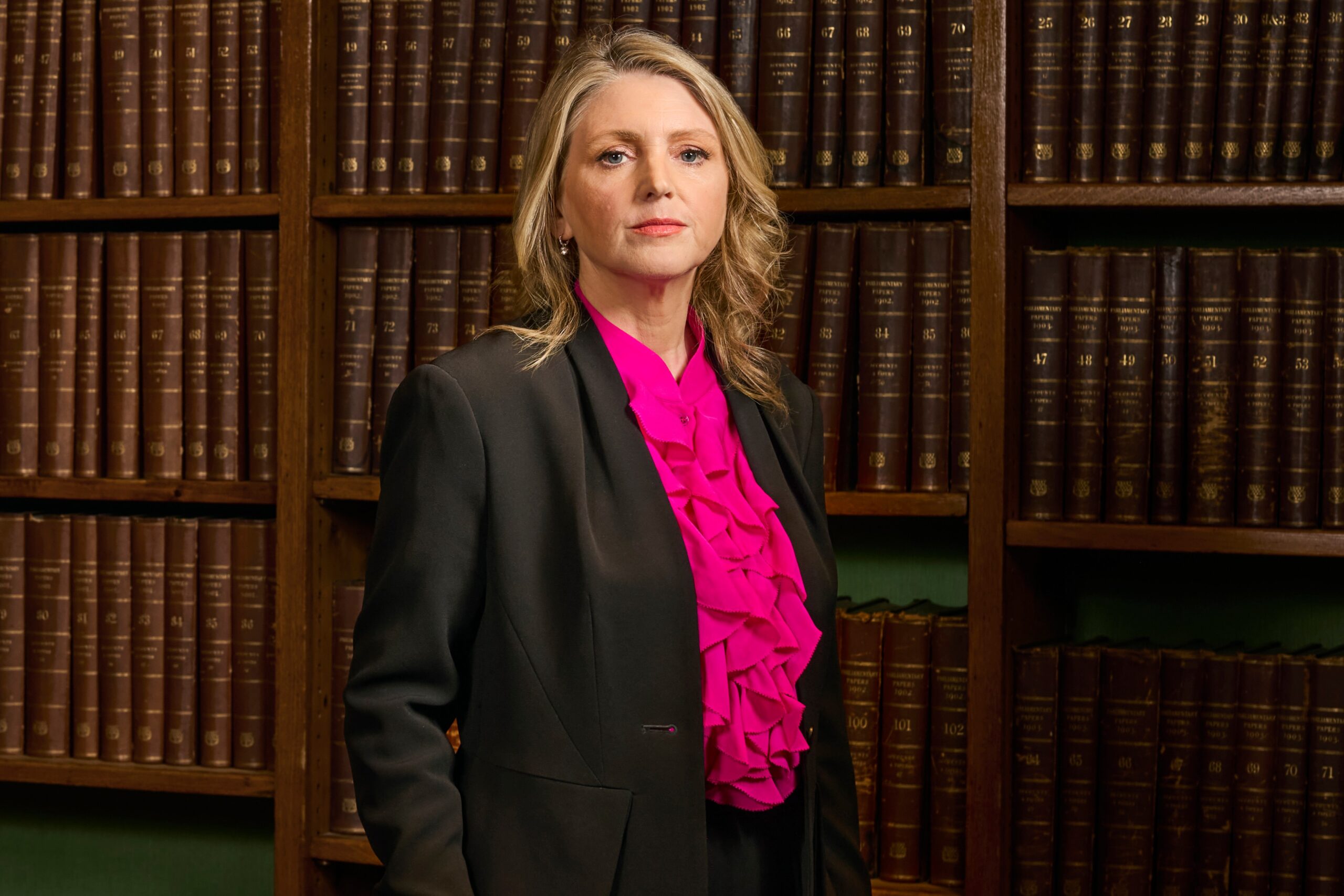
Posing for The Times’s photographer in the Old Court Room at Lincoln’s Inn, Gallagher is small, blonde, wearing lawyerly black and unlawyerly pink — vibrant against a backdrop of antiquated legal texts. She is also a talker, one of those people with enviable boundless energy. We cover football, kids (she has three teens), London haunts and politics before focusing on a working life that has taken her to courtrooms as far afield as Georgia and Kuwait, had her testify at a Senate committee meeting in Washington DC and rub shoulders with Amal Clooney and Meryl Streep at a press freedom awards ceremony.
Clooney is a colleague at Doughty Street Chambers and celebrity gossip is off limits. “She’s a dear friend and a truly brilliant lawyer,” she says. “We work very closely together.”
Caoilfhionn (pronounced Keelin) Gallagher was born in 1976 and grew up in Portmarnock, a seaside town north of Dublin, in a house full of books and newspapers. Her mother was a nurse who became a teacher and her father a civil servant and numismatist. Her parents were dismissive of television and the family didn’t own a set until she was 17.
She recalls the embarrassment of being “the weird kid without a TV” and how she and her sister eventually wrote a manifesto that argued why they needed a TV to watch foreign-language programmes. Having won that battle, they proceeded to watch “all sorts of nonsense”, she says, and blames that “forbidden substance” period for her mild TV addiction and a taste for reality shows — the Irish version of The Traitors, a swearier iteration of the British series, is a particular favourite.
“I’ve got very good security and law enforcement support”
JUDE EDGINTON FOR THE TIMES
At University College Dublin, where she switched from an English degree to study law, Gallagher was almost killed in a road accident. In 1996 she was hit just outside the university by a car travelling at 48mph.
“Both my legs were broken in several places and there were about eight hours where I thought I was paralysed,” she says. “I was very broken. I had facial injuries, a head injury. The first memory coming round from the accident was that they were stitching the top of my head. I can still feel them stitching it now.”
The university advised her to take a year off but Gallagher continued her studies. The experience of navigating the campus in a wheelchair led to a campaign to improve facilities and access for disabled people. “I’ve always had a bit of a tendency to campaign about things,” she says. “I’ve probably got the ‘it’s not fair’ gene in quite a large dose.”
After graduating she studied the King’s Inns Bar course in Dublin, then moved to England to take an MA at Cambridge before taking a job with Liberty, the civil rights organisation. It was the “war on terror” era and much of her work involved challenging the erosion of civil liberties as Tony Blair’s government introduced tougher antiterrorism laws.
• Gomorrah author: I exposed the mafia and it ruined my life
In 2005 she joined the human rights set at Doughty Street where, at the time, Sir Keir Starmer was head of chambers.
“Keir was someone I had looked up to,” Gallagher says. “His work on the death penalty around the world and the right to protest were inspiring. It’s been very disappointing to see what’s happened under his government, like the handling of the Palestine Action protests.”
She finds it amusing that her “stay in the UK, which was supposed to be just for a few months or a year, gradually became 24 years”.
Taking silk in 2017, Gallagher encountered some of the sexist quirks of the Bar when she had to improvise velvet slippers for the appointment ceremony after being told legal outfitters could not cater for her size 3½ feet. This “soft sexism”, she says, is a common feature of legal life. “Early on when I was pregnant with my daughter — who’s now nearly 17 — I told a few people and I had a well-meaning elderly silk say one day, ‘A solicitor was about to brief you on a case but I said, “No, no, she’s pregnant and she’s very tired.”’ People think they’re doing things to be helpful which are actually deeply patronising and sexist.”
• BBC claims journalists and crew ‘tied up and held at gunpoint by IDF’
During her pregnancy with her second child she was instructed in the 7/7 London bombings inquest, told people much later and gave birth within days of the hearings finishing.
“I did worry about work vanishing if you told people you were pregnant,” she says. “I know that still worries many women. It goes with the nature of being a self-employed professional.”
She has encountered predatory males and acknowledges the difficulties women have in calling out those behaviours in a profession where there is no real HR structure and the next job might depend on good relationships with the rest of the Bar.
She worries that while women enter the profession in equal numbers to men, it is the men who dominate the senior ranks — as of 2024, there were 1,537 men and 417 women KCs practising in England and Wales. “There’s no pipeline issue,” Gallagher says. “There are enough women going in at the start and there have been enough women going in at the start for quite a long time. Yet we are still seeing these distorted figures at the very top.”
Female solidarity, though, is a cause for celebration. Gallagher has had “recurrent pregnancy loss” and some years ago suffered a “horrendous” miscarriage while conducting a case at Oxford crown court.
“I had to excuse myself from the client, went into the robing room. I was very junior and very distressed,” she says.
“Then I saw this familiar face, Issy Forshall [a Doughty Street colleague], who I barely knew at the time, and she was incredible, a great support and never told a soul.
“That’s one of the things that I’ve really valued in my professional career — women supporting other women. You often hear that Madeleine Albright quote, ‘There’s a special place in hell for women who don’t help other women.’ But actually I think there’s a special place in heaven for women who support other women — and I say that as a Catholic atheist.”
Gallagher built her professional reputation through inquests and inquiries, including acting for bereaved families over Hillsborough and 7/7. But in recent years she has carved out her own niche, she says, “in an area which I would really like not to exist, which is the deaths of journalists”.
Since 2017 Gallagher has acted for the family of Daphne Caruana Galizia, the Maltese journalist murdered in a car bombing after exposing political corruption. She also represents the family of Anton Hammerl, a London-based South African photojournalist killed by pro-Gaddafi forces in Libya in 2011. Caruana Galizia’s family has won inquiries and finally convictions for her murder; Hammerl’s family has had no semblance of justice.
Gallagher says: “One of the things which always really shocks me, and which really drives me, is that in the vast majority of cases in which a journalist is killed, whether in peacetime, or in a democracy, or in a dictatorship, in the middle of conflict, wherever in the world — in nine out of ten cases they’re killed with total impunity.”
Gallagher was a student in Dublin when Veronica Guerin, an investigative reporter dedicated to exposing organised crime in the Irish Republic, was murdered in a contract killing. Guerin was in her car at traffic lights when a motorcycle pulled alongside and the pillion passenger opened fire. The gunman has never been convicted. “If people know they can kill a journalist and get away with it, that’s what they do. You want to silence the story, you silence the journalist.”
She is also exercised by a trend among regimes that hate press freedom to close down critical publications, such as the shutting of Apple Daily and the imprisonment of Jimmy Lai. Another three clients are or have been subject to similar efforts.
In Georgia, where the Kremlin-friendly Georgian Dream party holds power, Mzia Amaglobeli, the 50-year-old director of two online media outlets, Batumelebi and Netgazeti, has been on hunger strike while in prison. Her journalists continue to publish but in Guatemala the journal elPeriódico was closed down after the arrest of its publisher, José Rubén Zamora, who has since spent more than three years in prison. Another client, Maria Ressa, the founder of the Rappler website in the Philippines, was awarded a Nobel prize for her courage in exposing political corruption. The Rappler survived sustained attempts to shut it down.
“These cases are really emblematic,” Gallagher says. “Rather than taking out an individual journalist like Evan Gershkovich in Russia or Jason Rezaian in Iran, what we are now seeing is autocratic regimes targeting publishers.”
She insists, however, on staying positive. “People think Russia, China, Iran, these are enemies that are too big. But people I work with within Afghanistan have just gotten a British couple out of Taliban detention. We’ve seen Alaa Abd El-Fattahbeing released in Egypt. Last year we had the release in Russia of four political prisoners, including Evan Gershkovich. That was the biggest prisoner release that had happened since the Cold War.”
She combines positivity with legal and diplomatic creativity. By no means a natural bedfellow of President Trump, she sees opportunities in a recent executive order that enables the US to designate countries as “state sponsors of wrongful detention”. Gallagher has had high-level meetings with senior figures in the Trump administration to discuss some of her cases.
Her workload is a constant whirlwind. About half her time is spent in London, a quarter in Ireland (where she is special rapporteur on child protection) and a quarter travelling internationally. Does she — can she — ever switch off?
“I know people find running very therapeutic but I can’t run because of my knees, because of my accident. I can swim and cycle but I find the thoughts crowding in. I find it quite hard to switch off.”
So Gallagher has returned to a hobby she was pursuing in her teens but which she abandoned after her accident — learning to fly. “It’s a bit extreme,” she admits, “but when you’re flying a tiny tin can through the air you have to just concentrate on that, nothing else.”
Source: https://www.thetimes.com/life-style/celebrity/article/caoilfhionn-gallagher-journalism-jvsjbl93p