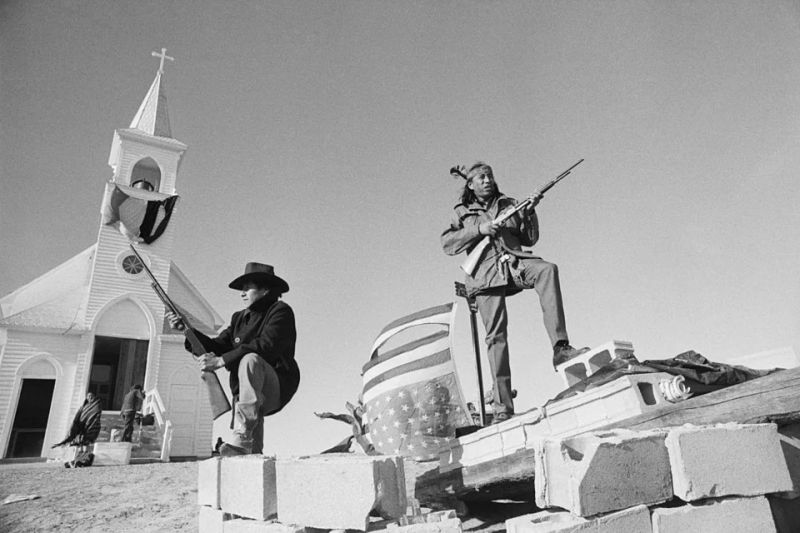
In 1973, about 200 Oglala Lakota and members of the American Indian Movement (AIM) occupied the town of Wounded Knee on Pine Ridge for 71 days, turning the site of the 1890 massacre into a front line against corrupt tribal politics and broken U.S. treaties.
Many accused tribal chairman Richard Wilson of corruption, patronage, and using his private militia; the Guardians of the Oglala Nation (GOONs); to intimidate and assault opponents, while tribal grazing and mineral leases went cheap to non-Native interests and violence on the reservation climbed.
After a failed impeachment attempt, traditional leaders and the Oglala Sioux Civil Rights Organization invited AIM; born in urban Minneapolis during the termination and relocation era; to help. On February 27, 1973, they caravanned to Wounded Knee, took over the trading post and church, and demanded Wilson’s removal, an end to GOON violence, and renewed treaty talks, especially around the 1868 Fort Laramie Treaty and the Black Hills.
Federal law enforcement answered with force: U.S. Marshals, FBI agents, BIA police, and South Dakota National Guard units ringed the town with roadblocks, armored personnel carriers, helicopters, snipers, and more than 100,000 rounds of ammunition.
For 71 days, gunfire flared, food and medicine were smuggled through the cordon, and spiritual leaders like Leonard Crow Dog revived ceremonies such as the Ghost Dance inside the occupied village.
On May 8, after negotiations that included promises to discuss treaty rights, the occupiers agreed to lay down arms and the government retook the site. Wilson stayed in office and was re‑elected in a 1974 election later described by the U.S. Commission on Civil Rights as riddled with fraud and intimidation, while Pine Ridge’s murder rate in the following years soared and many residents blamed GOON activity and federal tolerance for ongoing violence.
Messy and controversial; even inside AIM; the Wounded Knee Occupation forced the U.S. to face treaty violations, reservation poverty, and federal interference in tribal governance in a way that couldn’t be ignored, transforming Wounded Knee from only a symbol of massacre in 1890 into a second symbol of Native resistance in 1973.