
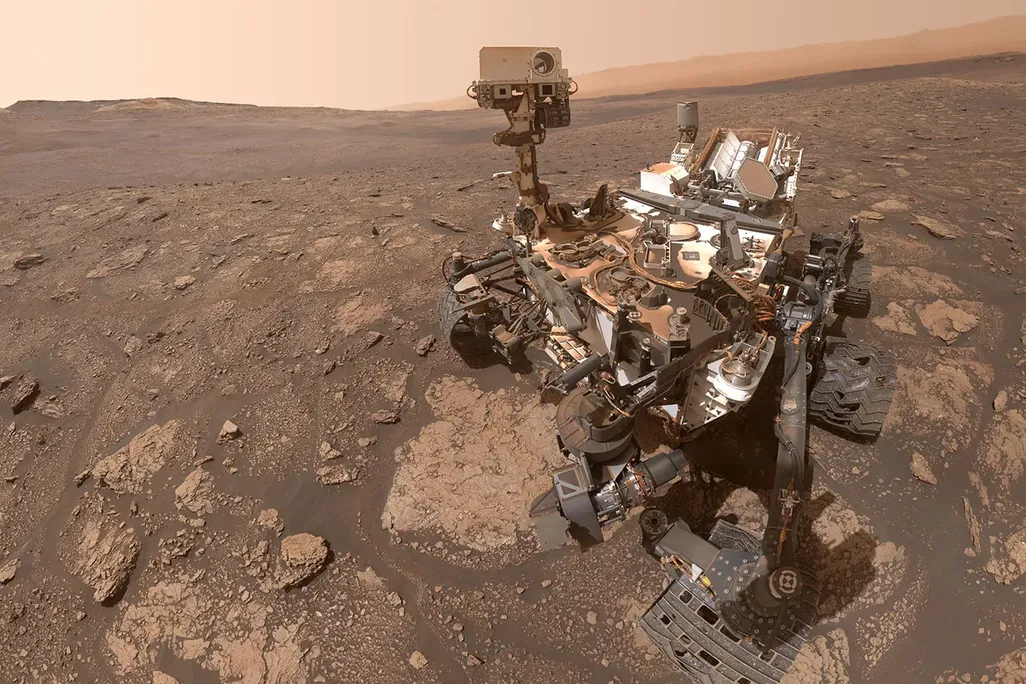
The organic molecules discovered by NASA’s Curiosity rover could have been formed by life, but they could have also come from geologic processes or meteorites
Carlyn Kranking | Associate Web Editor, ScienceApril 23, 2026 4:10 p.m.
:focal(800x453:801x454)/https://tf-cmsv2-smithsonianmag-media.s3.amazonaws.com/filer_public/6c/1b/6c1b6e38-1b30-41c0-a5ac-f8c6fcf1ca11/pia24173-1c-16.webp)
NASA’s Curiosity rover has discovered the most diverse collection of organic molecules ever found on Mars, including some that are considered building blocks for life on Earth.
A rock sample analyzed by the rover contained 21 organic molecules, and seven of them had never been detected on the red planet before, according to a statement from NASA. After years of studying Curiosity’s data, scientists published the findings on Tuesday in Nature Communications.
Organic, or carbon-containing, compounds form structures that are crucial for all Earth’s life, but their presence alone is not proof that Mars was once inhabited.
While ancient life is one explanation for how these compounds could have gotten to Mars, all of them could have feasibly formed in other ways. The molecules could have been created by geologic processes, for instance, or they could have been delivered to the planet by meteorites.
“Is it life? We can’t tell, based on this information,” Amy Williams, an astrogeologist at the University of Florida and a Curiosity mission scientist, says to the Guardian’s Hannah Devlin.
“But our findings further support the evidence that Mars was a habitable world around the time that life on Earth originated,” she adds to Will Dunham at Reuters.
A promising suite of chemistry
The rocks studied by Curiosity are roughly 3.5 billion years old and come from Mount Sharp, a peak within Mars’ Gale Crater that was, at the time, covered by lakes and streams. They’re made of sandstone and have some clay deposits, which are especially good at preserving organic molecules.
/https://tf-cmsv2-smithsonianmag-media.s3.amazonaws.com/filer_public/e1/e4/e1e463d0-86eb-44c6-9229-6256d0ee3b36/e2-pia23139-landscape_showing_clay_region.jpg)
To find and examine those molecules, Curiosity used a small drill to crush the Mars rock sample—nicknamed “Mary Anning 3”—into a fine powder in 2020. It deposited that Martian dust into an instrument called Sample Analysis at Mars(SAM), a miniature laboratory housed within the rover. SAM heated the material and analyzed the gases it released to determine the rock’s composition. The rover also dropped bits of the rock into a powerful liquid solvent that broke apart larger molecules to make them easier to study.
One of its most intriguing discoveries is a molecule known as a nitrogen heterocycle—a ring of connected carbon atoms that contains nitrogen. This structure, per NASA’s statement, is thought to be a precursor to more complex molecules that are key to life, including DNA and RNA.
“That detection is pretty profound,” Williams says in the statement. “Nitrogen heterocycles have never been found before on the Martian surface or confirmed in Martian meteorites.”
Researchers also identified benzothiophene, which contains carbon and sulfur and has been seen in meteorites. These meteorites, some scientists suspect, could have carried the building blocks of life to both Earth and Mars.
Finally, an experiment on Earth put a piece of the four-billion-year-old Murchison meteorite, which fell in Australia in 1969, into the same kind of liquid solvent used by the Mars rover. That meteorite broke down into some of the compounds seen in the Mars sample, including benzothiophene. It suggests, per NASA’s statement, that the organics seen in the Martian rock could have been produced as more complex, life-related compounds broke down.
“This is powerful information for future life detection missions and instruments,” Williams tells Space.com’s Leonard David. “We now know that larger molecules that could have been made by life can be preserved in the Martian near-surface.”
Did you know? Mars’ lost atmosphere
Today, Mars is a frigid desert planet that’s bombarded with solar radiation—and that’s because it has only a thin atmosphere. But billions of years ago, it had an atmosphere that would have made the world warm and wet. Solar wind eroded that atmosphere away over time.
Has Mars ever hosted life?
Mars rovers and orbiters are slowly piecing together the planet’s ancient past. Scientists are combing through this data in hopes of finding out whether microbial life ever flourished there, especially because Mars had wet eras in its history. But while researchers have found hints of previous habitability, they’re still in search of a smoking gun.
Last year, NASA reported what it called the “clearest sign yet” of ancient Martian life: a rock containing minerals that might have been produced by ancient microbes as they consumed organic matter. The rock, called Cheyava Falls, was spotted and sampled by the Perseverance rover on Mars’ Jezero Crater in 2024. However, the minerals in the rock could have also been made without life, so they’re not proof of microbes.
In another discovery, the Curiosity rover identified the largest organic molecules ever found on Mars last year. They’re thought to be fragments of fatty acids, which are building blocks of life on Earth.
The newly described organic compounds on Mars bolster all these findings. The research “once again increases the prospect that Mars offered a home for life in the ancient past,” Ashwin Vasavada, a project scientist for NASA, says in the statement. Researchers find it promising that these molecules have survived radiation on Mars for billions of years—it raises hopes that such old and scientifically significant material can still be recovered.
Looking ahead, the Rosalind Franklin mission, a rover from the European Space Agency that’s expected to launch in 2028, could gather additional details about Mars’ past. It will bring more sophisticated instruments to the red planet, including a 6.6-foot-long drill that can collect deeper samples than any mission has before.
“Our work suggests that if complex organic matter from life were preserved on Mars, we should be able to detect it with current and upcoming rover instruments,” Williams says to Reuters.