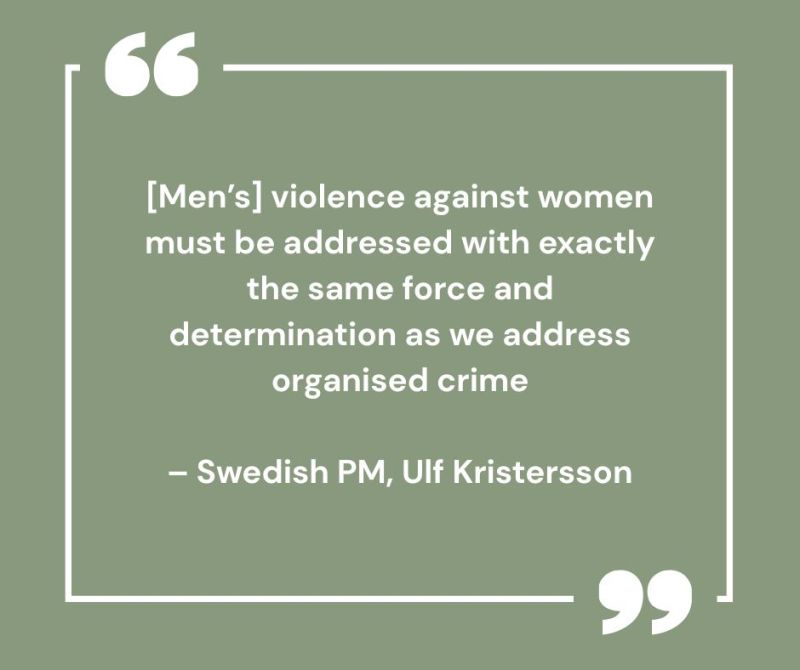
The announcement comes in the wake of two separate killings over the holiday period, where two men in their twenties took the lives of a 25-year-old and a 55-year-old woman.
Sweden established a similar council in 2022 to coordinate responses to organised crime. The new body, to be chaired by the PM, will focus on femicide and bring key actors together to improve the targeting and practical impact of measures to prevent and address MVAW. Like any mechanism, its value will depend less on its creation than on whether it is resourced, empowered, and sustained once political and media attention moves on.
Content warning: This text discusses lethal and sexual violence against women and girls.
According to media, one woman was attacked in her home after opening the door to a man alleging to be interested in an item she was selling online; her two teenage daughters were held hostage until police arrived. The other was attacked while on her way home from a night out.
The man who attacked the first woman had, reportedly, serious mental health issues and had recently been discharged from involuntary psychiatric care. His motive remains unclear. Public outrage has mainly focused on the perpetrator of the second murder.
Less than five years earlier, he had been released after serving two thirds of a sentence for attempted child abduction of a ten-year-old girl and possession of extensive child sexual abuse material (CSAM). While in prison, he made misogynistic remarks to a female prison chief and was convicted of making death threats against her and her colleagues. Upon release, the Swedish Prison and Probation Service reportedly assessed his risk of reoffending as low for general crimes but high for sexual offences, meaning he posed limited risk to the public at large but a high risk to women and girls. Tragically, that assessment proved accurate.
Unlike its Scandinavian neighbours, Sweden lacks mechanisms for managing dangerous recidivists through preventive detention (‘forvaring’ in Denmark and Norway). In October 2025, the Swedish government tabled legislation to introduce a similar measure, ‘säkerhetsförvaring’, in Sweden. While the proposal has been met with serious ethical concerns, the government cites this case as evidence of its necessity alongside existing measures, such as forensic psychiatric treatment orders. Yet none of this explains why a man assessed as high risk for sexual reoffending did not serve his full sentence.
While these cases involved attacks by strangers, it is worth keeping in mind that most femicides occur in the home, perpetrated by men known to the victim. Efforts to reduce femicide must therefore focus on the everyday systems that fail to protect women and girls, not just exceptional cases that capture the headlines.